I've decided to split my "Saturn: The Demon Deity Unveiled" post into separate posts, mainly due to the weird fact that I cannot seem to edit that post anymore. Maybe I added too much stuff to that post? Either way, I hope that splitting that massive post up will be easier for people to read.
Parts:
Part 1:
https://demythifyinggod.blogspot.com/2026/05/saturn-supreme-god.html
Part 2:
https://demythifyinggod.blogspot.com/2026/05/ea-saturn-in-middle-east.html
Part 3:
https://demythifyinggod.blogspot.com/2026/05/dyeus-pater-saturn-in-eurasia.html
Part 4:
https://demythifyinggod.blogspot.com/2026/05/atum-saturn-of-africa.html
Part 5:
https://demythifyinggod.blogspot.com/2026/05/viracocha-saturn-of-south-america.html
Part 6:
https://demythifyinggod.blogspot.com/2026/05/great-spirit-saturn-in-north-america.html
Part 1: Ea.
Ea on the Adda Seal (The British Museum, cylinder seal [The Adda Seal]):

The full seal:
.png)
Ea is the second male deity from the right with the eagle/Zu bird on his right arm, the bull in between his legs, and the streams of water with fish coming out of his body (The British Museum, cylinder seal [The Adda Seal], Description).
.png)
.jpg)
..png)
ORACC, Ancient Mesopotamian Gods and Goddesses. Enki/Ea, Ea's creatures: Iconography). We can see the stream of water with fish, and the goat-fish, in The Enthroned Enki relief. There were "snake figurines and fish offerings" to Ea at Eridu (Espak, 2006, General Conclusions [p. 1]) (Duke, 1971, p. 324 note 27).
We can find other symbols, or depictions, of Ea in the various poems of Mesopotamia. In the "A Shulgi Hymn to Enki," Enki was equated to the bull, and the sun. He is depicted as "Clad in lion-skin," and "in the entire(?) heavens." He also has some connection to the dragon. In the commentary to the poem, Mark E. Cohen said that there are multiple interpretations of the passage regarding Enki, the lion, and the dragon. What sticks out to me the most is that he said the lion and dragon are probably symbols of Enki's religion that we just don't know about yet. The dragon is called Mus-hus. As for Ea being the sun, Cohen suggests that Enki is probably the rising sun coming out of the Abzu (Apsu). He also said that the sun could be referring to Enki's priests, but said later that this doesn't seem likely. Therefore, Enki is most likely the sun (Cohen, 2005; in Sefati et al., 2005, pp. 74-80). Ea as the bull is the astrological symbol of Taurus, the planet Venus, and the Archangel Anael (Archangels and Angels, The Astrological Correspondences for Taurus) (Archangels and Angels, Archangel Anael-Angelic and Planetary Symbols) (Archangels and Angels, Archangel Anael-Angelic and Planetary Correspondences). Interestingly, the ram is also one of the symbols of Taurus (Archangels and Angels, The Astrological Correspondences for Taurus). Regarding Ea's relationship with the sun and the lion, this would equate him to the Archangel Michael (Archangels and Angels, Archangel Michael-Angelic and Planetary Symbols) (Archangels and Angels, Archangel Michael-Angelic and Planetary Correspondences). Interestingly, the Archangel Michael is also represented by the Hexagram (Archangels and Angels, Archangel Michael-Angelic and Planetary Correspondences).
According to Margoliouth (1868), Ea is usually in a triad, or trinity, made up of Anu, Enlil, and himself. However, Ea's religion is way older. Margoliouth quotes Professor Maspero in saying that Ea was "'the most active and energetic member of the triad.'" In fact, "'Anu and Bel (Enlil), together with all the living creatures,' had sprung from Ea," (in The Contemporary Review, Vol. 74, pp. 584-585). Margoliouth said that Ea would've been the top god instead of Anu if it wasn't for the "political motives and 'local vanity' (that) had not proved too strong for the theologians of the day," (p. 585).
%20.png)
.png)
.png)
%20(Spencer,%201915).png)
The Tetragrammaton (Ortlepp, 2010, p. 41), or YHVH (Bible Hub, Strong's Hebrew, 3068. Yhvh [Yehovah]) (Bible Hub, Strong’s Hebrew. 3069. Yhvh [Yehoveh]) comes in many forms: "Ya," "Yaw," "Yahu," and "Yah" (Langdon, 1931 [1964 reprint], p. 43) (Biglino, 2013, p. 63). From what I've found, it's also spelled as YHWH. There are also two main spellings of it: "YHW" and "YHWH." The spelling of the name as "YHW" is found on a Judean coin from the 4th century BC (399-300 BC) (Langdon, 1931 [1964 reprint], p. 43) (Hulster, n.d., What Did Yahweh Look Like?, para. 3; Judean Coin). YHW is also found on a "folded lead tablet" that contained a curse proclaimed by the god. The tablet dates back to the "Late Bronze Age II" (Stripling et al., 2023, Abstract; Paleographic analysis of the "Inner B" inscription). The date given by the authors is the middle-late 13th century BC (1250-1200 BC) (The archaeological context, para. 1-2). Langdon (1931 [1964 reprint]) said that YHW means "Yaw," and that the translation of the name as "Yahweh" or "Jehovah" never existed (p. 43).
According to Ortlepp (2011), the spelling of the name as "YHWH" is the proper one because it has been written the most. YHW, and even YH, are not the proper spelling. As for archeological finds, the spelling of the name can be seen on the Mesha stele, which dates to the 9th century BC (p. 41) (Biblical Archeology Society, 2013, para. 3). The Mesha stele is also called the Moabite stone (Biblical Archeology Society, 2013, Biblical Artifacts Found Outside the Trench: The Moabite Stone, para. 3). The stele/stone helped the tetragrammaton to be known by Israel's and Judah's neighbors (Drummond, 2023, para. 6). Interestingly, the Mesha stele is later (9th century BC) than the Late Bronze Age 2 tablet's spelling of the god's name (13th century BC)...
An older spelling of the name, "YHW3," was found in Egypt from 1390-1352 BC. This form of the name is associated with a people called the Shasu (Fleming, 2020, Ch. 2 p. 23). It was found in a temple of Amun-Ra in Soleb (Kennedy, 2019, p. 175 and p. 176 Figure 1; pp. 183-184 Figures 5-6a). However, the spelling of the name could also be YHW (Najovits, 2003, p. 198) (Murdock, 2014, p. 186), or YHWA (Hen, 2021, p. 4). Kennedy (2019) said that YHWH was also spelled "I-H-W3-3," and Shasu was spelled "S3SW" (p. 177). Clarke (2005) spells YHWH as "IHUH" or "YHUH" (Ch. 2: Gods of the Individuation Process in Egypt). Massey (1907) also stated that the Tetragrammaton in Egyptian was IHUH (Vol. 1, pp. 498-499, and 519). "S3SW" and "YHW3" (IHW33) were also found at Amara from the early 13th century BC (1400 BC) (Kennedy, 2019, pp. 177 and 189). It seems that the tetragrammaton (YHVH, YHWH, YHW3, and IHW33) is older than YHW. The "3," or two commas, is Egyptian in origin (Hen, 2021, p. 4). It's unknown precisely what it sounded like, but comparing it to the Semitic dialect, it probably made an "R" and "J" sound (Peust, 1999, p. 127 [in Gottingen, 1999]).
As for trying to pronounce the name properly, nobody seems to know how to do that (Drummond, 2023, para. 4-5). However, given the fact that Israelites used this god's name in their own names (Ex.: Elijah, Jeremiah, etc.), then that might be a way of saying the name (para. 4). Using "Yaw" as inspiration, I'm assuming the pronunciation is "Jah/Iah." A very helpful tip comes from an Egyptian god named Iah (Hart, 2005, p. 77). Also spelled "Iu" in Egyptian, this god had the same name as YHWH as Iah (Massey, 1907 [2013 edition], Vol. 1, p. 501). Iah (pronounced "Yah") is also found in the Ars Goetia Corpus, a supposed magic book belonging to King Solomon (Karnas, 2020, Sayfa 5, Presentation). As for the "WH" in the name, or "W3," it seems that it was pronounced as "U" (Clarke, 2005, Ch. 2: Gods of the Individuation Process in Egypt):
Pic 1:
.jpg)
.jpg)
If IH (YH) is "Iah" (Garcia-Fernandez, 2017, p. 222, Abstract) (Massey, 1907, p. 498) and WH is "U" (Clarke, 2005) (Parke-Taylor, 1975 [2006 edition], p. 49 [Akkadian form of YHWH]). Therefore, the name could be spelled, and pronounced, as "Iahu." This was stated in Massey (1907) (Vol. 1, pp. 498-499). Another form of this is "Yahu" (Biglino, 2013, p. 63) (Romer, 2015, pp. 30 and 32) or Yaho (Romer, 2015, pp. 30-32). "Yah[u]" is in Isaiah's name, based on a bulla discovered with his name on it (Shuster, 2018, para. 6). It seems that the Egyptian form of the Tetragrammaton is IHW33, while the Hebrew version of the name is YHW3/YHWH.
However, after looking at the Soleb inscription of the Tetragrammaton myself, and after spending weeks trying to read Egyptian hieroglyphs and learn Hebrew, it seems that the Egyptian Tetragrammaton is actually "YH3U," "YH3W," or "YH3O."
Egyptian Tetragrammaton inscription from the Amon-Ra temple in Soleb (Kennedy, 2019, p. 183 Figure 5):
.png)
.png)
.png)
.jpg)
.png)
.png)
.png)
.png)


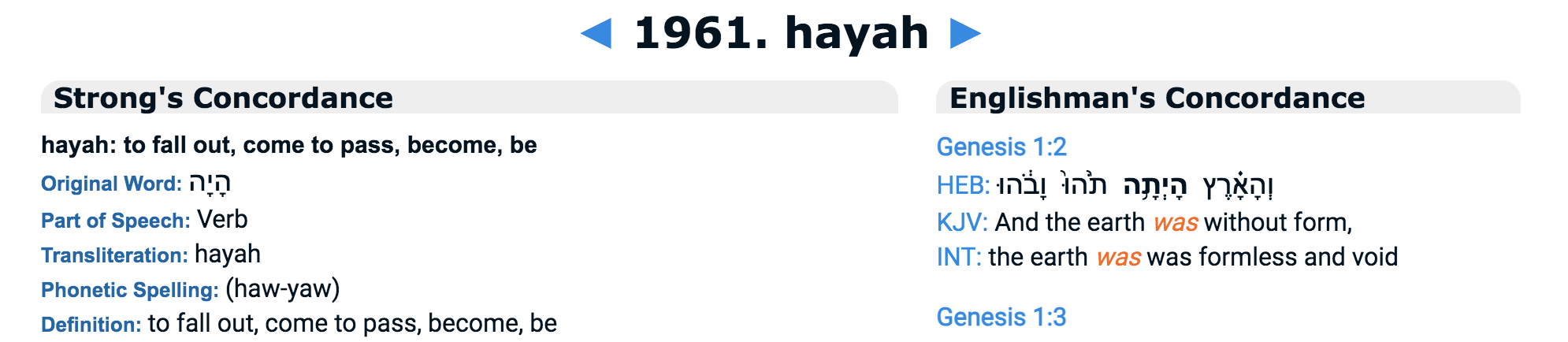
As for yod and hei in the Tetragrammaton, it spelled out "Yah," (Bible Hub, Strong's Hebrew, 3050. Yah):
.png)
.jpg)
According to Garrett and DeRouchie (2009 [2019 edition]), the mater (matres) lectionis "does not count as a consonant or close a syllable," but "is simply a vowel," (Ch. 2: Pointed Vowel Letters and the Silent Shewa, E. The Basics of Syllable Division):
%20is%20a%20mater%20lectionis%20(not%20consonant%20or%20close%20a%20syllable)%20(Garrett%20and%20Derouchie,%202009,%20Ch.%202)%20.png)
.png)
.gif)
.gif)
.png)
.png)
YHWH is typically spelled as "Yahweh", and "Jehovah" (Langdon, 1931 [1964 reprint], p. 43) (Tice, 1997 [2007 edition], pp. 5 and 7) (Hulster, n.d., What Did Yahweh Look Like?, para. 3; Judean Coin). However, Yahweh and Jehovah "never existed," according to Langston (1931 [1964 reprint]). Yaw/Yah was extended to be "Yahweh." The vowels from the word "Adonai" were put on the name, and that's how we get "Jehovah" (pp. 42-43). Romer (2015) said that Yahweh has a "more recent origin than 'Yaho' or 'Yahu'," (p. 32). In the Tanakh ("Old Testament"), Yahavah's name is usually translated as "I am who I am" (Exodus 3:14 [NASB]), or "ehyeh asher ehyeh" in Hebrew (Bible Hub, Exodus 3:14 [Interlinear]). As stated before, ehyeh means "I am" and ehyeh is Ea. He is also called "The LORD" and "The Lord God" (Jeremiah 1 footnote a [NASB]). However, Paul Tice says that Jehovah was an angel called Sabaoth (Tice, 1997 [2007 edition], p. 15). Sabaoth means "Lord of Hosts" (1 Samuel 4:4 [BSB]), or "Lord of Armies" (1 Samuel 4:4 [NASB]) (Zechariah 13:2 and 7 [NASB]). Jehovah was a cherubim, also known as "shining ones," and they were led by the angel Gabriel. Jehovah had the same power, or status, as Gabriel, due to being in the middle/above the cherubim (Tice, 1997 [2007 edition], p. 15) (1 Samuel 4:4 [BSB and NASB]). Another name for Jehovah is Samael, which means "blind god" (Tice, 1997 [2007 edition], p. 51). Samael is a particularly dangerous equation because he is Satan in Judaism (Jewish Virtual Library, Samael)! Samael is also the name of Yaldabaoth in the Gnostic text The Apocryphon of John. What's also scary about this is that Yaldabaoth, in the text, does everything that Yahavah does in the Tanakh. However, Yaldabaoth is also the bad guy in the text!
On 5/7/25, I noticed something. In the Strong's Exhaustive Concordance of Yhvh, it said that the Tetragrammaton came "From hayah." However, in the NAS Exhaustive Concordance, it said that the origin of the name came "from havah," (Bible Hub, Strong's Hebrew: 3068. Yhvh):
.png)
I've decided to learn Paleo-Hebrew. Well, technically it's Phoenician but the Phoenician alphabet is the Semitic alphabet (Brown University, Joukowsky Institute for Archaeology and the Ancient World, Archaeologies of the Greek Past: Alphabet [Early Greek]). Arabic, and Hebrew, are Semitic languages too (Daggumati and Revesz, 2023, p. 15 [5. Discussion of the Results]). Interestingly, the Greek alphabet also came from the Phoenician alphabet (Healey, 1990, p. 39) (Daggumati and Revesz, 2023, p. 9 [4. Experimental Results]; p. 14 [5. Discussion of the Results]; Figures 16-18), or from the "North Semitic script in the 8th century BCE," (Encyclopaedia Britannica, Greek alphabet, para. 1). I've decided to use both the Phoenician, and Greek, alphabets to guess what the Tetragrammaton could've been.
Classic Greek alphabet (Healey, 1990, p. 39):
.png)
.png)
.png)
.jpg)
.gif)
Speaking of the Egyptian Tetragrammaton, it could've been Ieo' (Ieoa), using our new system and Brown University. This is very close to the Greek Iaw (Iao) and Iw (Io).
I'm not the first person to say that Ieue is the true spelling of Yhvh (Rev. Taylor, 1833, p. 187) (Higgins, 1878, Vol. 1 pp. 459 and 461) (D.M. Murdock/Acharya S, 2014, p. 291). I'm going to stick with this method from now on.
In summation:
1.) Yhvh is Ieue. It was probably pronounced "I-u."
2.) Ahyh ('Ahayah) is Aeie, and spelled as 'eie. It was probably pronounced "E-i."
3.) Yhvdh (Judah/Yehudah) is Ieude. It was probably pronounced "I-u-de."
4.) Al ('Al/El/Enlil) is Al, and spelled as 'l. Only the "L" was pronounced.
As to what Ieue looks like, we have several artifacts that depict him. The first is a silver Judean coin from the 4th century B.C. It depicts the deity with the name "Yehud"/"yhd" (Hulster, n.d., What Did Yahweh Look Like?, para. 3; Judean Coin). Langdon (1931 [1964 reprint]) said that the name is "YHW," which means "Yaw" (p. 43). Cook (1914) also says the three words are "YHW" (Vol. 1 p. 232). It would be "YHV," using the modern spelling of the name. This would be "Ieu." Interestingly, Ieu is depicted as a man with a beard and a robe, and is seated on a wheel. Either Ieu has wings, or the wheel has wings (Hulster, n.d., What Did Yahweh Look Like?, para. 3; Judean Coin). Both Langdon and Cook say that it's a winged wheel (Langdton, 1931 [1964 reprint], p. 43) (Cook, 1914, Vol. 1 p. 232). There is also a falcon, (Hulster, n.d., What Did Yahweh Look Like?, para. 3), or a hawk (Langdton, 1931 [1964 reprint], p. 43), or an eagle/hawk (Cook, 1914, Vol. 1, p. 232), sitting on Ieu's arm.
Fontanille et al., (2023) gives a very descriptive history of the interpretation of the inscription on the coin. The coin was "reportedly found in Gaza," (p. 148). Originally, it was confirmed to have been "YHW." However, scholarship has tried to prove that the letters are "YHD" instead. The most recent decision on the lettering declares that the letters could've been either YHW, or YHD (pp. 130-131). As for where it was made, Fontanille et al. said that it was made in Philistia. However, other authors state that it was made in Judah (pp. 131, 140, and 148). Fontanille et al. said that the bird was a "hawk or a falcon," (pp. 143 and 145). The dating of the coin seems to be anywhere from the "late fifth century BCE," to 361 B.C. (pp. 136-137). Finally, the authors say that, although the deity on the coin could be "other celestial gods," the deity is "consistent with the nature of Yahweh," (pp. 145-146). The Philistian authors of the coin probably based their design of the deity on their own god Baal Shamen. Both Yahweh, and Baal Shamen, shared "celestial and solar attributes, so that they were essentially indistinguishable as implied by their similar epithets." Zeus Olympios was also "identified with Baal Shamen." Yahweh was equated to Baal Shamen in Samaria during "the time of King Ahab," and "by the Yahwists in Elephantine." Baal Shamen is also in the "Aramaic Ahiqar" version of Proverb 13 (p. 148).
Yehud Judean Coin (Hulster, n.d., What Did Yahweh Look Like?, Judean Coin):
.jpg)
.png)
.png)
%20(Langston,%201931,%20p.%2043).png)
%20(Fontanille%20et%20al.,%202023,%20p.%20130%20Type%201).png)

.png)

Zeus aetophoros coin from Mazaeus, Tarsus (361-334 B.C.) (Fontanille et al., 2023, p. 136 Figure 4.6):

%20in%204Q120%20(Vasileiades%20and%20Gordon,%202021,%20Figure%206).png)
%20(Cook,%201914,%20Vol.%201,%20p.%20235).png)
.jpg)
.png)


Tsaba (Sabaoth) is Saturn, so Ieue is both the moon (Iao) and Saturn. Ea/Ieue rules the First, Fifth, Sixth, and Seventh, Heavens.
The third depiction of Ieue comes from a coin from "the Persian period" of Gaza. It depicts Yaw (Ieu) and the goddess "'Ashtart-'Anat'" (Astarte-Anat) together (called "'Ashtart-Yaw'" by Langdon) (Langdon, 1931 [1964 reprint], p. 44 Figure 24):
.png)


%20Psalm%2084-11%20(Interlinear).png)
King Hezekiah's (left) and Isaiah's (right) bullae/seals (Ngo, 2018):
.jpg)
Seth on magical gem; intaglio (British Museum, magical gem; intaglio):
.png)
.png)
Interestingly, Ieue has a relationship with the lion, bull, and eagle. As quoted by Patai (1977), the scholar Goodenough said that "'Yahweh seems to have had the ferocity and glory of the lion, the bull, and the eagle, and to have been the spurting Stream of Life.'" Goodenough also stated that Ieue was given "'Helios' rulership charioteer of the universe, such saving power as that of Heracles and Ares, such gracious mercy as that offered by Aphrodite and the Nymphs.'" This seems to have been the effects of Hellenism on the Jews, in which they took on Greek culture (pp. 68-69). Ieue being linked to the lion and bull is reminiscent of Ea in the "A Shulgi Hymn to Enki." The eagle is akin to the eagle/Zu bird associated with Ea too. This strengthens the connection between Ieue and Ea even more.
.png)
.png)
.jpg)
.png)
We'll explore the other names of Ea below.
Encyclopaedia Britannica. Ea:
Kramer (1963) (P. 197):
Smith (1876):
https://www.google.com/books/edition/The_Chaldean_Account_of_Genesis/wqHj8AWy9C0C?hl=en
https://fdocuments.us/document/el-elyon-in-genesis-1418-20.html?page=1
-V2:
https://scholarlypublishingcollective.org/sblpress/jbl/article/63/1/1/190491
-V3:
https://www.jstor.org/stable/3262503
Bois (2010) (P. 363):
Horowitz (1998) (PP. 109-111):
https://books.google.com/books?id=xXzQAAAAMAAJ&newbks=1&newbks_redir=0&printsec=frontcover#v=onepage&q=chthonios&f=false
Seltman (1956) (P. 33):
https://archive.org/details/twelveolympianst0000char/page/33/mode/1up?q=Potei+Dan
Jordan (2004 [2014 edition]) (P. 90):
https://books.google.com/books?id=aqDC5bwx4_wC&printsec=frontcover&dq=yahweh+aztec+god&hl=en&newbks=1&newbks_redir=0&source=gb_mobile_search&sa=X&ved=2ahUKEwiA8paF7qGCAxVqFlkFHU2uCsgQ6AF6BAgMEAM#v=onepage&q=Enlil&f=false
Abraham (2009) (P. 23):
Jensen (1890) (PP. 136-138 [German]).
https://babel.hathitrust.org/cgi/pt?id=mdp.39015005721090&seq=157
Dunlap (1856) (P. 22):
The Christian Remembrancer. Volume 56. Article 8:
Coulter and Turner (2000 [2013 edition]) (PP. 13 and 168):
Liverani (2013) (PP. 51-52):
Encyclopaedia Britannica. Nippur:
https://www.britannica.com/place/Nippur
https://www.britannica.com/place/Erech
Crusemann et al., (2013 [2019 edition]):
https://books.google.com/books?id=muCvDwAAQBAJ&printsec=frontcover&dq=when+did+erech+begin&hl=en&newbks=1&newbks_redir=0&sa=X&ved=2ahUKEwjVj4eCoaCFAxXUFlkFHTncDA8Q6AF6BAgEEAI#v=onepage&q&f=false
Livius. The Sumerian King List:
https://www.livius.org/sources/content/anet/266-the-sumerian-king-list/
Margoliouth (1868; in The Contemporary Review) (Vol. 74) (PP. 581-592):
https://books.google.com/books?id=nla68_sQEhoC&printsec=frontcover&dq=Anu+sun+god&hl=en&newbks=1&newbks_redir=0&source=gb_mobile_search&ovdme=1&sa=X&ved=2ahUKEwivg6iGg4mFAxUTEFkFHbhqAF8Q6AF6BAgLEAM#v=onepage&q=Anu&f=false
Cook (1914) (Vol. 1):
Clay (1923) (P. 102):
Kitz (2018) (Abstract):
https://muse.jhu.edu/article/718758
-V2:
https://www.semanticscholar.org/paper/To-Be-or-Not-to-Be%2C-That-Is-the-Question%3A-Yhwh-and-Kitz-Clifford/df144c0a741f4e34f9e8a7405e3f8ae790e1a374
Rochberg (2010) (P. 217).
DeLonge and Levenda (2017) (Ch. 2, There Were Giants in Those Days...):
https://books.google.com/books?id=EWCsDQAAQBAJ&pg=PT96&dq=neanderthals+nephilim&hl=en&newbks=1&newbks_redir=0&source=gb_mobile_search&ovdme=1&sa=X&ved=2ahUKEwj1o6PJovKDAxXEEFkFHcnHA6w4KBDoAXoECAYQAw#v=onepage&q=neanderthals%20nephilim&f=false
Jensen (1890) (P. 271 [German]).
https://babel.hathitrust.org/cgi/pt?id=mdp.39015005721090&seq=157
https://archive.org/details/TalbottDavidTheSaturnMyth1980/page/n13/mode/2up?q=anu&view=theater
Rawlinson (1885) (PP. 74-75):
Encyclopaedia Britannica. Hades:
https://www.britannica.com/topic/Hades-Greek-mythology
Scribner (2024) (P. 30):
Toorn et al., (1999) (P. 73):
https://books.google.com/books?id=yCkRz5pfxz0C&printsec=frontcover&dq=Dictionary+of+Deities+and+Demons+in+the+Bible+(2nd+ed.)&hl=en&newbks=1&newbks_redir=0&source=gb_mobile_search&ovdme=1&sa=X&ved=2ahUKEwj36PPTp5aFAxVOFVkFHc_NApQQ6AF6BAgJEAM#v=onepage&q=Oannes&f=false
Kilmer (1985; in Conrad and Newig, 1985):
https://books.google.com/books?id=URe3ugEQB00C&printsec=frontcover#v=onepage&q&f=false
Taylor (2022; in Mankey and Taylor, 202) (Poseidon):
Bennett (1880) (P. 523):
Bible Hub. Exodus 3:14 (Interlinear):
https://biblehub.com/interlinear/exodus/3-14.htm
Bible Hub. Strong's Hebrew. 3068. Yhvh:
https://biblehub.com/hebrew/3068.htm
Bible Hub. Strong's Hebrew. 1961. hayah:
https://biblehub.com/hebrew/1961.htm
University of Pennsylvania. ORACC. Ancient Mesopotamian Gods and Goddesses. An/Anu:
http://oracc.museum.upenn.edu/amgg/listofdeities/an/index.html
Kramer (1944 [1961 edition]) (Ch. 2 PP. 69-70):
https://sacred-texts.com/ane/sum/index.htm
Kramer and Maier (1989 [2020 edition]):
-V2:
https://archive.org/details/mythsofenkicraft0000unse/page/6/mode/1up?view=theater
Spencer (1915; in Kelly, 1915, Volume 75; Volume 97) (P. 314):
Cumont (1912) (P. 46):
Long (1987 [2015 edition], p. 151 note 43):
Chronos by Ignaz Gunther (1765-1770) from the Bayerisches National Museum:
https://www.bayerisches-nationalmuseum.de/en/collection/highlights/00057847
Encyclopaedia Britannica. Cronus:
https://www.britannica.com/topic/Cronus
Boulary (1999) (P. 66):
San Diego Zoo. Animals. Nubian Ibex:
https://animals.sandiegozoo.org/animals/nubian-ibex
Pinches (1902) (PP. 59-60):
Langdon (1931 [1964 reprint]) (P. 43):
https://archive.org/details/MythologyOfAllRacesVolume5/page/n59/mode/2up?q=Yahweh
Hulster. n.d. What Did Yahweh Look Like? Bible Odyssey:
https://www.bibleodyssey.org/passages/related-articles/what-did-yahweh-look-like/
Stripling et al., (2023):
https://heritagesciencejournal.springeropen.com/articles/10.1186/s40494-023-00920-9
Ortlepp (2010) (P. 41):
https://books.google.com/books?id=k9JEAgAAQBAJ&pg=PA41&dq=mesha+stele+tetragrammaton&hl=en&newbks=1&newbks_redir=0&sa=X&ved=2ahUKEwia8sTZtI-BAxWbMlkFHbL9ANkQ6AF6BAgHEAI#v=onepage&q=mesha%20stele%20tetragrammaton&f=false
Biblical Archeological Society. 2013. Biblical Artifacts Found Outside the Trench: The Moabite Stone:
https://www.biblicalarchaeology.org/daily/biblical-artifacts/artifacts-and-the-bible/moabite-stone-mesha-stele/
Drummond (2023):
https://www.biblicalarchaeology.org/daily/biblical-artifacts/inscriptions/the-history-of-the-tetragrammaton/
Fleming (2020):
https://books.google.com/books?id=cfwAEAAAQBAJ&newbks=1&newbks_redir=0&source=gbs_navlinks_s
-Ch. 2 (First para.):
Kennedy (2019):
Najovits (2003) (P. 198):
https://books.google.com/books?id=UrR848g3gp8C&pg=PA198&dq=shasu+of+yhw&hl=en&newbks=1&newbks_redir=0&sa=X&ved=2ahUKEwi576v8xI-BAxXNlYkEHcOEDfgQ6AF6BAgLEAI#v=onepage&q=shasu%20of%20yhw&f=false
D.M. Murdock/Acharya S (2014) (PP. 186, 291, 430-431, and 433):
https://books.google.com/books?id=8ZWPAwAAQBAJ&pg=PA186&dq=shasu+of+yhw&hl=en&newbks=1&newbks_redir=0&sa=X&ved=2ahUKEwi576v8xI-BAxXNlYkEHcOEDfgQ6AF6BAgGEAI#v=onepage&q=shasu%20of%20yhw&f=false
Peust (1999) (p. 127) (in Gottingen, 1999):
https://digi.ub.uni-heidelberg.de/diglit/peust1999/0127/image,info
Hart (2005) (P. 77):
Massey (1907 [2013 edition]) (Vol. 1, p. 501):
https://books.google.com/books?id=QcBYAQAAQBAJ&pg=PA501&dq=iah+egyptian+god&hl=en&newbks=1&newbks_redir=0&source=gb_mobile_search&sa=X&ved=2ahUKEwiZkIjt97v9AhX9LFkFHV1zBRQQ6AF6BAgCEAM#v=onepage&q=iah%20egyptian%20god&f=false
-(V2) Vol. 1, pp. 498-499):
Karnas (2020):
Clarke (2005) (Ch. 2: Gods of the Individuation Process in Egypt):
Parke-Taylor (1975 [2006 edition]) (P. 49):
Garcia-Fernandez (2017):
https://www.academia.edu/40760080/The_Moon_god_Iah_in_ancient_Egyptian_religion
Biglino (2013) (P. 63):
Shuster (2018):
Hen (2021):
https://d-nb.info/1258383969/34
Tice (1997 [2007 edition]):
https://books.google.com/books?id=GYmubiLkrncC&printsec=frontcover&dq=jehovah+the+devil&hl=en&newbks=1&newbks_redir=0&source=gb_mobile_search&sa=X&ved=2ahUKEwjNzLXQxaz1AhV0onIEHRMrD4w4ChDoAXoECAMQAw
-V2:
https://books.google.com.mx/books?id=GYmubiLkrncC&printsec=frontcover&lr=&num=20&source=gbs_book_other_versions_r&cad=2#v=snippet&q=Jesus&f=false
The Apocryphon of John:
https://www.bibliotecapleyades.net/nag_hammadi/apocjn.htm
Jewish Virtual Library. Samael:
https://www.jewishvirtuallibrary.org/samael
Exodus 3:14 (NASB):
https://biblehub.com/nasb_/exodus/3.htm
1 Samuel 4:
-BSB:
https://biblehub.com/bsb/1_samuel/4.htm
-NASB:
https://biblehub.com/nasb_/1_samuel/4.htm
Zechariah 13 (NAS):
https://biblehub.com/nasb_/zechariah/13.htm
Jeremiah 1 footnote a (NASB):
https://biblehub.com/nasb_/jeremiah/1.htm#fn
Bible Hub. Strong's Hebrew. 3068. Yhvh ("Yehovah"):
https://biblehub.com/hebrew/3068.htm
Bible Hub. Strong’s Hebrew. 3069. Yhvh (“Yehoveh”):
https://biblehub.com/hebrew/3069.htm
Budge (1920 [2010 edition]):
https://books.google.com/books?id=_QjVv4s-I0oC&printsec=frontcover&dq=Egyptian+plant+hieroglyphs+alphabet&hl=en&newbks=1&newbks_redir=0&source=gb_mobile_search&ovdme=1&sa=X&ved=2ahUKEwjy-Ijpp8aCAxXSFlkFHSCxASgQ6AF6BAgIEAM#v=onepage&q&f=false
Frazer (2012) (PP. 64, 69-70, and 81 [Extra on p. 90]):
https://books.google.com/books?id=dd1OAAAAQBAJ&pg=PA60&dq=letter+y+in+egyptian+hieroglyphics&hl=en&newbks=1&newbks_redir=0&source=gb_mobile_search&ovdme=1&sa=X&ved=2ahUKEwis2YaOuMaCAxUstokEHUOJDp8Q6AF6BAgOEAM#v=onepage&q=letter%20y%20in%20egyptian%20hieroglyphics&f=false
Glassgolife. How to read Egyptian hieroglyphs
https://www.glasgowlife.org.uk/media/jsddgccz/translating-hieroglyphs.pdf
Egyptian Hieroglyphs. Lesson 1:
https://www.egyptianhieroglyphs.net/egyptian-hieroglyphs/lesson-1/
Zauzich and Roth (2010) (P. 10):
https://books.google.com/books?id=g1XY9SRP29YC&pg=PA10&dq=how+to+pronounce+3+glottal+stop+in+egyptian&hl=en&newbks=1&newbks_redir=0&source=gb_mobile_search&ovdme=1&sa=X&ved=2ahUKEwilj9D7-MaCAxW8EVkFHesaDawQ6AF6BAgLEAM#v=onepage&q=how%20to%20pronounce%203%20glottal%20stop%20in%20egyptian&f=fals
McDermott (2001 [2016 edition]) (PP. 22 [Ch. 1]):
Bible Hub. Strong's Hebrew. 3064. Yehudi:
https://biblehub.com/hebrew/3064.htm
Bible Hub. Strong's Hebrew. 3063. Yehudah:
https://biblehub.com/hebrew/3063.htm
Josephus. Jewish War. Book 5, Ch. 5, Section 7):
https://penelope.uchicago.edu/josephus/war-5.html
Diodorus Siculus. The Library of History. Book 1 Ch. 94 Section 2:
http://penelope.uchicago.edu/Thayer/e/roman/texts/diodorus_siculus/1d*.html
Hernandez (2000) (P. vii):
Jewish Virtual Library. The Hebrew Alphabet (Aleph-Bet):
https://www.jewishvirtuallibrary.org/the-hebrew-alphabet-aleph-bet#google_vignette
Jewfaq. The Hebrew Alphabet:
https://www.jewfaq.org/hebrew_alphabet
Garrett and DeRouchie (2009 [2019 edition]) (Ch. 2: Pointed Vowel Letters and the Silent Shewa, E. The Basics of Syllable Division):
https://books.google.com/books/about/The_Invention_of_God.html?id=XmsuCwAAQBAJ&printsec=frontcover&newbks=1&newbks_redir=0&source=gb_mobile_entity&hl=en&gl=US&ovdme=1#v=onepage&q&f=false
Rev. Taylor (1833) (PP. 187, and 340-341):
Drummond and Walpole (1810) (P. 62):
https://www.bibleodyssey.org/passages/related-articles/what-did-yahweh-look-like/
-Judean Coin:https://www.bibleodyssey.org/image-gallery/judean-coin/
Cook (1914) (Vol. 1):
Bible Hub. Exodus 3:14 (Interlinear):
https://biblehub.com/interlinear/exodus/3-14.htm
Jensen (1890) (P. 271 [German]).
https://babel.hathitrust.org/cgi/pt?id=mdp.39015005721090&seq=157
Clay (1923) (P. 102):
Kitz (2018) (Abstract):
https://muse.jhu.edu/article/718758
-V2:
-V3:
https://www.academia.edu/90531519/To_Be_or_Not_to_Be_That_Is_the_Question_Yhwh_and_Ea
Bennett (1880) (P. 523):
Bible Hub. Exodus 3:14 (Interlinear):
https://biblehub.com/interlinear/exodus/3-14.htm
Bible Hub. Strong's Hebrew. 3068. Yhvh:
https://biblehub.com/hebrew/3068.htm
Bible Hub. Strong's Hebrew. 1961. hayah:
https://biblehub.com/hebrew/1961.htm
Bible Hub. Strong's Hebrew. 1933. hava'
https://biblehub.com/hebrew/1933.htm
Bible Hub. Strong's Hebrew. 1933b. havah:
https://biblehub.com/hebrew/1933b.htm
Espek (2006):
https://www.memphis.edu/egypt/events/name_hieroglyphs.php
Australian Museum. Documents: Egyptian Hieroglyphs:
https://media.australian.museum/media/dd/Uploads/Documents/7770/Egyptian%20Heiroglyphs.340c0ac.pdf
-Australian Museum website:
Bible Hub. Strong's Hebrew. 3091. Yehoshua [Yehoshua']):
https://biblehub.com/hebrew/3091.htm
Psalm 18:
https://biblehub.com/nasb_/psalms/18.htm
Jacob (2005):
The Apocryphon of John:
https://www.bibliotecapleyades.net/nag_hammadi/apocjn.htm
Rollig (1971) (P. 500):
-Name and date of book (Bauer, 2013, p. 3 note 2):
Parpola (1993):
https://archive.org/details/theassyriantreeoflife/page/n21/mode/1up?view=theater
Toorn (1999; in Toorn et al., 1999) (P. 842):
Genesis 7:
https://biblehub.com/nasb_/genesis/7.htm
Deuteronomy 2:
https://biblehub.com/nasb_/deuteronomy/2.htm
Matthew 4:
Taylor (1993):
https://biblehub.com/nasb_/psalms/84.htm
Massey (1907 [2013 edition]) (Vol. 1, p. 501):
https://books.google.com/books?id=QcBYAQAAQBAJ&pg=PA501&dq=iah+egyptian+god&hl=en&newbks=1&newbks_redir=0&source=gb_mobile_search&sa=X&ved=2ahUKEwiZkIjt97v9AhX9LFkFHV1zBRQQ6AF6BAgCEAM#v=onepage&q=iah%20egyptian%20god&f=false
-(V2) Vol. 1, pp. 498-499):
Psalm 74:
https://biblehub.com/nasb_/psalms/74.htm
1 Kings 11:
-NASB:
https://biblehub.com/nasb_/1_kings/11.htm
-NIV:
https://biblehub.com/niv/1_kings/11.htm
-NLT:
https://biblehub.com/nlt/1_kings/11.htm
Cheyne and Black (1899) (P. 738):
https://books.google.com/books?id=GdYMAAAAIAAJ&pg=PA737&dq=chemosh+god&hl=en&sa=X&ved=2ahUKEwit79mh_OH7AhV6D1kFHTWQBBgQ6AF6BAgGEAE#v=onepage&q=chemosh%20god&f=false
Jewish Encyclopaedia. Jastrow, Jr. and Barton (2002). Chemosh:
https://www.learnreligions.com/chemosh-lord-of-the-moabites-117630
Bible Gateway. Encyclopedia of the Bible. Chemosh (from Pritchard, 1956):
https://www.biblegateway.com/resources/encyclopedia-of-the-bible/Chemosh
Encyclopaedia Britannica. Chemosh:
https://www.britannica.com/topic/Chemosh
2 Kings 3:
Jeremiah 6:
https://biblehub.com/nasb_/jeremiah/2.htm
Irwin (1999 [Thesis]):
https://tspace.library.utoronto.ca/bitstream/1807/73647/1/Irwin-Baal%20and%20Yahweh.pdf
Harwood (2001):
Forlong (1897) (P. 395):
Litke (1998; from Hallo, 1998) (PP. 83 and 87):
https://archive.org/details/ugaritforschunge0031unse/page/168/mode/1up?view=theater&q=Ea
Pinches (1896) (PP. 8, 11-13):
https://biblicalstudies.org.uk/pdf/jtvi/1894_001.pdf
-V2:
The New International Encyclopaedia (Second Edition) (1915) (Vol. 12 p. 625):
Vasileiades and Gordon (2021):
Encyclopaedia Britannica. Greek Alphabet:
https://www.britannica.com/topic/alphabet-writing/Greek-alphabet
University of Arkansas. The Bibliotheke. Greek Alphabet and Pronunciation. 2011:
Langdon (1918) (P. 434):
https://zenodo.org/records/1505573
Coulter and Turner (2000 [2021 edition]) (P. 161):
Kershaw (1997) (PP. 160-161):
Litwa (2019):
https://www.google.com/books/edition/The_Evil_Creator/hXU-EAAAQBAJ?hl=en
Epiphaneus. Panarion. Book 1 Section 2 Number 26. 10.1-10.3 (Williams, 2009 translation) P. 98):
https://biblehub.com/hebrew/3050.htm
Fontanille et al., (2023) (P. 130 Type 1; pp. 131, 145, and 148 for Yhv, Gaza, and Philistine info.):
https://www.biblegateway.com/passage/?search=Jeremiah%2046%3A10&version=NOG
Bible Hub. Strong's Hebrew. 6635. Tsaba:
https://biblehub.com/hebrew/6635.htm
2 Kings 23:10 (Interlinear):
https://biblehub.com/interlinear/2_kings/23-10.htm
Psalm 84:11 (Interlinear):
https://biblehub.com/interlinear/psalms/84-11.htm
Ngo (2018):
https://www.biblicalarchaeology.org/daily/news/seals-of-isaiah-and-king-hezekiah-discovered-exhibit/
British Museum. magical gem; intaglio:
https://www.britishmuseum.org/collection/object/H_1986-0501-97
Litwa (2019):
https://www.google.com/books/edition/The_Evil_Creator/hXU-EAAAQBAJ?hl=en
-V3:
Duke (1971):
https://www.jstor.org/stable/3296569
Genesis 3:
https://biblehub.com/nasb_/genesis/3.htm
Genesis 7:
https://biblehub.com/nasb_/genesis/7.htm
Genesis 11:
https://biblehub.com/nasb_/genesis/11.htm
Kelley (2009):
https://repositorio.uca.edu.ar/bitstream/123456789/7231/1/toward-new-synthesis-god-edom.pdf
Teixidor (1977):
https://books.google.com/books?id=m5Z9BgAAQBAJ&newbks=1&newbks_redir=0&printsec=frontcover&pg=PA90&hl=en&source=gb_mobile_entity#v=onepage&q&f=false
Knauf (1999; in Toorn et al., 1999) (PP. 674 and 677):
-Angelic and Planetary Symbols:
http://www.archangels-and-angels.com/aa_pages/correspondences/angelic_symbols/symbolsl_sachiel.html
-Angelic and Planetary Correspondences:http://www.archangels-and-angels.com/aa_pages/correspondences/angel_planet/archangel_sachiel.html
Archangels and Angels. Archangel Samael:-Angelic and Planetary Correspondences:
http://www.archangels-and-angels.com/aa_pages/correspondences/angel_planet/archangel_samael.html
-Angelic and Planetary Symbols:
http://www.archangels-and-angels.com/aa_pages/correspondences/angelic_symbols/symbolsl_samael.html
Archangels and Angels. Archangel Asariel:
-Angelic and Planetary Symbols:
http://www.archangels-and-angels.com/aa_pages/correspondences/angelic_symbols/symbolsl_asariel.html
-Angelic and Planetary Correspondences:
http://www.archangels-and-angels.com/aa_pages/correspondences/angel_planet/archangel_asariel.html
Thierens (1935) (P. 41):
-V2 (2020 edition):
Rossel (2007) (P. 87):
Sayce (1888):
The Met Museum. Cult statute of Qos-Dushara:
https://www.metmuseum.org/art/collection/search/757640
-Pic:
https://images.app.goo.gl/t86WbzD9BFUu1r2j8
Archangels and Angels. Archangel Azrael:
-Angelic and Planetary Correspondences
http://www.archangels-and-angels.com/aa_pages/correspondences/angel_planet/archangel_azrael.html
-Angelic and Planetary Symbols:
http://www.archangels-and-angels.com/aa_pages/correspondences/angelic_symbols/symbols_azrael.html
Lowery (2013) (PP. 227-228):
Archangels and Angels. Archangel Gabriel:
-Angelic and Planetary Correspondences:
http://www.archangels-and-angels.com/aa_pages/correspondences/angel_planet/archangel_gabriel.html
V2:
https://www.archangels-and-angels.com/aa_pages/correspondences/angel_planet/archangel_gabriel.html
-Angelic and Planetary Symbols:
http://www.archangels-and-angels.com/aa_pages/correspondences/angelic_symbols/symbolsl_gabriel.html
Brown University. Joukowsky Institute for Archaeology and the Ancient World. Archaeologies of the Greek Past: Alphabet (Early Greek):
https://www.brown.edu/Departments/Joukowsky_Institute/courses/greekpast/4739.html
Daggumati and Revesz (2023) (Table 2):
https://www.researchgate.net/figure/Adaptation-of-the-Phoenician-alphabet-to-the-Greek-alphabet-including-four-extra-letters_tbl2_369916621
Bourogiannis (2018) (Figure 1):
https://www.researchgate.net/figure/Comparative-table-of-Phoenician-and-earliest-Greek-alphabetical-scripts-after-JN_fig1_331300441
Healey (1990) (P. 39):
https://books.google.com/books?id=0_KnI588AnkC&pg=PA39&dq=Greek+alphabet&hl=en&newbks=1&newbks_redir=0&sa=X&ved=2ahUKEwiGu7_I-o2NAxUtGlkFHWU2KPYQ6AF6BAgNEAM#v=onepage&q=Greek%20alphabet&f=false
The Orthodox Churchman's Magazine (1802) (Vol. 2 pp. 374-375):
https://books.google.com/books?id=QTsEAAAAQAAJ&pg=PA374&dq=Ieuw+god&hl=en&newbks=1&newbks_redir=0&source=gb_mobile_search&ovdme=1&sa=X&ved=2ahUKEwij4PSsso2NAxVtFVkFHb9LOLIQ6AF6BAgJEAM#v=onepage&q=Ieuw%20god&f=false
Jeremiah 23:6:
-Septuagint (Ellopos):
https://www.ellopos.net/elpenor/greek-texts/septuagint/chapter.asp?book=44&page=23
-Hebrew Interlinear:
https://biblehub.com/interlinear/jeremiah/23-6.htm
Higgins (1878) (Vol. 1 pp. 459 and 461):
https://books.google.com/books?id=udYHAAAAQAAJ&pg=PA461&dq=Ieue+god&hl=en&newbks=1&newbks_redir=0&source=gb_mobile_search&sa=X&ved=2ahUKEwj0hqG2nImNAxUtFVkFHaeID7cQ6AF6BAgJEAM#v=onepage&q=Ieue%20god&f=false
Egyptian Hieroglyphs. Egyptian Hieroglyphs: Lesson 1:
https://www.egyptianhieroglyphs.net/egyptian-hieroglyphs/lesson-1/
van Kooten (2006; in van Kooten, 2006) (PP. 115-116):
https://books.google.com/books?id=6RJYEAAAQBAJ&pg=PA115&dq=Iao+The+Aramaic+papyri+from+the+Jews+at+Elephantine&hl=en&newbks=1&newbks_redir=0&sa=X&ved=2ahUKEwjjp6broauNAxWqkokEHS2BJ2IQ6AF6BAgLEAM#v=onepage&q=Iao%20The%20Aramaic%20papyri%20from%20the%20Jews%20at%20Elephantine&f=false
Archangels and Angels. The Astrological Correspondences for Cancer:
https://www.archangels-and-angels.com/aa_pages/correspondences/astrological_correspondences/cancer.html
Cohen (2005; in Sefati et al., 2005) (PP. 74-80):
http://enenuru.net/pdfs/Fs%20Klein.pdf
Archangels and Angels. The Astrological Correspondences for Taurus:
https://www.archangels-and-angels.com/aa_pages/correspondences/astrological_correspondences/taurus.html
Archangels and Angels. Archangel Anael:
-Angelic and Planetary Symbols:
https://www.archangels-and-angels.com/aa_pages/correspondences/angelic_symbols/symbols_anael.html
-Angelic and Planetary Correspondences:
https://www.archangels-and-angels.com/aa_pages/correspondences/angel_planet/archangel_anael.html
Archangels and Angels. Archangel Michael
-Angelic and Planetary Symbols:
https://www.archangels-and-angels.com/aa_pages/correspondences/angelic_symbols/symbolsl_michael.html
-Angelic and Planetary Correspondences:
https://www.archangels-and-angels.com/aa_pages/correspondences/angel_planet/archangel_michael.html
Rollig (1971) (PP. 499-500):
-Name and date of book (Bauer, 2013, p. 3 note 2):
Parpola (1993):
https://archive.org/details/theassyriantreeoflife/page/n21/mode/1up?view=theater
Toorn (1999; in Toorn et al., 1999) (P. 842):
Archangels and Angels. Archangel Raphael-Angelic and Planetary Correspondences:
http://www.archangels-and-angels.com/aa_pages/correspondences/angel_planet/archangel_raphael.html
Archangels and Angels. Archangel Samael-Angelic and Planetary Correspondences:
https://www.archangels-and-angels.com/archangels/a_samael/archangel_samael.html
Patai (1977) (PP. 68-69):
Maranz (2023 [Preprint]):
Zenodohttps://zenodo.orgPDFAkkadian Vocabulary of Noah's Ark – N. Maranz
-V2:
https://www.cambridge.org/engage/coe/article-details/6642adcb418a5379b02ebadc
John 14:
https://biblehub.com/nasb_/john/14.htm
Sanchoniatho. Phoenician History (Rev. Cumberland, 1720, translation):
-V1:
https://books.google.com/books?id=g94TAAAAYAAJ&printsec=frontcover#v=onepage&q&f=false
-V2:
https://archive.org/details/SanchoniathosPhonicianHistory/page/n47/mode/1up
-V3 (by Philo of Byblus):
https://www.escholar.manchester.ac.uk/api/datastream?publicationPid=uk-ac-man-scw:1m2096&datastreamId=POST-PEER-REVIEW-PUBLISHERS-DOCUMENT.PDF
Rawlinson (1889) (PP. 329 and 346):
https://www.google.com/books/edition/History_of_Phoenicia/CsczDX706UwC?hl=en&gbpv=1&dq=ieoud+god+phoenicia&pg=RA2-PA329&printsec=frontcover
Lambert (2013) (PP. 302-303):
https://books.google.com/books?id=-JUFEAAAQBAJ&pg=PA302&dq=Alala+Lugaldukuga&hl=en&newbks=1&newbks_redir=0&source=gb_mobile_search&sa=X&ved=2ahUKEwiMsZmx1OCKAxVMD1kFHflgL64Q6AF6BAgMEAM#v=onepage&q=Alala%20Lugaldukuga&f=false
Dunlap (1894) (P. 132 note 1):
https://books.google.com/books?id=MzZdAAAAcAAJ&pg=PA270&dq=Ieoud+Osiris&hl=en&newbks=1&newbks_redir=0&source=gb_mobile_search&sa=X&ved=2ahUKEwjfpIuWiNONAxUKFlkFHS55CMQQ6AF6BAgNEAM#v=onepage&q=Ieoud%20Osiris&f=false
D.M. Murdock/Acharya S (2014) (PP. 317 and 320):
Bible Hub. Strong’s Hebrew. 3091. Yehoshua:
https://biblehub.com/hebrew/3091.htm
Bible Hub. Strong’s Greek. 2424: Iesous:
https://biblehub.com/greek/2424.htm
Matthew 1:1 (Interlinear):
https://biblehub.com/interlinear/matthew/1-1.htm
Numbers 13:
https://biblehub.com/nasb_/numbers/13.htm
Bible Hub. Strong’s Hebrew. 1954. Hoshea:
https://biblehub.com/hebrew/1954.htm
Bible Hub. Strong's Hebrew. 3467. yasha:
https://biblehub.com/hebrew/3467.htm
Jude 1:
-NASB:
https://biblehub.com/nasb_/jude/1.htm
-BSB:
https://biblehub.com/bsb/jude/1.htm
John 1:
https://biblehub.com/nasb_/john/1.htm
John 14:
https://biblehub.com/nasb_/john/14.htm
Walker (1983) (PP. 463-464):
https://archive.org/details/womansencycloped00walk/page/464/mode/1up?q=Jeud
Maranz (2023 [Preprint]):
Zenodohttps://zenodo.orgPDFAkkadian Vocabulary of Noah's Ark – N. Maranz
-V2:
https://www.cambridge.org/engage/coe/article-details/6642adcb418a5379b02ebadc
Livingstone (1986) (P. 194):
https://archive.org/details/mysticalmytholog0000livi/page/194/mode/1up?q=o+175+Enki
-V2 (P. 191):
Part 2: Other Gods Equated to Ea:
.jpg)
.png)
.png)
.png)
%20(The%20Met%20Museum).jpg)
.png)
.png)
.png)
.png)
.png)
.png)
.png)
.jpg)
.png)
%20(Day,%202000,%20p.%2033).png)
.png)
Shed (Bible Hub, Strong's Hebrew, 7700. shed):
.png)
.png)
El is described as a "'bull' with powerful horns and a thick white beard" (Caquot and Sznycer 1980, p. 12) (Encyclopaedia Britannica, El, para. 2). Hmm. A bull god that rules over bull spirits or demons? How ironic. El as the bull was a symbol of his "procreative powers" (Pope, 1955, p. 35). Lewis (2020) shows a "bronze figurine of a muscular bull" that probably represented Ilu (El). It came from Ugarit (Lewis, 2020, p. 159 Figure 5.32):
.png)
It has also been stated that El being equated with the bull cemented his status as the leader of the gods. It was also a symbol for senior members of the pantheon (Lewis, 2020, pp. 154-155). Typhos/Set-Typhon was represented by the "Golden Bull" (Dunlap, 1894, pp. 196 and 228 note 2). Sounds like the golden calf from Exodus. The golden calf was said to have been the "gods" who delivered Israel out of Egypt (Exodus 32:4). Natan (2006) said that Il/El was a moon god (Vol. 2, p. 391). Rev. Taylor (1833) said that Jehovah, Jupiter, Adonis, Ammon, Hercules, Osiris, Dionysus, Aesculapius, Apollo, Phoebus, Bacchus, Pluto, and Baal, Bel, and El Belus, represented the sun (p. 340). El was Kronos, "Bel and Bolaten," "Abel (Abelios)," "Hael (Hel)," Aelios/"Helios (the Sun)," Apollon/Apollo, "Saturn and Sol," Horus, Dionysus, and Set (Setel/Set-El/El Sadi [El Shadday]) (Dunlap, 1894, pp. 5, 74, and 228 note 2). Il (El) was equated to Ra, and Asshur (Rawlinson, 1882, pp. 50-51). In Egypt, the Hyksos equated El with the god Re (Ra) Har-akhty (Seters, 1966, p. 178).
Cronus was also called Zeus, under the name Zeus Laphystios. He was also Baal (Brown, 1898, pp. 118, 146-147) (Brown, 1902, p. 127). It is said that human sacrifices were offered to Zeus Laphystios (Stoll, 1852, pp. 22-23) (Brown, 1899, p. 197). Zeus Laphystios also seems to have been associated with the ram, which was a solar symbol (Brown, 1899, pp. 197-198). Zeus was called Iw/Io, Kouros the son of Kronos, and was the leader of daimones/demons (Kershaw, 1997, pp. 160-161).
Allah's name (Allah.org, Allah [God]):
.jpg)
Allah is the god of Islam. The name means "the" (al-) "God" (Ilah), which comes together as Allah. The name "is probably a contraction," and derives from "il, el, and eloah, the latter two used in the Hebrew Bible (Old Testament)" (Encyclopaedia Britannica, Allah, para. 1-2). Ilah came from "aliha"/"Ya’lahu" in pre-Islamic times. The “i” in Al-ilah was dropped over time to form the name Allah (Rafiabadi, 2003, p. 202). Harwood (2001) said that "Al" was "sometimes transcribed as El," and "allahiym is usually transcribed as elohim," (p. vii). In the Jewish language, El is spelled with an alef (Bible Hub, Strong's Hebrew, 410. el). This would've made the spelling of the name as "'Al" (or "Aal"). Using our modern spelling method, El would actually be 'l (Al) because the alef is silent (pronounce just the "L").
'l (Al) (Bible Hub, Strong's Hebrew, 410. el):
%20(Bible%20Hub,%20Strong's%20Hebrew,%20410.%20el).png)
In the Jewish language, using the ancient alphabet, Eloah is spelled as 'lue (Alue). It is "probably prolonged" from 'l (El) (Bible Hub, Strong's Hebrew: 433. eloah, Lexical Summary and Strong's Exhaustive Concordance):

%20comes%20from%20ayil%20(Bible%20Hub,%20Strong's%20Hebrew%20410-el).png)
%20(Bible%20Hub,%20Strong's%20Hebrew%20352.%20ayil).png)
Just like Anum and Enlil, Il/El/Ilah/Allah is also associated with the moon (Natan, 2006, Vol. 2, p. 391). Wake (1870) said that the moon was worshipped before the sun, and that Saturn/El/Ra, represented the moon first (p. 214). The holy book of Islam is the Qur'an (Palmer, 2017, Introduction [p. 1]). The god of the Bible was also the god of the Qur'an.
Bois (2010) said that "Enlil and Enki are probably variations of the same god (Ea)" (p. 363 note 370). Bois also says that Enki was '''The Savage Bull of Sky and Earth,'" and Enllil was called "the Wild Ox that destroys through hurricane and flood." Enki, as a result, "must sometimes be a lunar god." The bull was also a symbol of the solar god and the sun (p. 363; note 370). This would make both Enlil and Enki sun gods.
Bois (2010) (P. 363 [Enki as the "Savage Bull"]):
.png)
P. 363 note 370 (Enlil and Enki were the same god called Ea; Enllil was "The Wild Ox"):
.jpg)
To my surprise, there are deeper connections between Ea and Enlil than I thought. There seems to have been a rivalry between the cities of Eridu and Nippur. Nippur and Eridu were the first two Babylonian cities. Nippur was the Northern Babylonian city, and Eridu was the Southern city. Eventually, the two cities merged (Spence, 1916 [2010 edition], pp. 14-15) (Kramer, 1972, p. viii). As for Enki, he lost the battle against Enlil in terms of dominance, and he was called Enlilbanda (Kramer, 1972, p. viii). Enlilbanda seems to have different meanings. Enlilbanda could mean "'Junior Enlil'" (Kramer, 1972, p. viii) (Frayne and Stuckley, 2021, p. 96) (University of Pennsylvania, ORACC, Ancient Mesopotamian Gods and Goddesses, Enki/Ea [god], Ea’s creatures: Name and Spellings). Another possible meaning comes from the "Akkadian prayer entitled 'Enlil of Intelligence.'" In the prayer, Enki is called "Enlilbanda, the skilled, the blessed..." Therefore, Enlilbanda means "Enlil of Intelligene" (Kalugila, 1980, p. 41; note 18). Regardless of its meaning, Cohen (2013) said that Enlilbanda was "the craftsman god," and "a nickname of Ea," (p. 117). Frayne and Stuckley (2021) said that Enlilbanda was "One of the names of Enki-Ea," (p. 96). Eridu's culture would eventually turn into Babylon's (Spence, 1916 [2010 edition], pp. 14-15).
Karatepe inscriptions (Yakubovick, 2010; in Cohen et al., 2010, pp. 391):
.png)
According to Keel and Uehlinger (1996), in Judah, a pottery "sherd" (shard) from the seventh century B.C. was found that had the name "El creator of Earth" on it. The owners of the pottery shard had Yahwistic names. The authors concluded that, since nothing seems to state otherwise, "Yahweh was known as El" in Judah and Jerusalem (p. 311). This shard was originally described by Miller, Jr. (1980).
CEKKE inscription (Yakubovick, 2010; in Cohen et al., 2010, p. 393):
.png)
.png)
.jpg)
According to Matthiae (2020), there are "Old Syrian glyptics from the first half of the second millennium BC" that shows El "with the same attributes as Enki, bearing overflowing pots of water, or with subterranean waters flowing from this figure," (Ch. 5. Early Syrian religion, the Red Temple, and the Temple of the Rock):
.png)
.png)

.png)
.png)
Since Ninurta is Cronus, and was the seated god with an overflowing vase, this would equate him to being both Ea and Enlil. Better yet, Rollig (1971) said that Enlil, Marduk, Ninurta, and Ea, were equated to the number 50 (p. 500 [German]). Parpola (1993) said that Enlil, Marduk, and Ninurta, were equated to 50. Ninurta was also the number 40, just like Ea (p. 182 notes 87-88). Toorn (1999) said that Ninurta was 40 (in Toorn et al., 1999, p. 842). On the "An = Anum Tablet Forerunner CBS 331," and on Tablet 1 of the An = Anum list, Ninurta is equated to the number 40, also called d40 and dnimin (Lambert and Winters, 2023; in George and Krebernik, 2023, pp. 64, 82, 99, 282, 434, 699, 721, and 753) (Litke, 1998; from Hallo, 1998, Vol. 3 pp. 45, 47, and 87-88). Plus, Ninurta and Ea share the name of dzi-zi-da (Lambert and Winters, 2023; in George and Krebernik, 2023, pp. 82, 114, 282, and 357) (Litke, 1998; from Hallo, 1998, Vol. 3 pp. 45 and 87). This would make Ea and Ninurta the same god. Finally, Litke said that Ninurta was equated to IM (Adad), Nabu, and Marduk (Litke, 1998; from Hallo, 1998, Vol. 3 p. 44 note 205). In total, Enlil, Marduk, Ea, Ninurta, Nabu, and Adad are the same individual.
As if that wasn't interesting enough, Ea was probably Enlil's father! On the An =Anum list, the god Lugaldukuga, equated to the god "a.a. Enlillake," is the father of Enlil (Litke, 1998; from Hallo, 1998, Vol. 3 p. 37; note 147). According to Horowitz (1998), on the "Late Babylonian tablet from Sippar," called CT 13 35-38, the incantation called The Bilingual Creation of the World by Marduk seems to state that Lugaldukuga was "Enki/Ea" (pp. 129-130). On CT 41 39, "Lugaldukuga is identified as Ea." Marduk is the son of Ea. Also, this incantation suggests that "Enki, rather than Marduk, fashioned the world," (Horrowitz, 1998, pp. 129-130). If Lugaldukuga was Ea, then this could mean that Ea was considered to be the father of Enlil-Marduk! But at the same time, Ea was also equated to Enlil-Marduk. It would be much easier just to say that all these deities were the same entity.
Let's talk about Marduk for a second. Marduk, also called Bel/Lord, was the top god of Babylon "and the national god of Babylonia." He was "the god of 50 names," and "of thunderstorms." His "star was Jupiter." He was also the star of the poem the Enuma Elish, in which he became the top god after defeating Tiamat. His consort was Zarpanitu. Bel (Enlil) "had all the attributes of Marduk, and his status and cult were much the same." Later on, Bel/Enlil became "the god of order and destiny," (Encyclopaedia Britannica, Marduk) (Encyclopaedia Britannica, Enlil). This helps to explain how Enlil and Marduk eventually merged together, as stated above. Another name of Marduk is Asalluhe, the "city-god of Ku'ar." He was the son of Enki-Ea, and a magic and thunder god. He seems to be the same god as Ishkur-Adad (Jacobsen, 1970, pp. 23-24, and 29). On the An = Anum list, Asarluhi is a name of Marduk (Litke, 1998; from Hallo, 1998, Vol. 3 p. 89). Merodach, another spelling of the name Marduk (Smith, 1876, p. 57) (Budge, 1891, p. 127), was "connected to the 'the fish of Ea,'" which is Pisces (Mackenzie, n.a [2023 edition], Astrology and Astronomy). According to Tyson (2024), "Marduk is called 'the fish of Enki/Ea,'" and the fish is the symbol of Enki-Ea (p. 37). Just like Ea, fish were sacrificed to Marduk/Bel in his temple (Burkert, 1972, p. 207) (Michalowski, 2025; in Ulanowski and Warburton, 2025, pp. 180-181). In fact, fish were sacrificed to Ninurta, Enki (Ea), and Marduk (Lewis and Llewellyn-Jones, 2018, Marine Creatures: Fish). Horus, Marduk, and Bacchus, were the fish. Marduk, in particular, was the "personating fish of Hea (Ea)," (Straiton, 1927, Vol. 2 p. 177). Hea (Ea) was also Pisces (p. 218). Ea, Marduk, and Ninurta, were the fish/Pisces. As a result of Enlil merging with Marduk, Enlil is also the fish/Pisces. This makes Enlil the bull, ram, and fish, god. Perhaps Enlil was always the fish god, since his and Marduk's cults were very similar anyway. You can also say that Marduk is Ea reborn, since the son is the father reborn as stated previously. Jacob (2005) said that Enki, and Marduk, were the same god (p. 166).
Map of the Kingdoms of Israel and Judah (Jewish Virtual Library, The Two Kingdoms of Israel):
.png)
I think it's necessary to figure out how Ea got so many different names. From what I've been able to find, Ea's different names came from the different people that worshipped him. The names of the tribes usually came from the deities, or a family leader. For example, as stated above, the Ammonites worshipped Baal. There was a god named Baal Ammon. Therefore, this must've been how the Ammonites received their name. On the other hand, the Semites received their name from a man named Shem, a son of Noah (Bible Hub, Topical Bible, Semites, 1. Biblical References; 3. Original Home of the Semites). Now, let's use this method to see which Hebrew tribe worshipped which form of Yahavah.
Before, I said that Yahavah sounds like the best way to say the Tetragrammaton. This is based on three of the four letters being in the words "Yehudi" (Yahavahudiy/Jewish/Jews) (Bible Hub, Strong's Hebrew, 3064. Yehudi) and "Yehudah" (Yahavadah/Judah) (Bible Hub, Strong's Hebrew, 3063. Yehudah). This can help us understand where the Jews got their name: The Yahavadiy (Jews) worshipped the god Yahavah (Ea), and they lived in the land of Yahavadah (Judah).
Tetragrammaton (Bible Hub, Strong's Hebrew, 3068. Yhvh ["Yehovah"]):
Yehudi (Jewish/Jews) (Bible Hub, Strong's Hebrew, 3064. Yehudi):
Yehudah (Judah) (Bible Hub, Strong's Hebrew, 3063. Yehudah):
The tribe of Ieue named themselves, and their land, after their god. I believe that Judah was a continuation of the Eridu religion.
Now, let's talk about Israel. I believe that this name is derived from the god El, who is Enlil. According to Friedman (2015), the people of Israel worshipped the god El originally. The Levites worshipped Yahweh (Ieue). When the Levites left Egypt during the Exodus and met the Israelites, both groups identified El and Yahweh as being the same deity (The Significance of God Revealing the Name YHWH in the Levitical Sources). Fleming (2020) that a "particular link between El and Israel [...] would go back at least to the the late 13th century," and that the Israelites served him. In fact, an altar made to El by Jacob in Shechem had the inscription "El Elohe Yisra'el," meaning "'El, god of Israel.'" This phrase can be seen in Genesis 33:20 (p. 251) (Genesis 33:20). Wright (2009) mentioned this inscription as well, and came to the same conclusion (Ch. 4). Smith (2001) said that it has been proposed that El was the original god of Israel because "El" is in the name "IsraEL." He also stated that "some evidence may point to El as the god associated with the Exodus from Egypt in some early biblical tradition," (Ch. 7 abstract). This makes sense because Yahavah said that he was originally known as El Shadday in Exodus 6:2-3. Also, in the Hearst Medical Papyrus, El Elyon was blamed for sending a disease ("black skin lesions") upon the Egyptians when they were fighting the Hyksos. The only other deity on the side of the Hyksos was Seth/Baal Haddu, whom the Hyksos worshipped. In the Rhind Papyrus and Tempest Stele, Seth/Baal Haddu caused storms while the Hyksos were losing to the Egyptians (Weinstein, 2021, Native Egyptian Overthrow of the Hyksos 15th Dynasty: 3. Natural Disasters). Enlil was the god of the Exodus! Not only that, he was the god Seth!
It has been said that the word "el" could also be a generic name for a god (Smith, 2001, p. 135) (Wright, 2009, Ch. 3) (Romer, 2015, p. 72) (Fleming, 2020, p. 251). However, Romer (2015) demonstrated that the name "el" in Israel is the proper name of the deity El (pp. 72-73), and that El was the original god of Israel before Yhwh came along (p. 74). Wright (2009) said that Yahweh (Yahavah) said he was called El before (El Shadday), and the personal names of people with the name "el" in it referred to the actual god named El (Ch. 4). In summation, the El in the Bible is the deity El (Enlil) himself.
Interestingly, Smith (2001) said that the name El appears in personal names of people in Amarna (p. 135). Amarna is the city built by the pharaoh Akhenaten that was dedicated to the sun god Aten. The city was originally called Akhetaten, the "Horizon of the Aten" (Stevens, n.d., para. 7-8). This could help to establish that Aten and El were seen as being the same deity as well, along with Ieue.
In summation, El (Enlil) was the original name of the god of Israel. This coincides with Exodus 6:2-3. Enlil was the god of the Exodus too. I believe that Israel was the continuation of the Nippur religion.
%20(Langdon,%201931,%20p.%2051)%20.png)
Melqart was also the god of the sea, and "sea-faring men," in Phoenicia and Greece. As a sun god, his resurrection was celebrated in Tyre and Macedonia during the months of February and/or March. He seems be reborn during this festival. Apparently, this created the celebration of "dies natalis Solis invicti, 'Natal day of the unconquerable sun'" in Syria. This celebration is similar to the resurrection of Bel-Marduk in Babylon, and Baal-Adonis of Gebal. Marduk's resurrection happened at the "New Year festival," (pp. 51-52). As stated before, Claus (1972) said that the father god is the "dying, setting sun," while the son represents the "youthful, rising sun" that "arises like the phoenix in the ashes of the elder, in a continual process of dying and return." Claus uses the gods "Tamuz-Adon" (Tammuz-Adon)/Melkart (father), and Hadad/Baal Shamen (son), as examples. The father god is in the underworld, but when he leaves he is reborn as his son (Vol. 4 p. 46). If Ieue was depicted like Melqart-Baal Hammon on coins, then that means those two gods are the same individual. The hippocampus was also the animal of Poseidon (Scales, 2009, Ch. 1 [p. 6]). Melqart-Baal Hammon was Poseidon! We already know that Poseidon was Ea, so Melqart-Baal Hammon is definitely Ea. In fact, Ea, Melqart-Baal Hammon, Tammuz-Adonis, Hadad, and Shamen, were the same god as well. Rawlings (2005) said that inscriptions from Carthage seem to equate Melqart as Astarte's consort (in Bowden and Rawlings, 2005, p. 175 note 32). If Melqart was Baal Hammon, then Astarte was Tanit. Interestingly, Melqart's temple in Tyre was the model for Solomon's temple (Encyclopaedia Britannica, Melqart, para. 1). I think Ieue was definitely Melqart.
%20IS%20Baal%20(Hosea%202-16).png)
.png)
%20(Psalm%2047-2%20%5BNOG%5D).png)
.png)
Links:
Sanchoniatho. Phoenician History (Rev. Cumberland, 1720, translation):
https://books.google.com/books?id=g94TAAAAYAAJ&printsec=frontcover#v=onepage&q&f=false
-V2:
https://archive.org/details/SanchoniathosPhonicianHistory/page/n47/mode/1up
Fant and Reddish (2008):
Lewis (2020):
https://books.google.com/books/about/The_Origin_and_Character_of_God.html?id=hOfuDwAAQBAJ&printsec=frontcover&newbks=1&newbks_redir=0&source=gb_mobile_entity&hl=en&gl=US&ovdme=1#v=onepage&q&f=false
Aalta et al., (2020) (p. 56):
https://books.google.com/books?id=KDcTEAAAQBAJ&pg=PA56&dq=yam+and+poseidon&hl=en&newbks=1&newbks_redir=0&sa=X&ved=2ahUKEwiboIHt6Ij8AhUAhnIEHY9aCqoQ6AF6BAgFEAI#v=onepage&q=yam%20and%20poseidon&f=false
Jordan (2004 [2014 edition]) (P. 90):
https://books.google.com/books?id=aqDC5bwx4_wC&printsec=frontcover&dq=yahweh+aztec+god&hl=en&newbks=1&newbks_redir=0&source=gb_mobile_search&sa=X&ved=2ahUKEwiA8paF7qGCAxVqFlkFHU2uCsgQ6AF6BAgMEAM#v=onepage&q=Enlil&f=false
Encyclopaedia Britannica. Zeus:
https://www.britannica.com/topic/Zeus
Caquot and Sznycer (1980) (P. 13):
https://books.google.com/books?id=S4geAAAAIAAJ&pg=PA12&dq=Baal+beard&hl=en&newbks=1&newbks_redir=0&source=gb_mobile_search&sa=X&ved=2ahUKEwjzjo7U36X3AhWKq3IEHdeiAm8Q6AF6BAgMEAM#v=onepage&q=Bull&f=false
University of Pennsylvania. ORACC. Ancient Mesopotamian Gods and Goddesses. Enlil/Ellil:
http://oracc.museum.upenn.edu/amgg/listofdeities/enlil/index.html
Smith (1876):
https://www.google.com/books/edition/The_Chaldean_Account_of_Genesis/wqHj8AWy9C0C?hl=en
Fontenrose (2022) (P. 157):
https://books.google.com/books?id=CjNnEAAAQBAJ&pg=PA157&dq=kronos+enlil&hl=en&newbks=1&newbks_redir=0&source=gb_mobile_search&sa=X&ved=2ahUKEwjxnse1m_39AhVokYkEHfhiBkwQ6AF6BAgCEAM#v=onepage&q=kronos%20enlil&f=false
Atrahasis (Dalley, 1998 translation [2000 edition]):
https://geha.paginas.ufsc.br/files/2017/04/Atrahasis.pdf
-Date of book:
https://books.google.com/books?id=0YHfiCz4BRwC&newbks=1&newbks_redir=0&source=gbs_navlinks_s
Langdon (1931 [1964 reprint]) (P. 43):
https://archive.org/details/MythologyOfAllRacesVolume5/page/n59/mode/2up?q=Yahweh
https://www.britannica.com/topic/Cronus
Kramer (1944 [1961 edition]):
https://books.google.com/books?id=1nhO28Gm0sAC&pg=PA89&dq=anu+ouranos&hl=en&newbks=1&newbks_redir=0&source=gb_mobile_search&sa=X&ved=2ahUKEwjk-deSkP39AhWXEVkFHQZzBwAQ6AF6BAgEEAM#v=onepage&q=anu%20ouranos&f=false
The Melammu Project. Kumarbi myth and Hesiod (1):
http://www.melammu-project.eu/database/gen_html/a0001230.html
Clair (1898):
https://books.google.com/books?id=F7EVAAAAYAAJ&newbks=1&newbks_redir=0&dq=St.+Clair,+Creation+Records&source=gbs_navlinks_s
Enuma Elish (King, 1902 translation):
https://sacred-texts.com/ane/enuma.htm
Encyclopaedia Britannica. Enuma Elish:
https://www.britannica.com/topic/Enuma-Elish
Genesis 1:
https://biblehub.com/nasb_/genesis/1.htm
Genesis 2:
https://www.ccel.org/c/charles/otpseudepig/enoch/ENOCH_1.HTM
Archangels and Angels. Archangel Uriel-Angelic and Planetary Correspondences:
http://www.archangels-and-angels.com/aa_pages/correspondences/angel_planet/archangel_uriel.html
Encyclopaedia Britannica. El:
The Met Museum. Enthroned deity:
https://www.metmuseum.org/art/collection/search/322889
Biglino (2023):
https://www.google.com/books/edition/Gods_of_the_Bible/uCrAzwEACAAJ?hl=en
Genesis 2 (DBT):
https://biblehub.com/dbt/genesis/2.htm
Bible Hub. Interlinear. Genesis 2:4:
https://biblehub.com/interlinear/genesis/2-4.htm
Bible Hub. Strong's Hebrew. 430. elohim:
https://biblehub.com/hebrew/430.htm
Bible Hub. Strong's Hebrew. 410. el:
https://biblehub.com/hebrew/410.htm
Bible Hub. Interlinear. Psalm 82:1:
https://biblehub.com/interlinear/psalms/82-1.htm
Psalm 82 (NASB):
https://biblehub.com/nasb_/psalms/82.htm
Vida (1944):
https://fdocuments.us/document/el-elyon-in-genesis-1418-20.html?page=1
-V2:
https://scholarlypublishingcollective.org/sblpress/jbl/article/63/1/1/190491
-V3:
Genesis 14 (NOG):
https://www.biblegateway.com/passage/?search=genesis+14&version=NOG
McCants (2012) (P. 16):
Rev. Taylor (1833) (PP. 339-341):
Kasak and Veede (2001):
Tov (2001) (P. 269):
https://archive.org/details/textualcriticism0000tove/page/250/mode/1up?view=theater&q=Elyon
-Septuagint: God’s angels:
https://www.septuagint.bible/-/deuteronomion-kephalaio-32
-NASB: Sons of Israel:
https://biblehub.com/nasb_/deuteronomy/32.htm
-CJB: Israel’s population:
https://www.biblegateway.com/passage/?search=Deuteronomy+32&version=CJ
-NOG: Sons of Israel:
https://www.biblegateway.com/passage/?search=Deuteronomy+32&version=NOG
https://biblehub.com/nasb_/genesis/32.htm
https://books.google.com/books?id=QcBYAQAAQBAJ&pg=PA501&dq=iah+egyptian+god&hl=en&newbks=1&newbks_redir=0&source=gb_mobile_search&sa=X&ved=2ahUKEwiZkIjt97v9AhX9LFkFHV1zBRQQ6AF6BAgCEAM#v=onepage&q=iah%20egyptian%20god&f=false
-V2 (Vol. 1, pp. 498-499):
Exodus 15:11 (Interlinear):
https://biblehub.com/interlinear/exodus/15-11.htm
https://biblehub.com/hebrew/7706.htm
https://www.google.com/books/edition/Did_God_Have_a_Wife/IGR7-OSz7bUC?hl=en&gbpv=1&bsq=God%20Almighty
Feldt (2007):
https://scholarsarchive.byu.edu/cgi/viewcontent.cgi?article=1697&context=msr
http://www.margaretbarker.com/Papers/WisdomOtherTree.pdf
https://biblehub.com/hebrew/7699.htm
Bible Hub. Strong's Hebrew. 1767. day:
https://biblehub.com/hebrew/1767.htm
https://biblehub.com/nasb_/genesis/17.htm
Exodus 6:
https://biblehub.com/nasb_/exodus/6.htm
https://biblehub.com/hebrew/7703.htm
Mordechai (2019) (P. 112):
Encyclopaedia Britannica. Beelzebub:
https://www.britannica.com/topic/Beelzebub
Blavatsky (1892) (P. 298):
Lesley (1886) (PP. 303-312):
Ryle (1921) (p. 197):
Jastrow (1898 [Part 1]) (P. 53):
https://books.google.com/books?id=peQLAAAAIAAJ&pg=PA745&dq=Dagan+Bel&hl=en&newbks=1&newbks_redir=0&source=gb_mobile_search&ovdme=1&sa=X&ved=2ahUKEwje89qmpMmCAxVWElkFHX9PABMQ6AF6BAgIEAM#v=onepage&q=Lil%20demon&f=false
Thierens (1935 [2020 edition], p. 24):
https://www.google.com/books/edition/The_Chaldean_Account_of_Genesis/wqHj8AWy9C0C?hl=en
Encyclopaedia Britannica. Ea:
https://www.britannica.com/topic/Ea
Cook (1914) (Vol. 1):
https://books.google.com/books?id=9e9gpRpZWCYC&newbks=1&newbks_redir=0&printsec=frontcover#v=onepage&q&f=false
Burkert (1977 [1985 translation]) (PP. 136-137):
https://archive.org/details/greekreligion0000burk/page/136/mode/1up?view=theater
-V2 (1925):
https://books.google.com/books?id=sxurBtx6shoC&pg=PA136&dq=poteidan+sky+god&hl=en&newbks=1&newbks_redir=0&source=gb_mobile_search&ovdme=1&sa=X&ved=2ahUKEwi5rrSq3eCCAxWiMVkFHaCVB2sQ6AF6BAgOEAM#v=onepage&q=poteidan%20sky%20god&f=false
Horowitz (1998) (PP. 109-111):
https://books.google.com/books?id=P8fl8BXpR0MC&pg=PA111&dq=Apsu+god&hl=en&newbks=1&newbks_redir=0&source=gb_mobile_search&ovdme=1&sa=X&ved=2ahUKEwjMyMXJ1eSCAxVWMlkFHaD-BPoQ6AF6BAgLEAM#v=onepage&q=Apsu%20god&f=false
Livingstone (2002) (P. 89):
https://books.google.com/books?id=1nhO28Gm0sAC&pg=PA89&dq=anu+ouranos&hl=en&newbks=1&newbks_redir=0&source=gb_mobile_search&sa=X&ved=2ahUKEwjk-deSkP39AhWXEVkFHQZzBwAQ6AF6BAgEEAM#v=onepage&q=anu%20ouranos&f=false
The Melammu Project. Kumarbi myth and Hesiod (1):
http://www.melammu-project.eu/database/gen_html/a0001230.html
Bachvarova (2013) (in Chavalas, 2013) (P. 274):
https://books.google.com/books?id=BY9mAQAAQBAJ&pg=PA274&dq=Alulu+Anu&hl=en&newbks=1&newbks_redir=0&source=gb_mobile_search&ovdme=1&sa=X&ved=2ahUKEwjt9O6F1OSCAxV0EmIAHYSHCb0Q6AF6BAgKEAM#v=onepage&q=Alulu%20Anu&f=false
Smith (1884) (P. 148):
https://books.google.com/books?id=us3Y7a9AhOYC&pg=PA155-IA3&dq=el+elu+deity&hl=en&newbks=1&newbks_redir=0&source=gb_mobile_search&ovdme=1&sa=X&ved=2ahUKEwj9q66_0J-CAxVSFlkFHaBfAesQ6AF6BAgFEAM#v=onepage&q=el%20elu%20deity&f=false
Acharya S (2004) (P. 121):
http://www.archangels-and-angels.com/aa_pages/correspondences/angel_planet/archangel_cassiel.html
Beaulieu (2018):
https://www.academia.edu/38312390
Day (2000 [2010 edition]):
Smith (1927) (Vol. 1) (PP. 532-533):
Dunlap (1894 [1898 edition]) (P. 77):
https://books.google.com/books?id=gY1AAAAAIAAJ&printsec=frontcover&dq=The+Ghebers+of+Hebron&hl=en&newbks=1&newbks_redir=0&source=gb_mobile_search&sa=X&ved=2ahUKEwiWl8TH9LeEAxUWElkFHXCUBRQQ6AF6BAgFEAM#v=snippet&q=Bel%20Kronos&f=false
Hilprecht (1910) (Vol. 5, p. 47):
Seltman (1956) (P. 33):
https://archive.org/details/twelveolympianst0000char/page/33/mode/1up?q=Potei+Dan
Coulter and Turner (2000):
-2013 edition (PP. 13 and 168):
-2020 edition (P. 168):
https://books.google.com/books?id=62hnEAAAQBAJ&printsec=frontcover&source=gb_mobile_entity&newbks=1&newbks_redir=0&hl=en&gl=US&focus=searchwithinvolume#v=onepage&q&f=false
-2021 edition (P. 348):
Brown (1898):
https://books.google.com/books?id=ML_PDwAAQBAJ&pg=PA196&dq=zeus+katachthonios&hl=en&newbks=1&newbks_redir=0&source=gb_mobile_search&ovdme=1&sa=X&ved=2ahUKEwiShZu85cWEAxUXKFkFHUpcBccQ6AF6BAgKEAM#v=onepage&q=zeus%20katachthonios&f=false
Kershaw (1997) (PP. 160-161):
Wake (1870) (P. 211):
https://books.google.com/books?id=-nFQAAAAcAAJ&pg=RA1-PA211&dq=bunsen+set+tet+thoth&hl=en&newbks=1&newbks_redir=0&sa=X&ved=2ahUKEwiv3OvMpp2DAxU9LVkFHdvSDzsQ6AF6BAgJEAI#v=onepage&q=bunsen%20set%20tet%20thoth&f=false
-V2 (P. 59; full paper starts on p. 33):
https://books.google.com/books?id=zuQlAQAAIAAJ&pg=PA59&dq=bunsen+set+tet+thoth&hl=en&newbks=1&newbks_redir=0&sa=X&ved=2ahUKEwiv3OvMpp2DAxU9LVkFHdvSDzsQ6AF6BAgEEAI#v=onepage&q=bunsen%20set%20tet%20thoth&f=false
Bible Hub. Strong's Hebrew. 5946. Elyon:
https://biblehub.com/hebrew/1167.htm
Bible Hub. Strong's Greek. 2316. theos:
https://biblehub.com/greek/2316.htm
Mikalson (2009) (P. 109):
https://books.google.com/books?id=8o6xxlwbldcC&pg=PA109&dq=Zeus+Hermes+Chthonios&hl=en&newbks=1&newbks_redir=0&source=gb_mobile_search&ovdme=1&sa=X&ved=2ahUKEwiz4c_504GEAxVTD1kFHTsPCOs4ChDoAXoECAYQAw#v=onepage&q=Zeus%20Hermes%20Chthonios&f=false
Chaniotis (2010) (P. 120 [in Mitchell and Nuffelen, 2010])
https://books.google.com/books?id=5oSzyxrBKIoC&pg=PA170&dq=zeus+hypsistos&hl=en&newbks=1&newbks_redir=0&source=gb_mobile_search&ovdme=1&sa=X&ved=2ahUKEwjgtqWV2IGEAxVwF2IAHf1BCNEQ6AF6BAgFEAM#v=onepage&q=zeus%20hypsistos&f=false
Mitchel (2010) (P. 170 [in Mitchell and Nuffelen, 2010])
Collar (2013) (P. 224):
-V2:
https://books.google.com/books?id=YqJgEAAAQBAJ&pg=PA194&dq=el+elyon+theos+hypsistos&hl=en&newbks=1&newbks_redir=0&sa=X&ved=2ahUKEwj3vMCh-42FAxVav4kEHVljCQgQ6AF6BAgNEAI#v=onepage&q=el%20elyon%20theos%20hypsistos&f=false
Merriam Webster. Allotment:
https://www.merriam-webster.com/dictionary/allotted
Enyclopaedia Britannica. Allah:
https://www.britannica.com/topic/Allah
Rafiabadi (2003) (P. 202):
https://books.google.com/books?id=xeK9w9P0sBQC&pg=PA202&dq=allah+ilah&hl=en&newbks=1&newbks_redir=0&source=gb_mobile_search&ovdme=1&sa=X&ved=2ahUKEwiHurzlppqDAxV_F2IAHQ5yCasQ6AF6BAgFEAM#v=onepage&q=allah%20ilah&f=false
Natan (2006) (Vol. 2, p. 391):
Wake (1870) (P. 211):
https://books.google.com/books?id=-nFQAAAAcAAJ&pg=RA1-PA211&dq=bunsen+set+tet+thoth&hl=en&newbks=1&newbks_redir=0&sa=X&ved=2ahUKEwiv3OvMpp2DAxU9LVkFHdvSDzsQ6AF6BAgJEAI#v=onepage&q=bunsen%20set%20tet%20thoth&f=false
-V2 (P. 59; full paper starts on p. 33):
https://books.google.com/books?id=zuQlAQAAIAAJ&pg=PA59&dq=bunsen+set+tet+thoth&hl=en&newbks=1&newbks_redir=0&sa=X&ved=2ahUKEwiv3OvMpp2DAxU9LVkFHdvSDzsQ6AF6BAgEEAI#v=onepage&q=bunsen%20set%20tet%20thoth&f=false
Genesis 14 (NOG):
https://www.biblegateway.com/passage/?search=genesis+14&version=NOG
Tov (2001) (P. 269):
https://archive.org/details/textualcriticism0000tove/page/250/mode/1up?view=theater&q=Elyon
-Septuagint: God’s angels:
https://www.septuagint.bible/-/deuteronomion-kephalaio-32
-NASB: Sons of Israel:
https://biblehub.com/nasb_/deuteronomy/32.htm
-CJB: Israel’s population:
https://www.biblegateway.com/passage/?search=Deuteronomy+32&version=CJ
-NOG: Sons of Israel:
https://www.biblegateway.com/passage/?search=Deuteronomy+32&version=NOG
Merriam Webster. Allotment:
https://www.merriam-webster.com/dictionary/allotted
https://www.merriam-webster.com/thesaurus/allot
Allah.org. Allah (God):
https://www.allah.org/index.php?c=110.About-Allah.org&cv=legacy-allah.org-page-content
Teixidor (1977 [2015 edition]) (PP. 42-43):
Albright (1994) (P. 127):
Sibley (2009) (P. 45):
Ford (2016) (P. 190):
Miller and Brandon (2014) (PP. 16 and 18):
Littleton (2006) (Vol. 4) (P. 480):
Long (1987 [2015 edition], p. 151 note 43):
Pope (1955) (P. 35):
Rawlinson (1882) (PP. 50-51):
Kramer (1972) (P. viii):
Cohen (2013) (P. 117).
https://archive.org/details/wisekingstudiesi0000kalu/page/40/mode/1up?q=Enlilbanda
Frayne and Stuckley (2021) (P. 96):
Yakubovich (2010; in Cohen et al., 2010) (PP. 391-392):
Ford (2016) (P. 190):
Miller and Brandon (2014) (PP. 16 and 18):
Genesis 6:
https://biblehub.com/nasb_/genesis/6.htm
Genesis 7:
https://biblehub.com/nasb_/genesis/7.htm
Kramer and Maier (1989 [2020 edition]):
-V2:
https://books.google.com/books?id=_nD8DwAAQBAJ&printsec=frontcover&dq=Enki+bull+symbol&hl=en&newbks=1&newbks_redir=0&source=gb_mobile_search&ovdme=1&sa=X&ved=2ahUKEwjR4bbRyaGGAxU2KlkFHQIRDccQ6AF6BAgIEAM#v=onepage&q=Enki%20bull%20symbol&f=false
-V3:
https://archive.org/details/mythsofenkicraft0000unse/page/6/mode/1up?view=theater
Day (2000) (P. 60):
Singer (2007; in Kosak, 2007) (P. 632):
Tsumura (200) (P. 139):
Dijkstra (2013; in Becking, 2013) (P. 83):
Jacobsen (1976) (P. 111):
Harwood (2001) (P. vi):
Toyraanvouri (2020):
https://aabner.org/ojs/index.php/beabs/article/download/787/741/
Bois (2010) (P. 363):
Chronos by Ignaz Gunther (1765-1770) from the Bayerisches National Museum:
https://www.bayerisches-nationalmuseum.de/en/collection/highlights/00057847
Clark (1913; in The American Journal of Theology, 1913) (Vol. 17 p. 417):
https://archive.org/details/jstor-497115/page/n9/mode/1up?view=theater&q=Ea
-Figure 2:
Suter (2000) (P. 67):
Cumont (1912) (P. 46):
Rollig (1971) (PP. 499-500):
-Name and date of book (Bauer, 2013, p. 3 note 2):
https://books.google.com/books?id=vp8iDQAAQBAJ&printsec=frontcover&dq=the+holy+book+of+islam&hl=en&newbks=1&newbks_redir=0&sa=X&ved=2ahUKEwiL7umO4ouHAxX8GFkFHdEYBjUQ6AF6BAgMEAI#v=onepage&q=the%20holy%20book%20of%20islam&f=false
https://www.jewishvirtuallibrary.org/the-two-kingdoms-of-israel
Bible Hub. Topical Bible. Semites:
https://biblehub.com/topical/s/semites.htm
Bible Hub. Strong's Hebrew. 3068. Yhvh ("Yehovah"):
https://biblehub.com/hebrew/3068.htm
Bible Hub. Strong's Hebrew. 3064. Yehudi:
https://biblehub.com/hebrew/3064.htm
Bible Hub. Strong's Hebrew. 3063. Yehudah:
https://biblehub.com/hebrew/3063.htm
Friedman (2015):
https://www.thetorah.com/article/the-historical-exodus
Fleming (2020) (P. 251):
https://books.google.com/books?id=cfwAEAAAQBAJ&printsec=frontcover&dq=Yahweh+Ea+god&hl=en&newbks=1&newbks_redir=0&source=gb_mobile_search&ovdme=1&sa=X&ved=2ahUKEwi1yta915-DAxXvFlkFHSwdC_EQ6AF6BAgMEAM#v=onepage&q=Yahweh%20Ea%20god&f=false
Genesis 33:
https://biblehub.com/nasb_/genesis/33.htm
Smith (2001):
https://books.google.com/books?id=afkRDAAAQBAJ&printsec=frontcover&dq=El+the+god+of+Israel&hl=en&newbks=1&newbks_redir=0&source=gb_mobile_search&ovdme=1&sa=X&ved=2ahUKEwi18cHWkPSDAxXnEVkFHbd_BfQQ6AF6BAgHEAM#v=onepage&q=El%20the%20god%20of%20Israel&f=false
-Ch. 7 abstract:
https://academic.oup.com/book/12858/chapter-abstract/163143030?redirectedFrom=fulltext#:~:text=Because%20the%20name%20of%20the,in%20some%20early%20biblical%20tradition
Exodus 6:
https://biblehub.com/nasb_/exodus/6.htm
University of Cambridge and Monash University. American Research Center in Egypt. Stevens, Anna. Akhenaten, Nefertiti, and Aten: From Many Gods to One:
https://www.arce.org/resource/akhenaten-nefertiti-aten-many-gods-one
Romer (2015):
https://books.google.com/books?id=Z59XCwAAQBAJ&printsec=frontcover&dq=El+the+god+of+Israel&hl=en&newbks=1&newbks_redir=0&source=gb_mobile_search&ovdme=1&sa=X&ved=2ahUKEwi18cHWkPSDAxXnEVkFHbd_BfQQ6AF6BAgOEAM#v=onepage&q=El%20the%20god%20of%20Israel&f=false
Weinstein (2021):
https://www.thetorah.com/article/we-were-slaves-to-the-hyksos-in-egypt
Wright (2009) (Ch. 4):
https://books.google.com/books?id=Hm15lrKLpIEC&pg=PT85&dq=Hermes+Yahweh&hl=en&newbks=1&newbks_redir=0&source=gb_mobile_search&ovdme=1&sa=X&ved=2ahUKEwjqtrqN9ICDAxUyF2IAHWUfApgQ6AF6BAgJEAM#v=onepage&q=Hermes%20Yahweh&f=false
1 Kings 11:
NASB:
https://biblehub.com/nasb_/1_kings/11.htm
NIV:
https://biblehub.com/niv/1_kings/11.htm
NLT:
https://biblehub.com/nlt/1_kings/11.htm
Leviticus 20:
https://biblehub.com/nasb_/leviticus/20.htm
Jeremiah 32:
https://biblehub.com/nasb_/jeremiah/32.htm
Adams (2017) (P. 63):
Coulter and Turner (2000 [2013 edition]) (PP. 43 and 87):
Foster (1901) (P. 139):
Numbers 23:
-NASB:
https://biblehub.com/nasb_/numbers/23.htm
-GWT (God's Word Translation):
https://biblehub.com/gwt/numbers/23.htm
-NETB (NET Bible):
https://biblehub.com/net/numbers/23.htm
Martin, Jr. (2021) (P. 44):
Encyclopaedia Britannica. Jupiter:
https://www.britannica.com/topic/Jupiter-Roman-god
Cook (1914) (Vol. 1):
Burkert (1977 [1985 translation]) (PP. 136-137):
https://archive.org/details/greekreligion0000burk/page/136/mode/1up?view=theater
-V2:
Ezra 6:
https://biblehub.com/nasb_/ezra/6.htm
Exodus 34:
https://biblehub.com/nasb_/exodus/34.htm
Numbers 31:
https://biblehub.com/nasb_/numbers/31.htm
Judges 11:
https://biblehub.com/nasb_/judges/11.htm
Isaiah 30:
https://biblehub.com/nasb_/isaiah/30.htm
Jeremiah 19:
https://biblehub.com/nasb_/jeremiah/19.htm
Stavrakopoulou (2013):
https://www.academia.edu/7656412
Irwin (1999 [Thesis]):
https://tspace.library.utoronto.ca/bitstream/1807/73647/1/Irwin-Baal%20and%20Yahweh.pdf
Romer (2015):
-V1:
Stavrakopoulou and Barton (2010) (PP. 163-164):
Psalm 47:2 (NOG):
https://www.biblegateway.com/passage/?search=Psalm%2047&version=NOG
Dunlap (1858) (PP. 109-110):
Pope (1955) (PP. 26-27):
https://archive.org/details/elinugaritictext0000marv/page/26/mode/2up?q=mlk&view=theater
Rawlinson (1882):
https://books.google.com/books?id=GCD3EAAAQBAJ&pg=PA146&dq=El+Molech&hl=en&newbks=1&newbks_redir=0&sa=X&ved=2ahUKEwjXrffgmdiEAxVvEGIAHYb8DqcQ6AF6BAgIEAI#v=onepage&q=El%20Molech&f=false
Encyclopaedia Britannica. Mithra:
Ridpaph (1890) (Vol. 1 pp. 133 and 135):
https://books.google.com/books?id=ZP5HAQAAMAAJ&pg=PA88&dq=Anu+Moloch&hl=en&newbks=1&newbks_redir=0&source=gb_mobile_search&ovdme=1&sa=X&ved=2ahUKEwiA_PKfsvmEAxW3MlkFHTsVCYo4ChDoAXoECAUQAw#v=onepage&q=Anu%20Moloch&f=false
Seisenberger (1911) (P. 63):
https://books.google.com/books?id=l35AAAAAIAAJ&pg=PA63&dq=Anu+Moloch&hl=en&newbks=1&newbks_redir=0&source=gb_mobile_search&sa=X&ved=2ahUKEwi4irK_r_mEAxVXkokEHRoHAj8Q6AF6BAgNEAM#v=onepage&q=Anu%20Moloch&f=false
Knappert (1877) (PP. 29-30):
Matthew 26:
https://biblehub.com/nasb_/matthew/26.htm
Jeremiah 2:
https://biblehub.com/nasb_/jeremiah/2.htm
Judges 6:
https://biblehub.com/nasb_/judges/6.htm
1 Kings 18:
https://biblehub.com/nasb_/1_kings/18.htm
Jeremiah 19:
https://biblehub.com/nasb_/jeremiah/19.htm
Hosea 2:
https://biblehub.com/nasb_/hosea/2.htm
Encyclopaedia Britannica. Dagan:
https://www.britannica.com/topic/Dagan
Pinches (1902) (P. 59):
Langdon (1931 [1964 reprint]):
https://archive.org/details/MythologyOfAllRacesVolume5/page/n59/mode/2up?q=Yahweh
Encyclopaedia Britannica. Adonis:
Encyclopaedia Britannica. Tammuz:
https://www.britannica.com/topic/Tammuz-Mesopotamian-god
Dawson (1888) (P. 369):
Bible Hub. Strong's Hebrew: 136. Adonay:
https://biblehub.com/hebrew/136.htm
de Jassy (1908; in Carus, 1908, Vol. 18 pp. 130-131):
Israel Museum, Jerusalem. Explore the Collection. Cultic stele:
https://www.imj.org.il/en/collections/371435-0
Massey (1883) (Vol. 1 p. 332):
Hommel (1897) (P. 62):
King (1902) (P. 268):
Seters (1966) (PP. 171-172, 174-175, and 178):
https://archive.org/details/hyksosnewinvesti0000vans/page/172/mode/2up?q=seth&view=theater
Callahan (2002):
https://nomorebiggov.files.wordpress.com/2008/11/secret-orgin-of-the-bible.pdf
https://oracc.museum.upenn.edu/amgg/listofdeities/enki/index.html
Encyclopaedia Britannica. Melqart:
https://www.britannica.com/topic/Melqart
Scales (2009) (Ch. 1 [p. 6]):
Claus (1972) (Vol. 4 p. 46):
https://archive.org/details/historyofoldtest0004sche/page/46/mode/1up?q=Asherah
-V2 (Snippet):
Lambert and Winters (2023; in George and Krebernik, 2023):
Fontanille et al., (2023) (P. 138):
2 Kings 23:10 (Interlinear):
https://biblehub.com/interlinear/2_kings/23-10.htm
Hebrews 9:
https://biblehub.com/nasb_/hebrews/9.htm
Hebrews 10:
-NASB:
https://biblehub.com/nasb_/hebrews/10.htm
-NIV:
https://biblehub.com/niv/hebrews/10.htm
Romans 3:
-NASB
https://biblehub.com/nasb_/romans/3.htm
-NIV:
https://biblehub.com/niv/romans/3.htm
Ephesians 2:
https://biblehub.com/nasb_/ephesians/2.htm
Archangels and Angels. Archangel Cassiel-Angelic and Planetary Correspondences:
http://www.archangels-and-angels.com/aa_pages/correspondences/angel_planet/archangel_cassiel.html
Archangels and Angels. Archangel Sachiel-Angelic and Planetary Correspondences:
http://www.archangels-and-angels.com/aa_pages/correspondences/angel_planet/archangel_sachiel.html
Sayce (1888):
Bible Hub. Strong's Hebrew. 7700. shed:
https://biblehub.com/hebrew/7700.htm
Bible Hub. Strong's Hebrew. 7706. Shadday:
https://www.britannica.com/topic/Marduk
Encyclopaedia Britannica. Enlil:
https://www.britannica.com/topic/Enlil
Jacobsen (1970) (PP. 23-24, and 29):
https://books.google.com/books?id=nldKAwAAQBAJ&pg=PA21&dq=Eridu+pantheon%C2%A0&hl=en&newbks=1&newbks_redir=0&source=gb_mobile_search&ovdme=1&sa=X&ved=2ahUKEwjo_uaVnomGAxVXN2IAHUkKC5U4FBDoAXoECAoQAw#v=onepage&q=Eridu%20pantheon%C2%A0&f=false
Budge (1981) (P. 127):
https://books.google.com/books?id=yh5HAAAAIAAJ&pg=PA158&dq=merodach+marduk&hl=en&newbks=1&newbks_redir=0&sa=X&ved=2ahUKEwjJzdi3g-CNAxUwkYkEHTCuLCoQ6AF6BAgLEAM#v=onepage&q=merodach%20&f=false
MacKenzie (n.a [2023 edition]) (Astrology and Astronomy):
https://books.google.com/books?id=ZVHiEAAAQBAJ&pg=PT95&dq=tammuz+ram&hl=en&newbks=1&newbks_redir=0&sa=X&ved=2ahUKEwih_cLCic-NAxUqKFkFHUuwA_EQ6AF6BAgHEAM#v=onepage&q=tammuz%20ram&f=false
Burkert (1972) (P. 207):
https://books.google.com/books?id=pNGOeAh1780C&pg=PA207&dq=Marduk+fish&hl=en&newbks=1&newbks_redir=0&source=gb_mobile_search&sa=X&ved=2ahUKEwiyvNe0g6aNAxWtF1kFHc_iK7sQ6AF6BAgHEAM#v=onepage&q=Marduk%20fish&f=false
Michalowski (2025; in Ulanowski and Warburton, 2025) (PP. 180-181):
https://books.google.com/books?id=RjZEEQAAQBAJ&pg=PA181&dq=Marduk+fish&hl=en&newbks=1&newbks_redir=0&source=gb_mobile_search&sa=X&ved=2ahUKEwiyvNe0g6aNAxWtF1kFHc_iK7sQ6AF6BAgJEAM#v=onepage&q=Marduk%20fish&f=false
Lewis and Llewellyn-Jones (2018) (Marine Creatures: Fish):
https://books.google.com/books?id=GvJFDwAAQBAJ&pg=PT664&dq=Marduk+fish&hl=en&newbks=1&newbks_redir=0&source=gb_mobile_search&sa=X&ved=2ahUKEwiyvNe0g6aNAxWtF1kFHc_iK7sQ6AF6BAgLEAM#v=onepage&q=Marduk%20fish&f=false
Straiton (1927) (Vol. 2 p. 177):
https://books.google.com/books?id=NwMvAAAAYAAJ&pg=PA177&dq=Marduk+fish&hl=en&newbks=1&newbks_redir=0&source=gb_mobile_search&sa=X&ved=2ahUKEwiyvNe0g6aNAxWtF1kFHc_iK7sQ6AF6BAgEEAM#v=onepage&q=Marduk%20fish&f=false
Tyson (2024) (P. 37):
https://books.google.com/books?id=ujwNEQAAQBAJ&pg=PA37&dq=Marduk+fish&hl=en&newbks=1&newbks_redir=0&source=gb_mobile_search&sa=X&ved=2ahUKEwiikYSkh6aNAxV7F1kFHc_bA2o4ChDoAXoECAYQAw#v=onepage&q=Marduk%20fish&f=false
Keel and Uehlinger (1996):
https://archive.org/details/godsgoddessesima0000keel/page/308/mode/1up?q=Yahweh+boat
-V2:
https://archive.org/details/godsgoddessesima0000keel/page/311/mode/1up?q=Yahweh+moon+god
Miller, Jr. (1980):
https://www.jstor.org/stable/1356757
Bible Hub. Strong’s Hebrew. 352. ayil:
Bible Hub. Strong's Hebrew: 433. eloah:
https://biblehub.com/hebrew/433.htm
Hawthorne (1887) (PP. 19 and 24):
https://bibleinterp.arizona.edu/sites/bibleinterp.arizona.edu/files/docs/Paper_Korpel_De_Moor_0.pdf
-Date:
https://cart.sbl-site.org/books/050365P
Oldernburg (1969) (P. 11):
Jacob (2005):
%20with%20overflowing%20waters%20(Langdon,%201931,%20p.%2095%20Figure%2048).png)
.png)
.png)
%20(Wiki).jpg)
.png)
%20(Langdon,%201931,%20p.%2068%20Figure%2038).png)
.png)
%20(Vatican%20Museums).jpg)
.png)
Anum is d60 (or just 60) (University of Pennsylvania, ORACC, Ancient Mesopotamian Gods and Goddesses, An/Anu: Name and Spellings: Written forms):
.png)
.png)
Links:
https://archive.org/details/MythologyOfAllRacesVolume5/page/n18/mode/1up
https://en.wikipedia.org/wiki/File:Altar_P%C3%A9rgamo_Urano_01.JPG
Bachvarova (2013) (in Chavalas, 2013) (P. 274):
https://books.google.com/books?id=BY9mAQAAQBAJ&pg=PA274&dq=Alulu+Anu&hl=en&newbks=1&newbks_redir=0&source=gb_mobile_search&ovdme=1&sa=X&ved=2ahUKEwjt9O6F1OSCAxV0EmIAHYSHCb0Q6AF6BAgKEAM#v=onepage&q=Alulu%20Anu&f=false
Livingstone (2002) (P. 89):
https://books.google.com/books?id=1nhO28Gm0sAC&pg=PA89&dq=anu+ouranos&hl=en&newbks=1&newbks_redir=0&source=gb_mobile_search&sa=X&ved=2ahUKEwjk-deSkP39AhWXEVkFHQZzBwAQ6AF6BAgEEAM#v=onepage&q=anu%20ouranos&f=false
The Melammu Project. Kumarbi myth and Hesiod (1):
http://www.melammu-project.eu/database/gen_html/a0001230.html
Encyclopaedia Britannica. Uranus:
https://www.britannica.com/topic/Uranus-mythology
Griswold (1910) (P. 31):
https://books.google.com/books?id=o_AcAAAAMAAJ&pg=PA31&dq=ouranos+rain+god&hl=en&newbks=1&newbks_redir=0&source=gb_mobile_search&ovdme=1&sa=X&ved=2ahUKEwj10JmFxLCDAxVoLFkFHbRHA60Q6AF6BAgKEAM#v=onepage&q=ouranos%20rain%20god&f=false
West (2007 [2008 edition]) (P. 137):
University of Pennsylvania. ORACC. Ancient Mesopotamian Gods and Goddesses. An/Anu:
http://oracc.museum.upenn.edu/amgg/listofdeities/an/index.html
Lewis (2020):
Sanchoniatho. Phoenician History (Rev. Cumberland, 1720, translation):
https://books.google.com/books?id=g94TAAAAYAAJ&printsec=frontcover#v=onepage&q&f=false
-V2:
https://archive.org/details/SanchoniathosPhonicianHistory/page/n47/mode/1up
Radau (1904) (PP. 92-93):
Rusten (1985 [in Bailey, 1985, Vol. 89]) (PP. 130, 135-136):
https://books.google.com/books?id=RmTxDwAAQBAJ&pg=PA24&dq=Odin+Dyaus&hl=en&newbks=1&newbks_redir=0&source=gb_mobile_search&sa=X&ved=2ahUKEwjNr_rbvOOCAxXTGVkFHXEdA90Q6AF6BAgJEAM#v=onepage&q=Odin%20Dyaus&f=false
Coulter and Turner (2000 [2020 edition]):
-2013 edition (p. 142):
Lyle (2012) (PP. 105-106):
Durham University. Department of Physics. User's Guide to the Night Sky. The Ecliptic: The Sun's Annual Path on the celestial Sphere:
https://astro.dur.ac.uk/~ams/users/solar_year.html
Encyclopaedia Britannica. El:
https://www.britannica.com/topic/El
Atrahasis (Dalley, 1998 translation [2000 edition]):
https://geha.paginas.ufsc.br/files/2017/04/Atrahasis.pdf
-Date of book:
https://books.google.com/books?id=0YHfiCz4BRwC&newbks=1&newbks_redir=0&source=gbs_navlinks_s
1 Enoch:
https://www.ccel.org/c/charles/otpseudepig/enoch/ENOCH_1.HTM
Archangels and Angels. Archangel Uriel:
-Angelic and Planetary Correspondences:
http://www.archangels-and-angels.com/aa_pages/correspondences/angel_planet/archangel_uriel.html
-Angelic and Planetary Symbols:
http://www.archangels-and-angels.com/aa_pages/correspondences/angelic_symbols/symbolsl_uriel.html
Horowitz (1998) (PP. 109-111):
https://books.google.com/books/about/Zeus.html?id=9e9gpRpZWCYC&printsec=frontcover&newbks=1&newbks_redir=0&source=gb_mobile_entity&hl=en&gl=US#v=snippet&q=Zeus%20Ouranos&f=false
Thierry (2015 [2016 edition; in Henry and Kelp, 2016]) (P. 649):
https://books.google.com/books?id=OdZS9gBu4KwC&pg=PA290&dq=Anu+Zeus&hl=en&newbks=1&newbks_redir=0&source=gb_mobile_search&ovdme=1&sa=X&ved=2ahUKEwjFkZe9jOCCAxX3FlkFHZWjClY4ChDoAXoECAkQAw#v=onepage&q=Anu%20Zeus&f=false
Chronos by Ignaz Gunther (1765-1770) from the Bayerisches National Museum:
https://www.bayerisches-nationalmuseum.de/en/collection/highlights/00057847
https://www.britannica.com/topic/Anu
Coulter and Turner (2000 [2013 edition], p. 59):
https://books.google.com/books?id=wDcd41aCRLQC&pg=PA347&dq=Zeus+Oromasdes+Hermes&hl=en&newbks=1&newbks_redir=0&source=gb_mobile_search&ovdme=1&sa=X&ved=2ahUKEwiLlryH7YCDAxWQLFkFHQGuDdUQ6AF6BAgLEAM#v=onepage&q=Zeus%20Oromasdes%20Hermes&f=false
Marks (2020 [in Pache et al., 2020]) (Mythic Background):
https://books.google.com/books?id=BVnSDwAAQBAJ&pg=PT123&dq=Anu+Zeus&hl=en&newbks=1&newbks_redir=0&source=gb_mobile_search&ovdme=1&sa=X&ved=2ahUKEwi9rtbChuCCAxWFEFkFHdRkBhYQ6AF6BAgIEAM#v=onepage&q=Anu%20Zeus&f=false
Beaulieu (2007 [in Heinz and Feldman, 2007]) (P. 152):
https://www.academia.edu/36775866
Beaulieu (2018):
https://www.academia.edu/38312390
Coulter and Turner (2000 [2020 edition]):
Encyclopaedia Brittanica. Gaea:
https://www.britannica.com/topic/Gaea
Falk (1996) (PP. 65-66):
https://books.google.com/books?id=z10-Xz9Kno4C&pg=PA66&dq=shamayim+god&hl=en&newbks=1&newbks_redir=0&sa=X&ved=2ahUKEwiS9dij-NSEAxUwF1kFHQ1GDl0Q6AF6BAgNEAI#v=onepage&q=shamayim%20god&f=false
Bible Hub. Strong's Hebrew. 8064. shamayim:
https://biblehub.com/hebrew/8064.htm
Hancke (2014) (P. 105):
Smith (1877) (P. 1126):
Smith (1876):
https://www.google.com/books/edition/The_Chaldean_Account_of_Genesis/wqHj8AWy9C0C?hl=en
Gainesville.org. The Maltese Cross:
https://www.gainesville.org/215/The-Maltese-Cross#:~:text=The%20Maltese%20Cross%20is%20known,John
Sovereign Order of Malta. The Eight-Pointed Cross:
https://www.orderofmalta.int/history/the-eight-pointed-cross/
Laughlin (1900; in The Open Court) (Vol. 14, p. 235):
https://books.google.com/books?id=custAAAAYAAJ&pg=PA235&dq=anu+symbol+winged+disk&hl=en&newbks=1&newbks_redir=0&source=gb_mobile_search&ovdme=1&sa=X&ved=2ahUKEwifjL-z_sGCAxUlEGIAHWXOBqgQ6AF6BAgIEAM#v=onepage&q=anu%20symbol%20winged%20disk&f=false
Rev. Fradenburgh (1883; in Whedon, 1893) (P. 114):
https://ucatholic.com/blog/constantine-converted-after-seeing-this-vision-in-the-sky-from-god/
Vatican Museums. Museums: Raphael's Rooms: Vision of the Cross:
https://www.museivaticani.va/content/museivaticani/en/collezioni/musei/stanze-di-raffaello/sala-di-costantino/visione-della-croce.html
Rawlinson (1885) (PP. 74-75):
Ridpaph (1890) (Vol. 1 pp. 133 and 135):
https://books.google.com/books?id=ZP5HAQAAMAAJ&pg=PA88&dq=Anu+Moloch&hl=en&newbks=1&newbks_redir=0&source=gb_mobile_search&ovdme=1&sa=X&ved=2ahUKEwiA_PKfsvmEAxW3MlkFHTsVCYo4ChDoAXoECAUQAw#v=onepage&q=Anu%20Moloch&f=false
Seisenberger (1911) (P. 63):
Krul (2018) (P. 10):
https://archive.org/details/TalbottDavidTheSaturnMyth1980/page/n13/mode/2up?q=anu&view=theater
Jensen (1890) (PP. 136-138 [German]).
https://babel.hathitrust.org/cgi/pt?id=mdp.39015005721090&seq=157
Inman (1868) (PP. 243-244):
Dunlap (1856) (P. 22):
Rollig (1971) (PP. 499-500):
-Name and date of book (Bauer, 2013, p. 3 note 2):
Parpola (1993):
https://archive.org/details/theassyriantreeoflife/page/n21/mode/1up?view=theater
Toorn (1999; in Toorn et al., 1999) (P. 73):
Kilmer (1985; in Conrad and Newig, 1985):
https://books.google.com/books?id=URe3ugEQB00C&printsec=frontcover#v=onepage&q&f=false
Mushet (1837) (PP. 62-63):
Aeschylus. Prometheus Bound (Pryse, 1925 translation) (P. 98):
Encyclopaedia Britannica. Hades:
https://www.britannica.com/topic/Hades-Greek-mythology
University of Pennsylvania. ORACC. Ancient Mesopotamian Gods and Goddesses. An/Anu:
http://oracc.museum.upenn.edu/amgg/listofdeities/an/index.html
https://oracc.museum.upenn.edu/amgg/listofdeities/enki/index.html
Daniel 2:19 (Interlinear):
https://biblehub.com/interlinear/daniel/2-19.htm
https://books.google.com/books?id=xwHLQlauenMC&pg=PA46&dq=elah+singular&hl=en&newbks=1&newbks_redir=0&sa=X&ved=2ahUKEwj60MqaqJ-GAxWsN2IAHQmGC30Q6AF6BAgMEAI#v=onepage&q=elah%20singular&f=false
The Holy Bible (Hodder and Stoughton, 1896 edition) (P. xxii):
Cohen (2021; in Kelly and Metcalf, 2021) (P. 155):
https://books.google.com/books?id=8UYlEAAAQBAJ&pg=PA155&dq=Alalu+Alala+god&hl=en&newbks=1&newbks_redir=0&sa=X&ved=2ahUKEwjQlpyI3o6HAxVcFFkFHcS8B94Q6AF6BAgKEAI#v=onepage&q=Alalu%20Alala%20god&f=false
Frayne and Stuckey (2021) (P. 11):
Yasumura (2011 [2013 edition]) (P. 77):
Thierens (1935 [2024 edition]) (P. 47):
-Date:
https://brill.com/display/title/65393
Archangels and Angels. Archangel Cassiel:
-Angelic and Planetary Symbols:
http://www.archangels-and-angels.com/aa_pages/correspondences/angelic_symbols/symbolsl_cassiel.html
-Angelic and Planetary Correspondences:
http://www.archangels-and-angels.com/aa_pages/correspondences/angel_planet/archangel_cassiel.html
http://public-library.uk/ebooks/32/54.pdf
Exodus 3:14 (Interlinear):
https://biblehub.com/interlinear/exodus/3-14.htm
Bible Hub. Strong’s Hebrew. 834. asher:
https://biblehub.com/hebrew/834.htm
Propp (1998):
https://library.biblicalarchaeology.org/article/santa-and-his-asherah/
-Endnote 3:
https://library.biblicalarchaeology.org/endnote/endnote-3-santa-and-his-asherah/
Albright (1925):
https://www.journals.uchicago.edu/doi/10.1086/370057
Dunlap (1894 [1898 edition]) (P. 77):
Harwood (2017) (P. 43):
Farbridge (1923) (P. 200):
https://books.google.com/books?id=QATXAAAAMAAJ&pg=PA200&dq=nannar+the+bull+of+anu&hl=en&newbks=1&newbks_redir=0&sa=X&ved=2ahUKEwj2warA-eGHAxWBFmIAHQkHDtsQ6AF6BAgKEAI#v=onepage&q=nannar%20the%20bull%20of%20anu&f=false
Johns (1909; in Sweet, 1909) (P. 51):
Pinches (1910; in Proceedings of the Society of Biblical Archaeology) (Vol. 32 pp. 67-68):
Baal statue (AO 11598) (Louvre Collections, Figurine: AO 11598):

%20(Fant%20and%20Reddish,%202008,%20p.%2082%20Figure%2022).png)
.png)
%20(EB).png)
.png)
.png)

%20(Louise,%202017,%20Figure%203).png)
.png)
Along with Baal Saphon, other names for Adad are "Baal Shamayin or Baal Shamen [or Baal of Heaven]," "Baal of Peor, Baal of Ugarit, Baal of Lebanon, and Baal of Sidon," were "local epithets of Hadad." Baal Malage was also Baal Shamayin (Sommer, 2009, p. 24). As noted before, Shamayin is Uranus and Saphon is Poseidon. This would make Adad-Zeus, Uranus, and Poseidon the same god. Brocklesby (1706) said that Adad was the sun, Saturn, Heaven, and Uranus. He also seems to have been equated to "Chemosh and Baal-peor, the Egyptians Osiris and Jupiter-Ammon," (p. 109). Adad was both Uranus, Cronus, and Poseidon/Zeus. This means that Adad was Molech as well. This was stated in Brocklesby as well, and matches Adad in being the bull calf.
Hadad's/Adad's cult seems to have been imported into the Canaanite pantheon by the Amorites in the 3rd millennium B.C. (Oldenburg, 1969, pp. 99-100) (Encyclopaedia Britannica, Adad, para. 1). According to Binger (1997), El ('l/Enlil) was Zeus in Ugarit "before Baal arrives." The Baal in question is Hadad (Adad) (p. 78). Sibley (2009) said that the "Ammorite settlers [...] called him Addu or Dadu." The Amorites also "brought him to Babylonia, where he merged with the native thunder god Ramman/Rimmon," (p. 45). Bottero (1992) said that the Amorites, also called Amurru, "were called Martu in Sumerian" and "The language that they used, Amorite, which was related to Canaanite, was replaced by Akkadian." The Amorites/Amurri were a group of "seminomadic Semitic tribes who entered Mesopotamia, individually or by groups, in order to settle there, starting from the third millennium," (p. 288). Martu is also the name of a deity. On the An = Anum list, Martu is a name for the god Sakkan. Another name for Sakkan is kur-gal (or Kurgal). Kurgal is a name for Enlil as well (Lambert and Winters, 2023; in George and Krebernik, 2023, pp. 78 and 250). Another name for Sakkan is sar-sar (p. 250). Sar-sar is another name for Ea (p. 114). Sar-sar is "identical with Amurru," (p. 261). Amurru also seems to have been a deity, and he was also Martu and Kurgal (pp. 260-261). One of Martu's names is Sah (p. 222). Sah is also a name for Nergal (p. 353). Frayne and Stuckey (2021) said that said that Amurru was the "divine personification of the Amorites," (p. 18). Toorn (1999) said that Amurru was "the personification of the Amorites," (in Toorn et al., 1999, p. 32).
Qos-Dushara statue (The Met Museum, Cult statute of Qos-Dushara):
To my surprise, Adad had sons. The reason I'm so surprised is because I haven't come across any sources saying that Adad had any. In the Hittite religion, Teshub had a son named Telepinus. He seems to have been equated to Marduk (Coulter and Turner, 2000, Marduk and Telepinus). Telepinus/Telepinu was "Teshub's firstborn son." His second son was called "Sharruma, who had a human head on a bull's body," (Sibley, 2009, pp. 48-49). If Adad's first son, Telepinus, was Marduk, then this is additional support for equating Adad to Ea/Ieue.
.png)
.png)
.png)
Links:
2 Kings 11:
https://biblehub.com/nasb_/1_kings/11.htm
Zechariah 12:
https://biblehub.com/nasb_/zechariah/12.htm
Bible Hub. Strong’s Hebrew. 4023. Mgiddown (Megiddo). Topical Lexicon: Context:
https://biblehub.com/hebrew/4023.htm
Encyclopaedia Britannica. Megiddo:
https://www.britannica.com/place/Megiddo
Louvre Collections. Figurines: AO 11598:https://collections.louvre.fr/en/ark:/53355/cl010136311
Fant and Reddish (2008):
Coulter and Turner (2000):
-2013 edition (PP. 13, 43, 87, and 168):
-2020 edition (P. 168):
https://books.google.com/books?id=62hnEAAAQBAJ&printsec=frontcover&source=gb_mobile_entity&newbks=1&newbks_redir=0&hl=en&gl=US&focus=searchwithinvolume#v=onepage&q&f=false
-2021 edition (P. 348):
The Met Museum. Enthroned deity:
Encyclopaedia Britannica. Zeus:
https://www.britannica.com/topic/Zeus
Smith (1927) (Vol. 1) (PP. 532-533):
Teixidor (1977 [2015 edition]) (PP. 42-43):
Albright (1994) (P. 127):
Sibley (2009) (P. 45):
Ford (2016) (P. 190):
Miller and Brandon (2014) (PP. 16 and 18):
Encyclopaedia Britannica. Shamash:
https://www.britannica.com/topic/Shamash
https://www.britishmuseum.org/collection/object/W_1881-0428-34-a
Rollig (1971) (PP. 499-500):
-Name and date of book (Bauer, 2013, p. 3 note 2):
Parpola (1993):
https://archive.org/details/theassyriantreeoflife/page/n21/mode/1up?view=theater
Toorn (1999; in Toorn et al., 1999) (P. 842):
Taylor (1993):
https://biblehub.com/nasb_/psalms/84.htm
Psalm 84:11 (Interlinear):
https://biblehub.com/interlinear/psalms/84-11.htm
Bible Hub. Strong's Hebrew. 8121. shemesh:
https://biblehub.com/hebrew/8121.htm
Massey (1907 [2013 edition]) (Vol. 1, p. 501):
Robertson (1917) (P. 249):
Sommer (2009) (P. 24):
Margoliouth (1868; in The Contemporary Review) (Vol. 74) (PP. 581-592):
Stone (2001 [2022 edition]) (Vol. 2 p. 127):
Dunlap (1894) (PP. 5, 208-209):
Parsons (1895):
https://archive.org/details/TalbottDavidTheSaturnMyth1980/page/n13/mode/2up?q=anu&view=theater
Encyclopaedia Britannica. Helios:
https://www.britannica.com/topic/Sol-Roman-god
de Jassy (1908; in Carus, 1908, Vol. 18 pp. 130-131):
Brocklesby (1706) (P. 109):
Rev. McClatchie (1876; in The Chinese Recorder and Missionary Journal, 1876, Vol. 7 p. 3):
Israel Museum, Jerusalem. Explore the Collection. Cultic stele:
https://www.imj.org.il/en/collections/371435-0
Seters (1966) (PP. 171-172, 174-175, and 178):
https://archive.org/details/hyksosnewinvesti0000vans/page/172/mode/2up?q=seth&view=theater
Callahan (2002):
https://nomorebiggov.files.wordpress.com/2008/11/secret-orgin-of-the-bible.pdf
https://books.google.com/books?id=S4geAAAAIAAJ&pg=PA12&dq=Baal+beard&hl=en&newbks=1&newbks_redir=0&source=gb_mobile_search&sa=X&ved=2ahUKEwjzjo7U36X3AhWKq3IEHdeiAm8Q6AF6BAgMEAM#v=onepage&q=Bull&f=false
Blenkowski and Millard (2000) (P. 97):
Smith (1884) (PP. 187, and 210-211):
Falkener (1882; in Transactions of the Society of Biblical Archaeology, Vol. 7 p. 286 note 2):
https://books.google.com/books?id=nz5miea7QK4C&pg=PA286&dq=rimmon+hadad&hl=en&newbks=1&newbks_redir=0&sa=X&ved=2ahUKEwjlwPSdlaiKAxVfF1kFHeBDNiIQ6AF6BAgKEAI#v=onepage&q=rimmon%20hadad&f=false
Amzallag (2023) (P. 53):
Pinches (1896) (P. 13):
https://biblicalstudies.org.uk/pdf/jtvi/1894_001.pdf
Encyclopaedia Britannica. Poseidon:
https://www.britannica.com/topic/Poseidon
Lambert and Winters (2023; in George and Krebernik, 2023) (PP. 266, 268, 270, 518, and 586):
https://oracc.museum.upenn.edu/amgg/listofdeities/enki/index.html
Bryce (2004) (Chapter 8: The Gods: the Storm God [p. 2]):
Mackenzie (1907) (PP. 259 and 261):
https://sacred-texts.com/egy/eml/eml31.htm
-V2:
https://archive.org/details/mysticalmytholog0000livi/page/201/mode/1up?q=O+175
-V3:
https://archive.org/details/mysticalmytholog0000livi/page/31/mode/1up?q=Ea+Enki
Genesis 3:
https://biblehub.com/nasb_/genesis/3.htm
Numbers 21:
https://biblehub.com/nasb_/numbers/21.htm
Fontanille et al., (2023) (P. 138):
Archangels and Angels. Archangel Sachiel-Angelic and Planetary Symbols:
http://www.archangels-and-angels.com/aa_pages/correspondences/angel_planet/archangel_sachiel.html
Williamson (2021):
https://brill.com/display/book/9789004461277/BP000013.xml
-Figure 3.15A-E (Dates given):
https://images.app.goo.gl/hJiS4FHZSz5tPMhx6
Louise (2017):
https://www.ancient-origins.net/artifacts-ancient-technology/vajra-ancient-weapon-war-008467
Encyclopaedia Britannica. Seth:
https://www.britannica.com/topic/Seth-Egyptian-god
Oldenburg (1969) (PP. 99-100):
https://books.google.com/books?id=jXexAwAAQBAJ&pg=PA78&dq=yam+and+poseidon&hl=en&newbks=1&newbks_redir=0&sa=X&ved=2ahUKEwiC-qbg64j8AhVwpnIEHUXvClc4FBDoAXoECAgQAg#v=onepage&q=yam%20and%20poseidon&f=false
Shoham (2011) (P. 267):
https://books.google.com/books?id=-xorBwAAQBAJ&pg=PA267&dq=El+Seth+hyksos+god&hl=en&newbks=1&newbks_redir=0&sa=X&ved=2ahUKEwippKGbkqKPAxVhKFkFHeWiFXEQ6AF6BAgKEAM#v=onepage&q=El%20Seth%20hyksos%20god&f=false
Bottero (1992) (P. 288):
Day (2000 [2010 edition]):
Feliu (2003):
Geller (1997) (P. 103):
Bible Hub. Strong's Hebrew: 7706. Shadday:
https://biblehub.com/hebrew/7706.htm
Bible Hub, Strong's Hebrew: 7703. shadad:
https://biblehub.com/hebrew/7703.htm
Fitzmyer (1961) (P. 185):
https://dokumen.tips/documents/the-aramaic-inscriptions-of-sefire-i-and-ii.html
-V2:
https://www.jstor.org/stable/595652
Forlong (1897) (P. 360):
Kelley (2009):
https://repositorio.uca.edu.ar/bitstream/123456789/7231/1/toward-new-synthesis-god-edom.pdf
Teixidor (1977):
https://books.google.com/books?id=m5Z9BgAAQBAJ&newbks=1&newbks_redir=0&printsec=frontcover&pg=PA90&hl=en&source=gb_mobile_entity#v=onepage&q&f=false
Knauf (1999; in Toorn et al., 1999) (PP. 674 and 677):
The Met Museum. Cult statute of Qos-Dushara:
https://www.metmuseum.org/art/collection/search/757640
-Pic:
https://images.app.goo.gl/t86WbzD9BFUu1r2j8
The Moon (NASA Science Space Place, All About the Moon):
.jpg)
Bois (2010) (P. 363 [Enki as the "Savage Bull"]):
P. 363 note 370 (Enlil and Enki were the same god called Ea; Enllil was "The Wild Ox"):
There also seems to be a relationship between Sin and Sinai. Sinai is the mountain where Ieue gave Moses the Ten Commandments (Exodus 24:12-18). Knohl (2010) said that in Psalm 68:9, the phrase "'God, he is Sinai,'" is given. He concludes that, along with other examples, "'Sinai' is one of the names of God." Both "'Sin' and 'Sinai' appear in close proximity in the Torah." Sin's city, Haran, is "whence, according to biblical tradition, where the patriarchs originated," (p. 86). This is actually in Psalm 68:8 (NIV, ESV, BSV, and CSV). Natan (2006) quotes Encyclopaedia Britannica, stating that "The name Sinai" is "derived from the original name [...] of the moon-god Sin," (Vol. 1 p. 337). Rev. Sayce (1897) said that "Sinai and Sin alike derived their names from Sin, the moon-god of Babylonia," (p. 188). Hart (2005) said that the Egyptian moon god Iah probably originated from the Hyksos who immigrated into Egypt. They "may well have looked for a lunar deity analogous to the Akkadian moon-god Sin who had an important temple at Haran in north Syria." Sin was described "as a 'young bull... with strong horns' (i.e. the tips of the crescent moon)." An "Egyptian equivalent of the epithet" is probably "Kamose ('the bull is born')," (p. 77).
Other people, like Dr. Julius Lewy, have hypothesized that Sin's religion was inserted into the Israelite religion (Key, 1965). Even better, according to Jarus (2014), there was "A lunar-crescent-shaped stone monument" discovered in Israel, near the Sea of Galilee. It probably has an affiliation with the moon god Sin. There was also a nearby "ancient town called Bet Yerah (which translates to 'house of the moon god') is located" nearby. The moon-shaped structure was dated to 3,050 to 2,650 B.C. (para. 1-6).
Farbridge (1923) said that Nannar has been described "as the 'bull of Anu'," (p. 200). An-Anum-Anu is also the name of Sin. Enlil's "attributes, names, etc.," were also given to Sin (Radau, 1904; in Carus, 1904, p. 92 note 4).
In Psalm 81, the trumpet is blown "at the new moon" on the "feast day" of Israel. It was "a statute for Israel," and "An ordinance of the God of Jacob," (Psalm 81:3-4). The "new moon," or "new moon feast," in mentioned in 1 Samuel 20:5, 18, and 24 (NASB and NIV). Iao is a demon represented by the moon in the Gnostic Phibionite religion (Epiphaneus, Panarion [Williams, 2009 translation], Book 1 Section 2 Number 26. 10.1-10.3 [P. 98]) (Litwa, 2019, p. 32).
Sin has an unusual relationship with the top three deities of Sumer: Anum, Ea, and Enlil. When the moon "progresses through his various stages ('crescent,' 'kidney,' and 'crown'), he assumes the powers or functions of An, Ea, and Enlil (in that order)." This means that Sin is "merely an aspect or manifestation" of those gods (Lambert and Winters, 2023; in George and Krebernik, 2023, pp. 32 and 293). On the Shorter An = Anum list, Sin is equated to the "powers" (par-su-su) of Anum, Enlil, and Ea (pp. 276, 293, and 497).
Sin and Ea are the same god. In fact, Sin is an "aspect or manifestation" of Ea, Enlil, and Anum. This makes Ea the moon god, and the father of Samas and Ishtar. This coincides with Anum being the father of Ishtar, and Zeus being the father of Aphrodite, as stated above.
Links:
NASA Science Space Place. All About the Moon:
-Photo:
https://images.app.goo.gl/Z22QEhbMwR5XUVwq5
-Website:
https://spaceplace.nasa.gov/all-about-the-moon/en/
Encyclopaedia Britannica. Sin:
https://www.britannica.com/topic/Sin-Mesopotamian-god
Margoliouth (1868; in The Contemporary Review) (Vol. 74) (PP. 581-592):
Albright (1919; in Montgomery and Edgerton, 1919) (Vol. 30 p. 77):
https://books.google.com/books?id=FInSAAAAMAAJ&pg=PA77&dq=Ningirsu+Enki+Ea&hl=en&newbks=1&newbks_redir=0&source=gb_mobile_search&ovdme=1&sa=X&ved=2ahUKEwjRhq20l6eGAxUNFFkFHVxHCLMQ6AF6BAgGEAM#v=onepage&q=Ningirsu%20Enki%20Ea&f=false
Bois (2010) (P. 363):
Exodus 24:
https://biblehub.com/nasb_/exodus/24.htm
Knohl (2010) (P. 86):
https://www.academia.edu/34528484/Pharaohs_War_with_the_Israelites_e_Untold_Story_srael_nohl
-V2:
https://azure.org.il/article.php?id=543
Psalm 68:
-NIV:
https://biblehub.com/niv/psalms/68.htm
-ESV:
https://biblehub.com/esv/psalms/68.htm
-BSV:
https://biblehub.com/bsb/psalms/68.htm
-CSV:
https://biblehub.com/csb/psalms/68.htm
Natan (2006) (Vol. 1 p. 337):
Rev. Sayce (1897) (P. 188):
Farbridge (1923) (P. 200):
https://books.google.com/books?id=QATXAAAAMAAJ&pg=PA200&dq=nannar+the+bull+of+anu&hl=en&newbks=1&newbks_redir=0&sa=X&ved=2ahUKEwj2warA-eGHAxWBFmIAHQkHDtsQ6AF6BAgKEAI#v=onepage&q=nannar%20the%20bull%20of%20anu&f=false
Psalm 81:
https://biblehub.com/nasb_/psalms/81.htm
1 Samuel 20:
-NASB:
https://biblehub.com/nasb_/1_samuel/20.htm
-NIV:
https://biblehub.com/niv/1_samuel/20.htm
Litwa (2019):
https://www.google.com/books/edition/The_Evil_Creator/hXU-EAAAQBAJ?hl=en
Epiphaneus. Panarion. Book 1 Section 2 Number 26. 10.1-10.3 (Williams, 2009 translation) (P. 98):
Radau (1904; in Carus, 1904) (P. 92, note 4):
Mackenzie (1907) (P. 259):
https://sacred-texts.com/egy/eml/eml31.htm
Lambert and Winters (2023; in George and Krebernik, 2023) (PP. 32, 276, 293, and 497):
Key (1965):
https://www.jstor.org/stable/3264069
Jarus (2014):
https://www.livescience.com/47835-massive-5-000-year-old-stone-monument-revealed-in-israel.html
.jpeg)
.png)
Links:
NASA. Mercury:
-Pic:
https://images.app.goo.gl/vG1Q3CNH1B3dYx7HA
-Link:
https://science.nasa.gov/mercury/
Encyclopaedia Britannica. Nabu:
https://www.britannica.com/topic/Nabu#:~:text=He%20was%20patron%20of%20the,Isaiah%20(46%3A1).
Pinches (1902) (P. 59):
Bertman (2003 [2005 edition]) (P. 122):
Toorn (1999; in Toorn et al., 1999) (P. 842):
Rollig (1971) (PP. 499-500):
-Name and date of book (Bauer, 2013, p. 3 note 2):
Parpola (1993):
https://archive.org/details/theassyriantreeoflife/page/n21/mode/1up?view=theater
https://oracc.museum.upenn.edu/amgg/listofdeities/enki/index.html
Archangels and Angels. Archangel Raphael-Angelic and Planetary Correspondences:
http://www.archangels-and-angels.com/aa_pages/correspondences/angel_planet/archangel_raphael.html
https://zenodo.org/records/1505573
Thompson (1999):
https://archive.org/details/mythicpastbiblic0000thom_y0n8
.jpeg)
.png)
As stated earlier, Ea and Nergal are equated to each other on the An = Anum list by the god Martu/Sakkan (Lambert and Winters, 2023; in George and Krebernik, 2023, pp. 78, 114, 222, 250, 260-261, and 353). This makes Ea-Nergal the god of the Martu/Amorites/Amurru.
The Tyrian god Melqart was equated to Nergal in Babylon (Encyclopaedia Britannica, Melqart, para. 1). This means that Nergal, Melqart, and by equation Baal Hammon-Enlil, Poseidon, Zeus, and Ea, are the same god.
The Hyksos "worshipped the Canaanite Gods of Resheph, Ashtoreth, and Anat," (Shoham, 2011, p. 267). According to my sources, Resheph (or Rasap) is the planet Mars/Nergal (van Soldt, 2016, p. 105) (Stavrakopoulou, 2004, p. 214) (Encyclopaedia Britannica, Resheph, para. 1).
Links:
Encyclopaedia Britannica. Nergal:
https://www.britannica.com/topic/Nergal-Mesopotamian-deity
Long (1987 [2015 edition]) (P. 151 note 43):
Encyclopaedia Britannica. Ares:
Metcalf (2015) (PP. 47-48):
https://books.google.com/books?id=tTTCCAAAQBAJ&pg=PA48&dq=Enki+Enlil+Banda&hl=en&newbks=1&newbks_redir=0&source=gb_mobile_search&sa=X&ved=2ahUKEwj1xKGpvpeGAxXEF2IAHe8aDPwQ6AF6BAgPEAM#v=onepage&q=Enki%20Enlil%20Banda&f=false
Jensen (1890) (P. 135 [German]):
https://babel.hathitrust.org/cgi/pt?id=mdp.39015005721090&seq=157
-V2:
https://archive.org/details/diekosmologieder00jensuoft/diekosmologieder00jensuoft/mode/2up?q=nirgal
Jacob (2005):
Langdon (1909) (P. 168):
Billings and Mirsky (2018):
https://www.scientificamerican.com/podcast/episode/mars-lander-will-peer-inside-the-red-planet/
Cohen (2005; in Sefati et al., 2005) (P. 78 note 5):
http://enenuru.net/pdfs/Fs%20Klein.pdf
Encyclopaedia Britannica. Melqart:
https://www.britannica.com/topic/Melqart
Jensen (1890) (P. 135 [German]):
https://babel.hathitrust.org/cgi/pt?id=mdp.39015005721090&seq=157
-V2:
https://archive.org/details/diekosmologieder00jensuoft/diekosmologieder00jensuoft/mode/2up?q=nirgal
Shoham (2011) (P. 267):
https://books.google.com/books?id=-xorBwAAQBAJ&pg=PA267&dq=El+Seth+hyksos+god&hl=en&newbks=1&newbks_redir=0&sa=X&ved=2ahUKEwippKGbkqKPAxVhKFkFHeWiFXEQ6AF6BAgKEAM#v=onepage&q=El%20Seth%20hyksos%20god&f=false
van Soldt (2016) (P. 105):
https://www.academia.edu/31959959/Divinities_in_Personal_Names_at_Ugarit_Ras_Shamra_Ougarit_24_%C3%A9tudes_ougaritiques_4_95ff
Stavrakopoulou (2004) (P. 214):
https://www.britannica.com/topic/Resheph
Lambert and Winters (2023; in George and Krebernik, 2023) (PP. 266, 268, 270, 518, and 586):
7.) Dumuzi:
Tammuz (1,500 B.C.) (Staatliche Museum zu Berlin) (Encyclopaedia Britannica, Tammuz):
%20(1500%20B.C.)%20(Encyclopaedia%20Britannica,%20Tammuz).jpeg)
Dumuzi-Abzu was both a goddess, and a god. In Eridu, he was the son of Enki-Ea and the god of the Steppe (Encyclopaedia Britannica, Dumuzi-Abzu). Dumuzi-Amaushumgalana was the Dumuzi of the Steppe, and the "young bridegroom" of Inanna-Ishtar (Encyclopaedia Britannica, Dumuzi-Amaushumgalana). Dumuzi was also called Tammuz. The spelling of the name Tammuz was based on the "early Sumerian Damu-zid," which later became "Dumu-zid or Dumuzi." Tammuz was the son of Enki, and married to Inanna. He was the god of "new life in nature in the spring," (Encyclopaedia Britannica, Tammuz, para. 1-2, and 4). I'll just call him Dumuzi. Dumuzi is a dying-and-rising god. He even had a dream about his death in the "'Dumuzi's Dream'" text. Although he tried to fight it, his death was inevitable. In the "'Descent of Inanna,'" Tammuz spends "half the year among the living," and the other half in the netherworld. Originally, Inanna was in the netherworld. However, Inanna asks Dumuzi to take her place (para. 6). The main cause of his death was "at the hands of demons from the netherworld." The god was lamented during the celebrations of his death. This happened between spring, or summer (para. 5). Another god Dumuzi was equated to was Damu (para. 9). Coulter and Turner (2000 [2013 edition]) also said that Dumu-zi, Dumuziapsu, Damu, and Tammuz, were Dumuzi. Dumuzi was also the son of Ea, represented by the bull, and was brought down to the underworld and killed by the demons (p. 158).
I must admit that I encountered this god a lot, but didn't think too much of him before. Now, I must add him to the list because he answers another piece of the Jesus puzzle. Dumuzi had three main female supporters: his "devoted sister Gestinanna, his wife Inanna, and his mother Ninsun. The three women are depicted "surrounding" the "dying Dumuzi," (Coulter and Turner, 2000 [2013 edition], p. 158). This reminds me of Jesus' female followers at his death, and resurrection. For example, in Mark, there are three women who see the empty tomb: Mary Magdalene, Salome, and Mary the mother of James. Interestingly, this happened when the sun rose (Mark 16:1-2). During Jesus' crucifixion, there seems to be three or four women present in John: Mary (Jesus' mom), "His mother's sister, Mary the wife of Clopas, and Mary Magdalene." I don't know if Mary's sister is Mary the wife of Clopas, so I'll say that three-four women were there (John 19:25 [NASB]). The BSB version of this passage has four women present, so I'll go with four women (John 19:25 [BSB]). The other gospels have a different count for how many women were present at Jesus' death, and resurrection.
Compared to other dying-and-rising gods, Dumuzi (or as Tammuz) was equated to Adonis (Coulter and Turner, 2000 [2013 edition], p. 158) (Claus, 1972, Vol. 4 p. 46) (Langdon, 1931 [1964 reprint], pp. 51-52) (Bremmer, 2019, p. 293-294) (Encyclopaedia Britannica, Adonis, para. 2) (Hewitt, 1901, p. 29), Melkart (Langdon, 1931 [1964 reprint], pp. 51-52) (Claus, 1972, Vol. 4 p. 46), Marduk (Brown, 1899, Vol. 1 p. 231) (Langdon, 1931 [1964 reprint], pp. 51-52) (Hommel, 1897, p. 68), and Itanos/Tan who later became Zeus (Hewitt, 1901, p. 29). Adonis, in particular, spends half the year with Aphrodite (Ishtar), and the rest of the year in the underworld. Interestingly, Adonis was killed by a boar (Encyclopaedia Britannica, Adonis, para. 1). As stated before, Elyon was also killed by a boar and was Adonis. Itanos'/Tan's mother was "Brito-martis the virgin (martis) cypress tree (berut)." She was also the mother of Adonis (Phoenician), Tammuz (Hebrew), and Dumu-zi (Akkadian) (Hewitt, 1901, p. 29). Sayce (1888) said that Dumuzi was Tammuz, and the "primeval Merodach." He was also the son of Ea and Damkina (p. 144). Elyon was Dumuzi, but there's more to that though. Tammuz (Dumuzi) was weeped for in Jerusalem (Ezekiel 8:14), and worshipped in Bethlehem (Ball, 2016, p. 491). As if there was enough evidence to link Jesus to Dumuzi already...
According to Maranz (2023) (preprint), the "E" in Ea's name is "I3." This represents the number 4. Tammuz (Dumuzi) is d4, and Ea is d40. Together, they make the name "I3.A"/"'I.A." Both Ea and Tammuz were also symbolized by the ram (pp. 22-23; p. 23 note 38). Marduk was also syncretized to Dumuzi in Babylon (p. 33). Brown (1899) also said that Tammuz (Dumuzi) was associated with the ram (Vol. 1 pp. 54 and 198). Dumuzi is Ea! This also means that Elyon-Adonay was Ea/Ieue as well. Since Jesus was the son of Ea/Ieue, this also helps to explain (at least, part of it) why Jesus was a dying-and-rising god: He was Dumuzi! Not only that, but Ea being Dumuzi also coincides with Ishtar being Ea's mother, and his wife, at the same time.
Dunlap (1858) equated Ieoud (Ea), Tammuz, and Hadad to Adonis (p. 206). Lambert (2013) said that Ea, and Enlil, were equated to the god Lugaldukuga. He was the god of the Apsu. In "A late text" catalogued as ZA 6 (1891) 243 34-36, he was a dying-and-rising god that was weeped for in the month of Tishri. The gods Tammuz, and Enmesarra, were weeped for as well but in different months (pp. 302-303). The tablet O 175, which is "Another late text," equates Lugaldukuga to the gods "Enmessara and Alala (p. 302). Livingstone (1986) showed that, on line 1 on the "obverse" side of tablet O 175, Enlil was equated to Lugaldukuga and Enmessara. Enmessara was equated to Anu in line 2. In line 3, the gods Ansar, Anu, Lugaldukuga, Alala, Enmessara, Dumuzi, Ea, and Alla are equated to each other (p. 191). The Rev. Theophilus Gales said that Ieue was also Dionysus, who was called "Jehovahnissi" (Ieue nsi) in Exodus 17:15. The scholar Hugh Sanford said that Nissi is Mount Sinai (D.M. Murdock/Acharya S, 2014, pp. 317 and 320). The oracle of Apollo Klarios/Clarius stated that Adonis-Dionysus, Helios, Zeus, and Hades were the sun and the god Iao (Brown, 1877, Vol. 1 pp. 46-47). Once again, Ea and Dumuzi were not just father and son, but the same deity. In my "Was Jesus Christ Real?" post, I concluded that Jesus Christ and Ea/Ieue were Dumuzi. Link to that post is below.
Dumuzi and Anum were also equated on the "reverse" side of the tablets O 175/Ra 16 145, and AO 17626 (RA 41 31) (Livingstone, 1986, pp. 187, 194, and 198-199). On the Shorter An = Anum list, Damu, who seems to be similar or identical to Dumuzi, is equated to Anum as "dDamudAnum" (Lambert and Winters, 2023; in George and Krebernik, 2023, pp. 6, 31, 49, 274, and 292). Dumuzi and Anum also seem to have been equated as well (pp. 274 and 292). Damu has been equated to Dumuzi before, as stated previously. This means that Dumuzi was both Saturn, and Uranus! Marduk and Dumuzi were the same god as well, meaning that Dumuzi is Jupiter too. Dumuzi's numbers would be d4, d40, and d60.
Links:https://www.britannica.com/topic/Dumuzi-Abzu
Encyclopaedia Britannica. Dumuzi-Amaushumgalana:
https://www.britannica.com/topic/Dumuzi-Amaushumgalana#:~:text=Dumuzi%2DAmaushumgalana%2C%20in%20Mesopotamian%20religion,Lady%20of%20the%20Date%20Clusters.
Encyclopaedia Britannica. Tammuz:
https://www.britannica.com/topic/Tammuz-Mesopotamian-god
-Pic:
https://images.app.goo.gl/CgMM1BzFbadGDksm8
Lambert and Winters (2023; in George and Krebernik, 2023) (PP. 266, 268, 270, 518, and 586):
https://dokumen.pub/an-anum-and-related-lists-god-lists-of-ancient-mesopotamia-orientalische-religionen-in-der-antike-1-9783161613821-9783161613838-3161613821.html
Coulter and Turner (2000 [2013 edition]) (P. 158):
https://books.google.com/books?id=sEIngqiKOugC&pg=PA158&dq=dumuzi+planet%C2%A0&hl=en&newbks=1&newbks_redir=0&source=gb_mobile_search&sa=X&ved=2ahUKEwi_x9bclsmKAxVZEFkFHdikBRsQ6AF6BAgGEAM#v=onepage&q=dumuzi%20planet%C2%A0&f=false
Claus (1972) (Vol. 4 p. 46):
https://archive.org/details/historyofoldtest0004sche/page/46/mode/1up?q=Asherah
-V2 (Snippet):
https://books.google.com/books?id=mRUbkByWSL4C&q=History+of+the+Old+Testament%0D%0Aby+Schedl,+Claus+vol.+4+melkart&dq=History+of+the+Old+Testament%0D%0Aby+Schedl,+Claus+vol.+4+melkart&hl=en&newbks=1&newbks_redir=0&source=gb_mobile_search&sa=X&ved=2ahUKEwiIycWansOJAxVWKlkFHR0-FXYQ6AF6BAgMEAM#melkart%20setting%20sun
Brown (1899) (Vol. 1 p. 231):
https://books.google.com/books?id=WW5AAAAAIAAJ&pg=PA357&dq=poseidon+dagon&hl=en&newbks=1&newbks_redir=0&source=gb_mobile_search&sa=X&ved=2ahUKEwjenv209cOJAxW7M1kFHSjwMnoQ6AF6BAgJEAM#v=onepage&q=Ea&f=false
Langdon (1931 [1964 reprint]):
https://archive.org/details/MythologyOfAllRacesVolume5/page/n59/mode/2up?q=Yahweh
Hommel (1897) (P. 68):
https://books.google.com/books?id=l6o2AAAAMAAJ&printsec=frontcover&dq=professor+hommel+ancient+hebrew+tradition&hl=en&newbks=1&newbks_redir=0&source=gb_mobile_search&ovdme=1&sa=X&ved=2ahUKEwj5zszthrGFAxVOFlkFHSQeApgQ6AF6BAgLEAM#v=onepage&q=Ea%20&f=false
Bremmer (2019) (PP. 293-294):
https://books.google.com/books?id=5I_HDwAAQBAJ&pg=PA292&dq=dumuzi+adonis&hl=en&newbks=1&newbks_redir=0&sa=X&ved=2ahUKEwiC1Lrm5-KKAxWEMVkFHYsgHv0Q6AF6BAgGEAI#v=onepage&q=dumuzi%20adonis&f=false
Encyclopaedia Britannica. Adonis:
https://www.britannica.com/topic/Adonis-Greek-mythology
Hewitt (1901) (P. 29):
https://books.google.com/books?id=AV0AAAAAMAAJ&pg=PA29&dq=Tan+Akkadian+god&hl=en&newbks=1&newbks_redir=0&source=gb_mobile_search&sa=X&ved=2ahUKEwihmP6g-MiKAxXPk4kEHXBuMdUQ6AF6BAgGEAM#v=onepage&q=Tan%20Akkadian%20god&f=false
Mark 16:1-2:
https://biblehub.com/nasb_/mark/16.htm
John 19:25:
-NASB:
https://biblehub.com/nasb_/john/19.htm
-BSB:
https://biblehub.com/bsb/john/19.htm
Livingstone (1986) (P. 194):
https://archive.org/details/mysticalmytholog0000livi/page/194/mode/1up?q=o+175+Enki
-V2 (P. 191):
Ball (2016) (P. 491):
https://biblehub.com/nasb_/ezekiel/8.htm
Maranz (2023 [Preprint]):
Zenodohttps://zenodo.orgPDFAkkadian Vocabulary of Noah's Ark – N. Maranz
-V2:
https://www.cambridge.org/engage/coe/article-details/6642adcb418a5379b02ebadc
Brown (1899) (Vol. 1 pp. 54 and 198):
https://books.google.com/books?id=ouF5_WqiploC&pg=PA54&dq=ram+of+athamas+tammuz&hl=en&newbks=1&newbks_redir=0&sa=X&ved=2ahUKEwj0v4HDjs-NAxW6D1kFHbVsDNcQ6AF6BAgLEAM#v=onepage&q=ram%20of%20athamas%20tammuz&f=false
Lambert (2013) (PP. 302-303):
Dunlap (1858) (P. 206):
D.M. Murdock/Acharya S (2014) (PP. 317 and 320):
Brown (1877) (Vol. 1 pp. 46-47):
Part 3: Ea's Female Companion:
.png)
.png)
.png)
.png)
Asherah is a Phoenician (Bible Hub, Strong's Hebrew, 842. Asherah, Strong's Concordance) (White, 2021, para. 4) and Canaanite (Biale, 1982, p. 253) goddess, and is known as the "Lady Asherah of the Sea," or "The Lady of the Sea" (White, 2021, para. 3). She was the goddess of the tribe of Asher, one of the twelve tribes of Israel (Fast, 1938 [2011 edition], p. 10). She was the first goddess to have been worshipped by Israel (Patai, 1968, p. 29). Yahweh (Ieue) was Asherah's consort (Feldt, 2007, pp. 87 and 90). Archeology tells us that Asherah was worshipped by the Israelites, and her clay figurines were used to worship her, in particular by Israelite women (pp. 117 and 92; p. 90 and Figure 2). Dever (2005) stated that two inscriptions, from Kh. el-Qom and Kuntillet Ajrud, equate the two gods as being a couple. The inscriptions say "Yahweh and his Asherah," (pp. 43, 162-163, 196, 198, and 202). Then, Asherah was removed by Yahweh's followers (p. 215). Ide (1991) said that Yahweh divorced Asherah, and instructed the Israelites to get rid of anything related to her (Ide, 1991, pp. 33 and 92). Asherah was the goddess of the tribe of Asher, one of the twelve tribes of Israel (Fast, 1938 [2011 edition], p. 10). She was the first goddess to have been worshipped by Israel (Patai, 1968, p. 29). Bread was used in worshipping her, along with cakes, water, and oil (Feldt, 2007, p. 98). Asherah was also called "Elat." Elat is the female version of the masculine name "El" (p. 96) (Ide, 1991, p. 33).
Asherah figurine drawing (Feldt, 2007, p. 90 Figure 2):

Asherah figurine ("Nude female figure") (MET Museum, Nude female figure) (Also mentioned in Patai, 1968 as being Asherah [p. 65 Figure 1]):
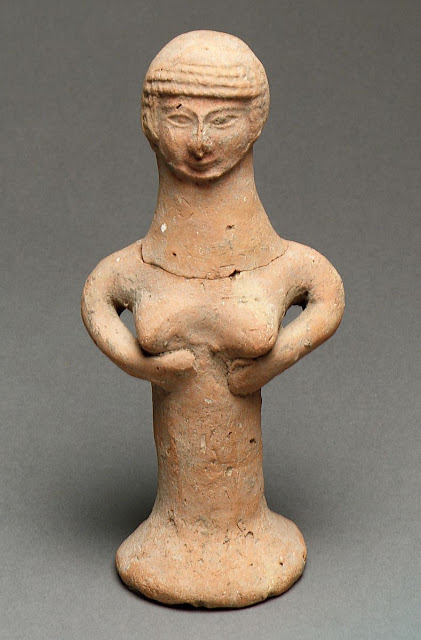
Let's talk about the goddess Namma for a second. According to Alban (2003), Nammu was also called Ninmah, and Ninhursag. She is the "goddess of the sea and mother earth, giving birth to all the world." She is the "primordial creatrix," and her name is the "oldest recorded name of a deity." She was probably a "fish-tailed, snake, or dragon" goddess (p. 157). Baring and Cashford (1991 [1993 edition]) said that Nammu was probably "portrayed as a serpent goddess." She might've been depicted as a "goddess with a serpent head," (Ch. 5 [p. 92?]). Nammu, also called Namma, is also the mother of all the gods. Her role was later taken over by Tiamat (University of Pennsylvania, ORACC, Ancient Mesopotamian Gods and Goddesses, Namma (goddess)). She is the "'mother who gave birth to the heavens and the earth'." Since no male was associated with Namma, it is possible that she created the cosmos by asexual reproduction (Functions, para. 1-2). At Eridu, it seems that Namma originally had a higher position than Enki did (Divine Genealogy and Syncretisms). Baring and Cashford said that "Tiamat seems to have been a later or alternative name for Nammu," (Baring and Cashford, 1991 [1993 edition], Ch. 5 [p. 92?]). On the An = Anum list, Nammu is spelled as "Namma" (Lambert and Winters, 2023; in George and Krebernik, 2023, pp. 70, 349, 386, 430, and 530-531). I'll go with Namma. In the Enki and Ninmah story, the senior and lower gods complain about the workload. Namma goes to Enki, her son (she is also stated as being the mother of all the senior gods), and tells him to create mankind to take the workload off of the gods. Enki tells her to make mankind out of clay. Namma takes the clay, and gives birth to mankind (lines 1-37 [ETCSL translation]) (Spar, 2009, para. 6). Snakes, or serpents, were also a symbol of Asherah (Salem and Salem, 2000, p. 161) (Dever, 2005, p. 186) (George and George, 2014, p. 207), and she was also called "Mother of the gods" (Dever, 2005, p. 186). Inanna was also associated with serpents, which she seems to have inherited from the "Neolithic [...] Snake Goddess." Inanna also seems to have been a goddess of the water originally (Baring and Cashford, 1991 [1993 edition], Ch. 5 [p. 82?]). I think Namma, Asherah, and Inanna are the same person. This also means that Ea's/Ieue's mother was also his wife.
According to Binger (1997), a case can also be made that Asherah (Asratum) was also the mother of El ('l/Enlil) in Ugarit. Asherah would be equated to Rhea, and El would be equated to Zeus. This was "before Baal arrives." The Baal in question is Hadad (Adad) (pp. 77-78). This can help link Asratum to Namma.
Asherah had her own trinity. It consisted of Qudshu/Qadesh, Astarte, and Anat, and comes from the Triple Goddess Stone from Egypt (Picknett and Prince, 2019, pp. 161-162) (Irwin, 1999, p. 220). Qadesh is Asherah (Picknett and Prince, 2019, p. 161). This would make Asherah, Astarte, and Anat, the same deity, which makes sense because Asherah and Anat were the same goddess: Asratum. Astarte was a moon goddess (Wright, 1901, p. 448), and was blended with Anat to become the goddess Atargatis (Encyclopaedia Britannica, Anath, para. 3). Anat was worshipped alongside YHW (Ieu) in Elephantine, and was likely Yahweh's (Ieue's) consort (Cornell, 2019, para. 4-5) (Mondriann, 2013, pp. 537 and 550) (Langdon, 1931 [1964 reprint], p. 44). This also means that Asherah/Asratum was Ieue's consort. Anat was also called "'the Virgin,'" and was the "goddess of love and war" (Encyclopaedia Britannica, Anath, para. 1-2). Interestingly, Athena was also the "goddess of war," and "virginity was attributed to her very early," (Encyclopaedia Britannica, Athena, para. 1 and 3). I think Anat and Athena might be the same goddess. I also think that Anat-Athena could also be Wisdom from Proverbs 8:22-31. According to Rabbi Shapiro (2014), Wisdom is Ieue's daughter (pp. 48 and 54). Athena is Zeus' daughter (Encyclopaedia Britannica, Athena, para. 2). Athena was also the goddess of "practical wisdom," and later became "allegorized to personified wisdom," (para. 1 and 6). In fact, Cornelius (2004) said that Anat was equated to Athena "in the Greek-Phoenician bilingual KAI No. 42. Cornelius also said that Anat is "also related to [...] Ishtar-Shawushka and [...] Inana-Ishtar-Inin-Annunatum," (p. 92). Finally, Cornelius stated that Astarte is Ishtar and Shawushka (p. 93). Anat is Athena after all, and both Anat and Astarte are Ishtar. Ea's/Ieue's mother was also his wife, and his daughter.
Triple Goddess Stone from Egypt depicting Qudshu/Qadesh (Edwards, 1955; retrieved from Wikipedia):
.png)
%20(University%20of%20Cambridge,%20Museum%20of%20Classical%20Archaeology%20Databases).jpg)
Venus de Milo (150-125 B.C.) (Louvre Museum) by Shonagon (Wikipedia):
%20(Louvre%20Museum)%20(Shonagon)%20(Wikipedia).jpg)
Links:
University of Chicago. Institute for the Study of Ancient Cultures West Africa and North Arica. Seal, Cylinder A27903:
https://isac-idb.uchicago.edu/id/90eec75d-0343-4a85-8810-ad0cdcc2a081
Dunlap (1894 [1898 edition]) (P. 77):
https://books.google.com/books?id=WvkDAAAAQAAJ&pg=PT44&dq=Dagon+Apollo+corn&hl=en&newbks=1&newbks_redir=0&source=gb_mobile_search&sa=X&ved=2ahUKEwj_ytbv1YmFAxWPMlkFHRrICSYQ6AF6BAgLEAM#v=onepage&q=Dagon%20Apollo%20corn&f=false
Kavanagh (1871) (Vol. 1, p. 19):
https://www.google.com/books/edition/Did_God_Have_a_Wife/IGR7-OSz7bUC?hl=en&gbpv=1&bsq=God%20Almighty
https://books.google.com/books/about/The_Jews.html?id=nnG3c--uKtMC&printsec=frontcover&newbks=1&newbks_redir=0&source=gb_mobile_entity#v=onepage&q&f=false
Link 2:
https://archive.org/details/jews00howa/page/n7/mode/1up?view=theater
https://www.metmuseum.org/art/collection/search/323163
https://www.google.com/books/edition/When_God_Had_a_Wife/kLKXDwAAQBAJ?hl=en&gbpv=0
-eBook:
https://itunes.apple.com/WebObjects/MZStore.woa/wa/viewBook?id=1462738065
https://tspace.library.utoronto.ca/bitstream/1807/73647/1/Irwin-Baal%20and%20Yahweh.pdf
https://en.m.wikipedia.org/wiki/File:Qetesh_relief_plaque_%28Triple_Goddess_Stone%29.png
Wright (1901) (P. 448):
https://www.journals.uchicago.edu/doi/pdf/10.1086/472832
V2:
https://www.jstor.org/stable/3136671
Encyclopaedia Britannica. Anath:
https://www.britannica.com/topic/Anath
Cornell (2019):
https://www.asor.org/anetoday/2019/11/Judeans-and-Goddesses-at-Elephantine/
Mondriann (2013):
https://repository.up.ac.za/bitstream/handle/2263/40058/Mondriaan_Anatyahu_2013.pdf
Encyclopaedia Britannica. Athena:
https://www.britannica.com/topic/Athena-Greek-mythology
https://www.jstor.org/stable/3296569
https://www.britannica.com/topic/Aphrodite-Greek-mythology
https://www.britannica.com/topic/Ishtar-Mesopotamian-goddess
Langdon (1931 [1964 reprint]):
https://archive.org/details/MythologyOfAllRacesVolume5/page/n18/mode/1up
Dunlap (1894) (PP. 75):
Massey (1883) (Vol. 2 p. 296):
Venus de Milo (150-125 B.C.) (Louvre Museum) by Shonagon (Wikipedia):
https://commons.wikimedia.org/wiki/File:V%C3%A9nus_de_Milo_-_Mus%C3%A9e_du_Louvre_AGER_LL_299_;_N_527_;_Ma_399.jpg
Athena Parthenos (440 B.C.) (University of Cambridge, Museum of Classical Archaeology Databases, Varvakeion Athena Parthenos):
https://museum.classics.cam.ac.uk/collections/casts/varvakeion-athena-parthenos
-Pic:
https://images.app.goo.gl/kgw3kugJyd7QB44L8
-2013 edition (p. 142):
-2000 edition (V1: Ninhursag):
-V2 (Damkina is Ninhursag, and Ninki):
-V3 (Ninhursag):
https://archive.org/details/encyclopediaofan0000coul/page/346/mode/2up?q=ninhursag
Trzaskoma et al., (2016) (P. 443):https://books.google.com/books?id=jmr9DAAAQBAJ&pg=PA443&dq=Damkina+Ninhursag&hl=en&newbks=1&newbks_redir=0&source=gb_mobile_search&sa=X&ved=2ahUKEwjCs42FvLCLAxVoD1kFHWilA2c4FBDoAXoECAIQAw#v=onepage&q=Damkina%20Ninhursag&f=false
Lambert and Winters (2023; in George and Krebernik, 2023) (PP. 17 and 70):
https://dokumen.pub/an-anum-and-related-lists-god-lists-of-ancient-mesopotamia-orientalische-religionen-in-der-antike-1-9783161613821-9783161613838-3161613821.html
Proverbs 8:
https://biblehub.com/nasb_/proverbs/8.htm
Rabbi Shapiro (2014):
https://books.google.com/books?id=tu6JBAAAQBAJ&printsec=frontcover&dq=Lady+Wisdom+divine+sex&hl=en&newbks=1&newbks_redir=0&source=gb_mobile_search&sa=X&ved=2ahUKEwjfq5mFltD1AhX2rHIEHbVIDzUQ6AF6BAgHEAM
-eBook version:
https://books.apple.com/us/book/embracing-the-divine-feminine/id1493951998
Cornelius (2004) (P. 92):
https://books.google.com/books?id=5vYSQ3RpkEkC&pg=PA92&dq=anatum+anat+goddess&hl=en&newbks=1&newbks_redir=0&sa=X&ved=2ahUKEwiZoKvR_9OOAxV5M1kFHSzZFPgQ6AF6BAgFEAM#v=onepage&q=anatum%20anat%20goddess&f=false
Alban (2003) (P. 157, chapter 9):
https://books.google.com/books?id=JjoBs_u5rigC&pg=PA157&dq=nammu+goddess&hl=en&newbks=1&newbks_redir=0&source=gb_mobile_search&ovdme=1&sa=X&ved=2ahUKEwillsOSn8aBAxVMGVkFHUe0Bp8Q6AF6BAgKEAM#v=onepage&q=nammu%20goddess&f=false
University of Pennsylvania. ORACC. Ancient Mesopotamian Gods and Goddesses. Namma (goddess):
http://oracc.museum.upenn.edu/amgg/listofdeities/namma/index.html
Spar (2009):
https://www.metmuseum.org/toah/hd/epic/hd_epic.htm#:~:text=According%20to%20the%20Sumerian%20story,the%20gods%20from%20their%20toil.
Salem and Salem (2000) (P. 161):
https://books.google.com/books?id=Fd1KpWroqUYC&pg=PA161&dq=asherah+snake&hl=en&newbks=1&newbks_redir=0&source=gb_mobile_search&ovdme=1&sa=X&ved=2ahUKEwjy25Oy5M6BAxXJD1kFHXbUB1AQ6AF6BAgHEAM#v=onepage&q=asherah%20snake&f=false
George and George (2014) (P. 207):
https://books.google.com/books?id=xrKuAwAAQBAJ&pg=PA207&dq=asherah+serpent+symbol&hl=en&newbks=1&newbks_redir=0&sa=X&ved=2ahUKEwjtuPuf886BAxXxMlkFHUiwAYsQ6AF6BAgNEAI#v=onepage&q=asherah%20serpent%20symbol&f=false
Bible Hub. Strong's Hebrew. 842. Asherah: Strong's Concordance, NAS Exhaustive Concordance:
https://biblehub.com/hebrew/842.htm
White (2021):
https://www.biblicalarchaeology.org/daily/ancient-cultures/ancient-israel/asherah-and-the-asherim-goddess-or-cult-symbol/
-V2:
https://www.researchgate.net/profile/Sergey-Krupin/publication/343737801_Significance_of_the_goddess_Ashera_before_Nebuchadnezzar/links/5f3d0127458515b7292c90ba/Significance-of-the-goddess-Ashera-before-Nebuchadnezzar.pdf?origin=publication_detail
Biale (1982):
https://www.academia.edu/35615351/David_Biale_The_God_with_Breasts_El_Shaddai_in_the_Bible_History_of_Religions_21_3_February_1982_240_256
Fast (1938):
https://books.google.com/books/about/The_Jews.html?id=nnG3c--uKtMC&printsec=frontcover&newbks=1&newbks_redir=0&source=gb_mobile_entity#v=onepage&q&f=false
-V2:
https://archive.org/details/jews00howa/page/n7/mode/1up?view=theater
Patai (1968):
https://archive.org/details/x-the-hebrew-goddess/mode/2up
Baring and Cashford (1991 [1993 edition]) (Ch. 5 [p. 92?]):
Binger (1997) (PP. 77-78):
Part 4: Conclusions:
Ea was the Saturn of the Middle East. He is the god of the Bible (Ieue/Yhvh and 'l/El), and the Qur'an (Allah). Other spellings of his name include Eau, Ia, Iau, Iao (Iaw), Ieue, and 'eie (Aeie). The other Middle Eastern gods, called Elohim in the Bible, were different versions of Ea/Ieue himself. The goddess was seen as Ea's mother, wife, and daughter.


