I've decided to split my "Saturn: The Demon Deity Unveiled" post into separate posts, mainly due to the weird fact that I cannot seem to edit that post anymore. Maybe I added too much stuff to that post? Either way, I hope that splitting that massive post up will be easier for people to read.
Parts:
Part 1:
https://demythifyinggod.blogspot.com/2026/05/saturn-supreme-god.html
Part 2:
https://demythifyinggod.blogspot.com/2026/05/ea-saturn-in-middle-east.html
Part 3:
https://demythifyinggod.blogspot.com/2026/05/dyeus-pater-saturn-in-eurasia.html
Part 4:
https://demythifyinggod.blogspot.com/2026/05/atum-saturn-of-africa.html
Part 5:
https://demythifyinggod.blogspot.com/2026/05/viracocha-saturn-of-south-america.html
Part 6:
https://demythifyinggod.blogspot.com/2026/05/great-spirit-saturn-in-north-america.html
Part 1: Dyeus Pater:
Zeus from the Vatican Museum, Vatican City by Vladimir Wrangel (Encyclopaedia Britannica, Zeus):
Now, we head to the continent of Eurasia. According to Tucker (1890), the people of the "Baltic shores" worshipped the god Dyeus-pater, which represented "Heaven" and "the all-father." The "earth was the all-mother, and the rest of gods and men were the offspring of this pair." Being the "highest divinity-Dyeus, 'the brilliant,' the shining, and Pater, 'the father.' The name Dyeus is in the word "Tuesday, 'the day of Tiu.'" Tiu "is the Germanic pronunciation of the name." Dyeus was also "Jupiter of the Romans, the Zeus-pater of the Greeks, the Djaus-pitar of the old Hindus," (p. 32).
According to Briggs (2003), Dyeus was a "shinning god of the sky" that destroyed enemies with lightning, and controlled the rain (Chapter D):
Briggs also said that Dyeus' "consort was the Earth Goddess (or Mother Earth) who caused the vegetation to grow." The followers of Dyeus, the Aryans/Indo-Europeans, arrived in Iran and India around 2,500 B.C. (Chapter D). Lehmann (1993) said that the name "*dyeus" was "Proto-Indo-European." He was also the "Greek Zeus and Latin Jupiter," and even the sun god Sius (p. 265). Winn (1995) also said that Dyeus was an Indo-European god, perhaps the oldest one (p. 81). The Indo-Europeans were the Hittites (Lehmann, 1977, p. 263). The god of the Hittites was Pappas/Attis, also called Sutekh, Baal, Tark or Tarku, and Ramman (Mackenzie, 1907, p. 259). The Hittite god was also the god of the Hyksos (p. 261). Ramman was a name of Adad, as we already know. Sutekh, or Setekh, was Seth (Budge, 1904, Vol. 2 pp. 283-284) (Encyclopaedia Britannica, Seth). Dyeus was Adad, and Seth!
Another version of the nam is Dyaus, which is Hindu. He was the primordial sky father, and creator god. He created "the rest of the Vedic pantheon," along with his wife Prthivi. Later on, he was replaced by the god Indra (Jordan, 2004 [2014 edition], pp. 83-84, and 359) (Encyclopaedia Britannica, Zeus, para. 1). Smith (1884) said that D'yaus, Vul/Yav, Il/El, Yao/Iao, and Jahveh (Ieue), were all related and he became the single god of the Hebrews (p. 148). Anu (Uranus) was "a personification of the sky," and is equated to Dyaus, Jupiter, and Zeus (Frazer, 1926, pp. 66-67). Doesn't the name Dyeus/Dyaus sound familiar to Ea/Ieue? They're even spelled similarly.
According to Winn (1995), it seems that Dyeus Pater is the original Indo-European version of the name Dyaus Pitar. Dyeus evolved to be Dyaus in India, Zeus/Zeus pater in Greece, Jupiter in Latin (Rome), and Tiu in old English or Tyr in Iceland. The day Tuesday is named after Tiw ("Tiw's day"). In Iran, he became "heaven" and was "Replaced by a new god." In Slavic religion, his name survives as "duzdi" and "dozd" (Russian). These names mean "'rain'" or "'bad sky'" (pp. 81-82). So, the name evolved from Dyeus to Dyaus, and then to Zeus and other names. Dyeus Pater, or Dyeus, being associated with the "bright sky" or "shinning sky," and "heaven," reminds me of Uranus, who was also called "heaven." Dyeus' symbols included "solar images" (the sun), and below the solar images were "weapons and a plowing figure" (p. 82). The plow was a symbol of Zeus, Dagon, Enlil, and Ea/Eau. The names of Dyeus are also stated in The Christian Remembrancer (Volume 56, p. 168, Article 8).
Evolution of Dyeus Pater (Winn, 1995, p. 81):
In the Latin Vulgate, the Latin translation of the Bible by Saint Jerome made in 382-405 A.D. (Vulgate, Home, para. 1-3), Deus is the name of god (Vulgate, Genesis-Chapter 1). Deus/Deus pater is Jupiter (Hampton, 1841, p. 54 note 2). Paul (1904) said that Dyauspitar, Zeuspater, Jupiter, and the Christian Deus, came from Dyaus. They, and the word Deva, come from the root word Div, which means "to shine" (p. 79 notes):
Winn (1995) said the same thing (p. 23):
Winn also said that the "dy" in Dyeus became a "z" in Greek, which means Dyeus became Zeus. In Latin, "dy" became "i." This becomes Iu-piter and Ioves. Leeming (2005) said Zeus became Ju Piter/Jupiter (p. 128). Bell (2018 [2020 edition]) said that the word deus originated from dyeus (pp. 19-20). It has been stated that Jehovah, Iao, and Jeu-pater/Jao-pater, were all the same name for Jehovah (Ieue), Jupiter, Jovis, and Janus (Drummond and Walpole, 1810, p. 62).
Another spelling of the name that I've seen is Dios. This version of the name is Spanish because I've seen it in the Spanish translation of the readings for Mass. Dios is, of course, another name for Zeus (Cook, 1925, Vol. 2, pp. 276-277, 279-280), Dyeus and Deus (Winn, 1995, p. 23), but also Uranus. Dios is the father of Aphrodite, but Uranus is also Aphrodite's father. Anum is Inanna's father, and Anum is Uranus while Inanna is Aphrodite (Marks, 2020, Mythic Background; in Pache et al., 2020) (Romer, 2020; in Burian et al., 2020, p. 202). As stated before, Anum is Uranus-Saturn, Inanna is Ishtar, and Ishtar is Anum's wife. Strangely enough, Anum was both Ishtar's husband and father. Anum being Ishtar's father would equate him to Zeus. Going back to Dios, he has also been equated to Poseidon (Seltman, 1956, p. 33), making Uranus, Zeus, and Poseidon, the same individual under the name Dios. Interestingly, Cook (1925) said that there was a Dios Papas, or "Dios the Father," and a Dios Nysos or "Dios the Son." Dios Nysos turned into Dio-nysos (or Dionysus), which means "son of Zeus" (Vol. 2 p. 277). Zeus Dios was like Dionysus in personality, and was represented by grapes and the plough (p. 281). In fact, Zeus and Dionysus are synchronized under the name Zeus Dionysus (p. 282), so Dionysus is Zeus! Uranus, Zeus, Poseidon, and Dionysus, are all the same individual! They all come from Dyeus.
According to Cicero, there were three different forms of Jupiter. The first is the son of Aether, and father of Liber/Bacchus/Dionysus and Persephone. The second is the son of Caelus/"Ouranos (Heaven)", and is the father of Minerva/Athena. The third is the son of Saturn/Cronus (The Nature of the Gods, Book 3 section 21 para. 53 [University of Chicago]; book 3 section 53 [ToposText]) (Dowden, 2006, p. 105). The first Jupiter is Caelus (Uranus), the son of Aether. The second Jupiter must be "Saturation" (Cronus), the son of Caelus (Uranus) (Cicero, The Nature of the Gods, Book 3 section 17 para. 44 [University of Chicago translation]). Finally, the third Jupiter must obviously be the usual Jupiter who is the son of Saturn. This means that Uranus, Cronus, and Zeus, were all the same individual: Dyeus/Zeus Pater!
All of the male gods are just different personalities of Dyeus/Zeus, but I'll discuss them separately below.
Uranus statue on the Pergamon Altar in the Pergamon Museum (Wikipedia). Photo belongs to Miguel Hermoso Cuesta:
This would be a good time to talk about Uranus. Uranus was the son and husband of Gaea. He is the father of "the Titans, the Cyclopes, and the Hecatoncheires." Later on, he is castrated by his son, Cronus (Encyclopaedia Britannica, Uranus, para. 1). Ouranos' (Uranus) name means "heaven," (Griswold, 1910, p. 31). As stated previously, the Indo-Europeans were Hittites. The Greeks had "the Hittite and Hurrian myth" of Anum (Uranus), Kumarbi (Cronus), and Teshub (Zeus) in their religion (Colavito, 2014, p. 51).We already know that Anum was castrated by Kumarbi-Enlil, and then defeated by Teshub-Adad, in the Hittite religion. This is why Uranus is castrated by Cronus in the Greek religion. We should also remember that Adad was also Uranus, especially under the name Baal Shamayin (Baal Samen). Baal Shamayin was also a name for Anum, thus equating Anum to Adad and Uranus to Zeus.
Uranus is also probably equated to another god named Zagreus, a god from Crete. According to Kerenyi (1976 [2020 edition]), in the epic called Alkmeonis, Zagreus and "Mistress earth"/Gaia are positioned "above all other gods!" This author of the epic represented Zagreus as either "the supreme god of heaven (as a counterpart to Mother Earth), Father Zeus, or the other Zeus, the Zeus of the underworld," (p. 83). Colavito (2014) said that Zagreus was the "bull-headed consort of the earth goddess and was the greatest of the gods, according to the lost epic poem Alcmeonis." Later on, Zagreus was "identified with Dionysus," (p. 43). Alcmeonis dates to the "sixth or fifth century BC," (Wheatley and Hannah, 2009, p. 170). Aside from Dionysus, and probably Zeus, the only other deity that matches Zagreus in Alcmeonis is Uranus ("the supreme god of heaven"). Dyeus' wife was the the Earth Goddess/Mother Earth, as stated previously. This makes Dyeus, Uranus, Zagreus, and Dionysus the same god. According to Leeming (2005), Dyaus "'covered'" his wife just like "Ouranos covered Gaia in Greece," (p. 128). Scull (1880) said that Prithivi was Gaea (Gaia) (p. 53). Prithivi is Dyeus' wife. Scull also said that Dione, one of Zeus' wives and probably his first Greek wife, was Gaea, and her "elemental attributes were partially transferred to Hera," (pp. 53, 77, and 363). Hera was probably Dione herself (p. 97). This officially equates Dyeus/Zeus to Uranus.
There is a name of Zeus called Zeus Ouranios/ouranos ("Zeus of the sky") (Cook, 1914, Vol. 1 p. 8). Zeus Ouranios "supplanted the primitive Kronos," according to Professor Ridgeway (Harrison, 1901; in Nut, 1901, Vol. 15 p. 476). In the "Our Father" prayer, God the Father (Pater) is in Heaven. The Greek word for Heaven is Ouranois (Matthew 6:9 [Interlinear]). Ouranois is Ouranos, and it means "Heaven, heavens, sky, air" (Bible Hub, Strong's Greek, 3772. ouranos). Jesus' Father was Zeus Pater, and Heaven/Uranus is the sky and not an alternate dimension or universe. Heck, Heaven is Zeus himself! This means that the Heaven that we think of is false.
Based on Cicero, Uranus (the first Zeus) is the father of Persephone and Dionysus (
The Nature of the Gods, Book 3 section 21 para. 53 [
University of Chicago]; book 3 section 53 [
ToposText]) (Dowden, 2006, p. 105). Jacob (2005) said that Ouranus, and Anu, are Dyaus (pp. 105 and 167). Both Uranus, and Anum, are Zeus.
Links:
Uranus statue in the Pergamon Museum (Wikipedia):
https://en.wikipedia.org/wiki/File:Altar_P%C3%A9rgamo_Urano_01.JPG
Encyclopaedia Britannica. Uranus:
https://www.britannica.com/topic/Uranus-mythology
Griswold (1910) (P. 31):
https://books.google.com/books?id=o_AcAAAAMAAJ&pg=PA31&dq=ouranos+rain+god&hl=en&newbks=1&newbks_redir=0&source=gb_mobile_search&ovdme=1&sa=X&ved=2ahUKEwj10JmFxLCDAxVoLFkFHbRHA60Q6AF6BAgKEAM#v=onepage&q=ouranos%20rain%20god&f=false
Cook (1914) (Vol. 1 p. 8):
https://books.google.com/books/about/Zeus.html?id=9e9gpRpZWCYC&printsec=frontcover&newbks=1&newbks_redir=0&source=gb_mobile_entity&hl=en&gl=US&ovdme=1#v=onepage&q&f=false
Harrison (1901; in Nut, 1901, Vol. 15) (P. 476):
Leeming (2005) (P. 128):
https://books.google.com/books?id=iPrhBwAAQBAJ&pg=PA128&dq=dyeus+varuna+replaced&hl=en&newbks=1&newbks_redir=0&source=gb_mobile_search&ovdme=1&sa=X&ved=2ahUKEwiX2Mb79s-DAxUCEVkFHYJJCbwQ6AF6BAgKEAM#v=onepage&q=dyeus%20varuna%20replaced&f=false
Kerenyi (1976 [2020 edition]) (P. 83):
Cicero. The Nature of the Gods:
-Book 3 (University of Chicago):
2.) Cronus:
Chronos by Ignaz Gunther (1765-1770) from the Bayerisches National Museum:
According to Cicero, Cronus (the second Zeus) was the father of Athena (
The Nature of the Gods, Book 3 section 21 para. 53 [
University of Chicago]; book 3 section 53 [
ToposText]) (Dowden, 2006, p. 105). This corresponds to Sanchoniatho saying that El's-Cronus' daughter was Athena (
Phoenician History [Rev. Cumberland, 1720 translation], p. 30). Scull (1880) said that "Dyu or Dyaus" was Cronus in India, and "Moloch, Cronus the destroyer" in Phoenicia (p. 60). His wife Rhea was probably also Dione, and Gaea (Gaia) (p. 65).
We already know who Cronus-Saturn is, so no need for a review of his story. Cronus was also worshipped on a mountain called Mount Kronion, which is located in Olympia, Greece (Hutchinson, 1901, p. 12) (Jongh et al., 2000, p. 408). Since Anum-Uranus was Saturn in the Middle East, we could assume that Dyeus was also Cronus. According to Lyle (2012), Dyaus is Cronus in the Hindu religion while Varuna was Uranus (p. 106 Figure 9-1). Interestingly, Leeming (2005) said that Dyaus became Varuna (p. 128). This makes Dyeus both Uranus, and Cronus. The Christian Remembrancer also equated Dyaus/Zeus to Kronos, and the "sky or day," (Volume 56, p. 168, Article 8). As for Cronus being equated to Zeus on the Eurasian continent, Cronus and Zeus were the same deity under the name Zeus Laphystios, as stated before. Another name given to Cronus is Zeus Lycaeus, who dwelt on Mount Lycaeus in Arcadia (Frazer, 1913, Vol. 9 p. 353) (Hutchinson, 1901, p. 13). Frazer (1913) said that the Greeks identified Cronus/Saturn "with the cruel Semitic Baals who delighted in the sacrifice of human victims, especially of children." However, human sacrifice to Zeus Lycaeus seemed to have happened on Mount Lycaeus (Vol. 9 p. 353). Mount Lykaion (Lycaeus) is in Arcadia, Greece (University of Pennsylvania, Penn Art and Sciences: Art and Archaeology of the Mediterranean World, Mount Lykaion [Greece]). According to Farnell (1920 [1921 edition]), human sacrifices to Zeus Lykaios (Lycaeus) and Laphystios continued in the Hellenism period (p. 119). In Rhodes, humans were sacrificed to Cronus on Mount Atabyris (Duncker, 1881, Vol. 1 p. 432). Mount Atabyros is in Rhodes of Dodecanese, Greece. The mountain was dedicated to Zeus Atabyrios (ToposText, Zeus Atabyrios [Rhodes] 6 Mt. Atavyros). Farnell (1920 [1921 edition]) said that Porphyry stated that human sacrifices to Kronos in Rhodes survived in the Roman period until the Emperor Hadrian came along (p. 120). Sounds like the Greeks also sacrificed humans to Cronus, just like the Semites did. Zeus Atabyrios seems to be another name of Cronus as well. This means that Cronus was equated to Zeus three times. Uranus, Cronus, and Zeus were the same individual: Adad-Dyeus!
Amazingly, according to Strodl (1875), the Greeks worshipped Kronos with human sacrifices. The surprising part about this is that these sacrifices were also dedicated to Zeus, Dionysus, Apollo, and Athena! These sacrifices "continued to take place up until the Christian period," (pp. 48-49 [German])! Strodl also stated that Zeus Laphystios was the Minyan (Minoan) Zeus (p. 49 [Greek]). The Greeks not only committed human sacrifice, but they continued up to the Christian era! Jacob (2005) said that, according to Euripides, the Chronos of the Orphic religion was called "Zeus Aitherios," (p. 105).
Links:
Chronos by Ignaz Gunther (1765-1770) from the Bayerisches National Museum:
https://www.bayerisches-nationalmuseum.de/en/collection/highlights/00057847
Cicero. The Nature of the Gods:
-Book 3 (University of Chicago):
Hutchinson (1901) (P. 13):
https://books.google.com/books?id=WmhbAAAAMAAJ&pg=PA13&dq=Kronos%C2%A0Lycaeus&hl=en&newbks=1&newbks_redir=0&source=gb_mobile_search&sa=X&ved=2ahUKEwjXweDipeCJAxViEVkFHSc-KzQQ6AF6BAgFEAM#v=onepage&q=Kronos%C2%A0Lycaeus&f=false
Jongh et al., (2000) (P. 408):
https://books.google.com/books?id=bko8u2MQA5oC&pg=PA408&dq=mount+kronion+greece&hl=en&newbks=1&newbks_redir=0&sa=X&ved=2ahUKEwi-rLygw-KJAxVyF1kFHRAmMn0Q6AF6BAgGEAI#v=onepage&q=mount%20kronion%20greece&f=false
Lyle (2012) (PP. 105-106):
https://books.google.com/books?id=RrIwBwAAQBAJ&pg=PA106&dq=Dyaus+Anu&hl=en&newbks=1&newbks_redir=0&source=gb_mobile_search&ovdme=1&sa=X&ved=2ahUKEwic-dyLu96CAxXHElkFHRRpCTIQ6AF6BAgIEAM#v=onepage&q=Dyaus%20Anu&f=false
Leeming (2005) (P. 128):
https://books.google.com/books?id=iPrhBwAAQBAJ&pg=PA128&dq=dyeus+varuna+replaced&hl=en&newbks=1&newbks_redir=0&source=gb_mobile_search&ovdme=1&sa=X&ved=2ahUKEwiX2Mb79s-DAxUCEVkFHYJJCbwQ6AF6BAgKEAM#v=onepage&q=dyeus%20varuna%20replaced&f=false
The Christian Remembrancer. Volume 56. Article 8:
https://books.google.com/books?id=lr0RAAAAYAAJ&pg=PA169&dq=Poseidon+sun+rising+out+of+the+ocean&hl=en&newbks=1&newbks_redir=0&source=gb_mobile_search&ovdme=1&sa=X&ved=2ahUKEwiMicmwndeEAxVfF1kFHayGAkcQ6AF6BAgLEAM#v=onepage&q=Poseidon%20sun%20rising%20out%20of%20the%20ocean&f=false
Frazer (1913) (Vol. 9 p. 353):
University of Pennsylvania. Penn Art and Sciences: Art and Archaeology of the Mediterranean World. Mount Lykaion (Greece):
https://aamw.sas.upenn.edu/aamw/resources/fieldwork/mount-lykaion-greece
Duncker (1881) (Vol. 1 p. 432):
https://books.google.com/books?id=-XwOAAAAQAAJ&pg=PA432&dq=Hea+Cronos+god&hl=en&newbks=1&newbks_redir=0&source=gb_mobile_search&ovdme=1&sa=X&ved=2ahUKEwjigZaFg7SFAxU4GVkFHSpIDKk4ChDoAXoECAgQAw#v=onepage&q=Hea%20Cronos%20god&f=false
ToposText. Zeus Atabyrios (Rhodes) 6 Mt. Atavyros:
https://topostext.org/place/362279SAta
Strodl (1875) (PP. 48-49 [German]):
3.) Zeus Pater:
Jupiter (100-200 A.D. copy) statue from Smyrna (original from 2nd century B.C.) (Louvre Museum, Collections: Jupiter [MR 255]). Picture is from
Wikipedia:
%20from%20Smyrna%20(original%20from%202nd%20century%20B.C.)%20(Wikipedia).jpg)
Zeus was known under the names Dan, Tan, and Zan (Seltman, 1956, p. 33) (Hewitt, 1907, Vol. 1 p. 188). Dan later became Poseidon. He was the top god of the Mycenaeans, and Minoans (Castleden, 2005, pp. 141-143) (Seltman, 1956, p. 33) (Cook, 1925, Vol. 2, p. 846). Tan was a god of the Phoenicians, Akkadians, and Idaean-Cretan-Minoan Greeks. He was the mud god who ruled the mud beneath the water. In the North Pole, Tan is called Danu. Tan's mother was the virgin goddess Brito-martis, the mother of the sun god. The Dorian Greeks called him Zan, and Tan/Zeus Kretagenes. He was probably also Zeus Dolichenos, and he and Marduk shared the double thunderbolt (Hewitt, 1901, p. 29) (Hewitt, 1907, Vol. 1 pp. 188-189) (Seltman, 1954; in Quennell and Hodge, 1954, pp. 189-190). Tan is El Eliun (Elyon) (Byblos), Tammuz (Hebrew), Dumuzi (Akkadian), and Adonis (Phoenician). The Idaeans depicted him as half-man and half-fish on Cretan coins (Hewitt, 1907, Vol. 1 pp. 188). This reminds me of Dagon, as shown previously. According to Seltman (1954), the Cretan-Minoan Zeus (Tan/Zan) was a dying-and-rising god. He even had a tomb on Crete, which aggravated the other Greeks. He was also both Poseidon, and Zeus. In fact, Seltman said that Poseidon and Zeus "were really the same deity," (in Quennell and Hodge, 1954, p. 190).
Dan/Poseidon was the god of the first Greeks ("Minyan Greeks") from 2000 BC. The second generation of Greeks, the "Achaean Greeks," worshipped the "Sky-god Zeus." They made Poseidon a lesser version of Zeus because these new Greeks became the new rulers of the land. This was unnecessary because Dan/Potei Dan, also called Dios, was Zeus (Seltman, 1956, p. 33) (Cook, 1925, Vol. 2, p. 846). The Cretan-Minoan Greeks depicted Zeus as a "youthful god." The Greeks (Achaeans/second generation of Greeks) took over Crete and equated him "with their own powerful male deities," turning him into a grown man. This is the Zeus we know of today (Seltman, 1954; in Quennell and Hodge, 1954, p. 190). Zeus was also given Poseidon's trident in some depictions of him. This can be seen on 3rd-century B.C. Malaysian tetradrachim coin depicting Zeus Osogollis with the trident and eagle (Williamson, 2021, Figure 3.15E):
Zeus never gave up his trident that he had in the Middle East as Adad. Zeus's thunderbolt also had either one-prong, or three prongs (Louise, 2017, Figure 3):
This is reminiscent of Poseidon's trident. Here's a better picture of it (Hopeman, 2013, p. 103 Figure 11):
The vase dates back to 540-530 B.C. On it, Zeus is fighting Typhon. Notice that Zeus' name is spelled as "IEYS" on the vase. The name is also spelled "Ieus" using the lower-case version of the Greek letters. This is Ieue! Zeus and Ieue are the same god!
Zeus, also called Jupiter, was the chief deity of the Greek pantheon of gods, and was the god of "thunder and lightning, rain, and winds." He was the ruler of heaven, which was located on Mount Olympus (Encyclopaedia Britannica, Zeus, para. 1 and 3). According to an article by Lehti (2024), another spelling of Zeus Pater is "Dzeus Pater." Jupiter is "the Italic evolution of Dyeus Phter, the sun or sky father, and an Italic variant of Zeus Pater (from Dzeus Pater)," (p. 1). Jahveh (Ieue), also called Vul, is a god of the atmosphere who was also a god called D'yaus (Smith, 1884, p. 148). Dyaus Pitar, or Dyaus, is a Hindu god whose name is linked with Zeus. Both gods are sky gods (Jordan, 2004 [2014 edition], pp. 83 and 359) (Encyclopaedia Britannica, Zeus, para. 1). Sanchoniatho also says that Zeus was Dagon ([Rev. Cumberland, 1720 translation], p. 32), who was the god of the atmosphere (Caquot and Sznycer, 1980, p. 13). This helps to explain why the Idaean-Cretan Zeus was half-man and half-fish. Dagon also had Poseidon's trident, once again linking Poseidon and Zeus as the same deity. On the An = Anum list, a list of Sumerian deities, Dagan is equated to Enlil (Litke, 1998; from Hallo, 1998, Vol. 3, p. 42). Enlil's titles range from "god of ghosts, wind, air, and atmosphere" (University of Pennsylvania, ORACC, Ancient Mesopotamian Gods and Goddesses, Enlil/Ellil: Functions, para. 1) (Fontenrose, 2022, p. 157). Ancient poet Nonnos said that Zeus was also the god of the air (Cook, 1914, Vol. 1, p. 751). Dagon was the god of corn (Harper, 1895, p. 409) (Dowling, 1913, p. 73), just like Zeus (Cook, 1914, Vol. 1, p. 598 note 2; p. 741). Zeus, Ea, Vul, Dyaus, Dagan, and Enlil, all seem to be the same deity. Merodach (Marduk) is equated to the planet Jupiter (Smith, 1884, pp. 148 and 216). Tartu (2001) also stated that Enlil and Marduk were represented by the planet Jupiter (pp. 14 and 20). Encyclopaedia Britannica said that Marduk was represented by Jupiter (Encyclopaedia Britannica, Marduk, para. 4). This would make Zeus and Enlil-Marduk the same individual.
Zeus, under the name Beelsamen or Baal-samen ("'Lord of Heaven'"), was a sun god (Cook, 1914, Vol. 1 p. 191). There's even a "fine bronze disk" which depicts Zeus as Baal Samen on it (p. 191 Figure 138):
Claus (1972) said that the god Hadad (Adad) was Baal Shamen, and the rising sun (
Vol. 4 p. 46). We already know that Adad was equated to Zeus. Zeus' smiting pose also links him with Adad:
Baal statue (AO 11598) (Louvre Collections, Figurine: AO 11598):
Zeus statue from Staatiliche Museen zu Berlin (5th century BC) (Encyclopaedia Britannica, Zeus):
Both Poseidon, and Zeus, were Adad.
Zeus also has a connection to the moon. In Greece, Zeus was typically equated with the moon goddess. This is because the Greeks "consistently regarded the moon as feminine." However, "in quasi-Greek districts," Zeus is shown as a moon god. A few coins ("tetradrachms"), from 126-96 B.C., show Zeus with the crescent moon above his head (Cook, 1914, Vol. 1, pp. 730-732; p. 731, Figures 538-539). Ieue was also associated with the moon (Nehemiah 10:33) (Psalm 81:3), and Ea was equated to the moon god Sin.
Tetradrachms showing Zeus as a moon god (Cook, 1914, Vol. 1, p. 731 Figures 538-539):
The moon goddess in question was Selene. That was her name in Greece, and Luna in Latin. Her brother was Helios. Later on, "Selene was sometimes identified with Artemis, or Phoebe ('the bright one')." She was sometimes paired with Zeus. She is depicted with the moon/crescent moon on her head (Encyclopaedia Britannica, Selene).
Selene in her Chariot (3rd century A.D.) (
Metropolitan Museum of Art) by Marie-Lan Nguyen (
Wikipedia):
It has also been stated that the Romans knew that they, and the Jews, both worshipped the god Jupiter! In Josephus' book Antiquity of the Jews, the Roman Emperor Ptolemy Philadelphus, and his "library keeper" Demetrius Phalereus, gathered up many religious texts in order to be translated into Greek. This included the Jewish laws. Aristeus, a friend of Philadelphus, said that they, and the Jews, worship the same god, "life" or "Jupiter" ("he breathes life into all men") (Book 12, Ch. 2, Sections 1-2). The Greek translation of the Jewish laws are the Septuagint, translated around 285-246 BC (Pietersma and Bright, 2007, p. xiii).
Josephus,
Antiquity of the Jews, Book 12 Chapter 2 Section 2:
According to Cook (2004), another Jewish writer, a Hellenist, equated the god of the Jews to Zeus/Dis. "A tradition" originating from "Orpheus and an oracle of the Clarian Apollo identify Iao (the Jewish god) with Liber (Dionysus), Zeus, Helios, and Hades." The author Varro said that "Jupiter and the God of the Jews were identical," (pp. 118-119). As explained by Patai (1977), Hellenistic Jews are Jews who partook in Greek culture. Hellenistic Jews equated the Jewish god to Zeus. Interestingly, the Hellenistic Jews said that the Jewish god/Zeus "was originally the only god recognized by the Greeks," (pp. 68-70). The Romans, Greeks, and the Jews worshipped Zeus/Jupiter, and all of these ethnicities knew it!
Binger (1997) said that (before Baal was introduced to the Greek and Ugaritic pantheons) Zeus was El (p. 78):
Zeus has also been called a god of the Earth, just like Poseidon, Ea, and Enlil. According to West (2007 [2008 edition]), Hesiod called Zeus "Zeus of the Earth," or Chthonios, and he was associated with the plough. The Christian God also plays a similar function in a prayer, and the source for both of these probably goes back to an Indo-European origin. Zeus of the Earth was also called Chthonios (p. 183):
Zeus of the Earth-Chthonios sounds like Poseidon, especially since he is associated with Demeter (see Taylor, 2022; in Mankey and Taylor, 2022, Poseidon, and The Christian Remembrancer, Volume 56 p. 169 Article 8). Cook (1914) straight up said that Chthonios was also called Zeus Chthonios, and he was associated with crops (Cook, 1914, Vol. 1, pp. 668-669) (Cook, 1914, Vol. 2, p. 829). In the winter, Zeus Chthonios goes into the Underworld and "rules over the shades of Hades," (Brown, 1877, Vol. 1, p. 55). Rev. Taylor (1833) said that a "verse cited by Macrobius" said that Jupiter, Pluto, the Sun, and Dionysus, are all one god (p. 340). Pluto is Roman name of the Greek god Hades (Encyclopaedia Britannica, Hades). The Roman sun god was Sol, who was called Helios in Greece (Encyclopaedia Britannica, Sol, para. 1). Helios was also connected to Apollo, who was a sun god as well (Encyclopaedia Britannica, Helios, para. 1) (Encyclopaedia Britannica, Apollo, para. 1). Apollo's "forename Phoebus means 'bright' or 'pure,' and the view became current that he was connected with the Sun. See Helios," (Encyclopaedia Britannica, Apollo, para. 1). According to Dunlap (1894), "the Greek Apollon, the Cretan Apellon"/Apollo, and Helios, are El (Enlil) (pp. 5 and 74). All of this means that Cronus, Poseidon, Zeus, Dionysus, Hades, and Helios, were all the same deity!
Professor Muller said that Zeus, Poseidon, and Hades, represented the sun and were originally the same deity under the name Dyaus (Brown, 1898, pp. 119-120). Poseidon-Neptune represents "The Sun, rising out of the ocean and again sinking into it" (Rhyn, 1895, p. 7). He was also "the sun rising out of the sea," (The Christian Remembrancer, Volume 56, p. 169, Article 8). Pluto (Hades) represents "the invisible Sun that through the night tarries in the underworld," (Rhyn, 1895, p. 7).
Zeus is the Archangel Sachiel. Out of all the gods that are said to be this individual, the names Adonai Tsevaot and Yehovah stood out to me (Archangels and Angels, Archangel Sachiel-Angelic and Planetary Correspondences). I can already tell that Yehovah is another spelling of the name Jehovah (Ieue). The name Adonai Tsevaot means "Lord of Hosts" (Hood, 2019, Abstract) (One for Israel, 2016, What Does "Lord of Hosts" Mean?, para. 1) (Avery, n.d., Names for God, LORD of hosts; Hebrew Words for LORD of hosts), which is another name for Ieue as described above: Sabaoth! Also, Zeus is also stated to be Sachiel too. Ieue on the Judean Coin looks a lot like Zeus as well...
Yehovah (Yahavah) being the Archangel Sachiel (
Archangels and Angels, Archangel
Sachiel-Angelic and Planetary Symbols):
Deities associated with Sachiel:
"Zeus on a coin of Alexander the Great" from the Thessaloniki, Archaeological Museum (333-323 BC) (Livius, Zeus on a coin of Alexander the Great):
Zeus coin featured in a
BAR article from 2006 (
Center for Online Judaic Studies, Zeus Coin):
Ieu on the 4th-century Judean coin:
Both Ieue (Ea) on the Judean coin, and Zeus on the two coins above, share the same physical features, clothing, and an arm stretched out with a bird (hawk or falcon) on it! The only difference is that there are no wings on Zeus' throne. The "Zeus on a coin of Alexander the Great" coin also comes from the 4th century BC, just like the Judean coin. Cook (1914) said that the Judean coin depicts Ieu as a "solar Zeus" (Vol. 1, p. 233). Ieu really is Zeus! The eagle is one of Zeus' symbols, along with the thunderbolt (
Encyclopaedia Britannica, Zeus, para. 6). Ieue is described as an eagle watching over the Israelite tribes (Deuteronomy 32:11-12). Cook (1914) said that the bird on Ieu's hand on the Judean coin was probably an eagle (Vol. 1, p. 232). It has also been stated on this post previously that Ea/Ieue is connected to the eagle/Zu bird.
Remember the name IA-U? Well, according to Parke-Taylor (1975 [2006 edition]), John Allegro said that YHWH and IA-U come from the same "linguistic background" as Zeus' name (p. 49). Parke-Taylor also said that Enno Littmann stated a "connection between the name YHWH and Zeus." Littman said that the Tetragrammaton, and Zeus' name, are a "derivation from Dyeus, Indo-European in origin" (pp. 49-50).
Origin of YHWH (Yhvh) (Parke-Taylor, 1975 [2006 edition], p. 49):
P. 50:
As we already know, Iau is another spelling of Ea/Eau. Not to mention, Zeus' name was also spelled as Ieus. Finally, let's talk about one of Zeus' Roman names: Jove/Iove (
Encyclopaedia Britannica, Jupiter). According to Lehti (2024), "the Italic name Iove," or "Jove Pater" and Jupiter, is "pronounced Yohweh" or "'Yo-we.'" In Hebrew, Iove is connected "phonetically with to the name YHWH, later corrupted to Yahweh," (Abstract; pp. 1-2). The "'I'" or "'Y'" is the Hebrew letter Yod. The Vav is the "'v' or rather 'w.'" It seems that the "w" is the original letter. The "Heh (Hei)" is the "e" (pp. 2-3). In total, this means that "Iove (Jovis) can be confidently transliterated into the Phoenician as [...] (YHWH)," (p. 3):
After discovering this, I went to check what the original Italian or Latin alphabet was. According to Oniga (2014), the "Classic Latin" letter "V" was the letter "u" (p. 10; Table 2.1). It also seems that the Roman "u" and "w" were pronounced the same way. Both letters were represented by the uppercase "V." The lowercase "v" is also "u"/'w" (pp. 11-12).
Classical Latin alphabet (Oniga, 2014, p. 10 Table 2.1):
According to Dijkstra (2001), other spellings of Ieue were "YW," "YHW," and "YH." "YW" was the spelling used in the "Northern Kingdom" (in Becking et al., 2001, p. 21). YW would be "IU"/"JU." This is the same Iu/Ju as seen in Jupiter. Ieue is Jupiter.
In total, Jove would've been spelled as "Ioue" or "Joue." This explains how "Iupiter"/"Jupiter" or "Iu"/"Ju"came from Jove. Thus, Ea/Eau/Ieue and Zeus/Ieus/Ioue are the same god. They have the same name, and symbols.
Massey (1907 [2013 edition]) said that Iah in Latin is Jupiter and Jove (Vol. 1, p. 501). Jupiter/Jove (also spelled Iuppiter and Iovis) is the Roman version of Zeus (
Encyclopaedia Britannica, Jupiter, para. 1) (
Encyclopaedia Britannica, Zeus, para. 1) (White, 1900, pp. 31 and 90). Zeus was also called "Dyaus" (
Encyclopaedia Britannica, Zeus, para. 1). Jupiter was also "concerned with oaths, treaties, and leagues" (
Encyclopaedia Britannica, Jupiter, para. 3). Ieue swore oaths, or covenants, all the time in the
Tanakh. The best example is the covenant/oath he made to Abraham (Genesis 17:1-14) (Luke 1:73). A covenant "is a promise sanctioned by an oath" (
Encyclopaedia Britannica, Covenant, Nature and significance, para. 3). It's interesting to note that Jesus said to "take no oath at all" because they are "of evil origin" (Matthew 5:33-37).
Cook (1914) stated that, in 168 B.C., Antiochus IV Epiphanes "transformed the temple of Jerusalem into a temple of Zeus Olympios." The name Iao/Iaw was also associated with Zeus. An Egyptian incantation, associates Zeus with Iao as "Zeus Iao," (Vol. 1 p. 233). The oracle of Apollon Klarios described Iao (Ea) as "the greatest of all gods." It said that Iao was Zeus in the Spring, Helios in the summer, Iao in the autumn, and Hades in the winter (p. 234). To top it off, an "onyx" (coin) depicting a beardless Zeus with a thunderbolt in his outstretched hand, and an eagle near his feet, has the names "Iao Sabao[th]" (Iaw Cabaw) on the back of it (p. 235).
Iaw Cabaw (Iao Sabao[th]) onyx/coin (Cook, 1914, Vol. 1, p. 235 Figure 172):
Notice how Iao's thunderbolt is three-pronged, just like Zeus'/Ieus'.
As already stated, Iaw (Iao) is the Greek translation of the Tetragrammaton (
The New International Encyclopaedia [Second Edition], 1915, Vol. 12 p. 625) (Vasileiades and Gordon, 2021, Figures 5-6). This is confirmed by Iao being in "The Aramaic papyri from the Jews at Elephantine," and the
Septuagint translation "of Leviticus among the Dead Sea scrolls, 4Q120, dating probably from the first century AD," (pp. 115-116). The fragment 4Q120 can be seen in Vasileiades and Gordon (2021) (Figure 6). The Greek "w," called omega, was pronounced "o" with a line above it (Encyclopaedia Britannica, Greek Alphabet). Sophocles (1854) said that omega was pronounced "oh, or French eau in beau," (pp. 50 and 60). Professor Muntz from the University of Arkhansas said that omega was "pronounced like the o in ode." Omega was also "always long" (University of Arkansas, The Bibliotheke, Greek Alphabet and Pronunciation, 2011). The name Ea was also spelled as "Aos" in Greek (Langdon, 1918, p. 434) (Coulter and Turner, 2000 [2021 edition], p. 161), which looks similar to Iao. As stated before, Cook (1914) said that the name Iao comes from the name Ea/Eau, also spelled Iau, and is Ea (Vol. 1, p. 188 note 2; p. 228). Iao, or Iau according to Clemens, is "a God of the Sun and Fire, there seems to be no doubt." Other spellings of the name are "the Sumerian Iabe," Iahveh, Iaau which is also Iahav and Iahaveh (Bunsen, 1860, Vol. 4 p. 193 note 23; p. 194). "Iahav" is Ieu (Yhv), and "Iahaveh" is Ieue. Zeus was called Iw/Io, Kouros the son of Kronos, and was the leader of daimones (Kershaw, 1997, pp. 160-161).This is basically another spelling of Iaw/Iao.
Litwa (2019) said that the Phibionite Christian sect listed Iao as the moon, and Sabaoth (who represents the Jewish Sabbath) was Saturn. Jupiter is the sixth planet, which is ruled by Yaldabaoth. This would make Zeus and Yaldabaoth the same deity (p. 34; Figure 1.4). Epiphaneus is the source of this chart, but said that Yaldabaoth and Sabaoth are interchangeable in their positions (Panarion, Book 1 Section 2 Number 26, 10.1-10.3 [Williams, 2009 translation, p. 98]), but This would make Iao (Ieue) the moon god, and Yaldabaoth and/or Sabaoth the god of Saturn. Ieue is not only Cronus, but Zeus as well!
The god Theos Hypsistos was mentioned before. From what I can tell, Theos Hypsistos was basically Zeus/Zeus Hypsistos. Theos Hypsistos "might also sometimes be called Zeus" at "many sanctuaries where Theos Hypsistos was worshipped." The eagle, the symbol of Zeus, was also the symbol of Zeus. Theos Hypsistos later became equated with the Jewish god, Jehovah/Yahweh (Ieue), "in the late Hellenistic and imperial periods," (Mitchel, 2010; in Mitchell and Nuffelen, 2010, pp. 171 and 186). Ustinova (1999) said that, in Thrace, the cult of Theos Hypsistos "appears as a development of the local worship of Zeus." The eagle was the symbol of Theos Hypsistos in Thrace, along with what appears to be the bull (p. 249). Vitas (2021) said that both Theos and Zeus Hypsistos were represented by the eagle in Thrace. Plus, most of the iconography for Theos Hypsistos links him to Zeus-Jupiter. Hypsistos was also equated to Helios in Alexandria, and in Pergamon (pp. 166-167). Hypsistos is also Elyon-Adonis/Adonay, as stated previously. Theos Hypsistos was Zeus, Helios, and Adonis. It's conclusive now that the god of Jesus is Zeus!
Since Poseidon and Zeus were the same individual, this would make the Archangels Sachiel and Asariel the same archangel.
Mallory and Adams (1997) said that the Norse god Odin was Zeus. The god Buri is Uranus, Bor is Cronus, and Odin is Zeus (p. 19):
Encyclopaedia Britannica said that Buri was the grandfather of Odin (Encyclopaedia Britannica, Aurgelmir). It seems that Odin lost his left eye (Paxson, 2017, p. 228). Odin did this to obtain a "magic spear" (Losch, 2001 [2002 edition], p. 53 note 6). Odin's left eye seems to have been the moon. Having one eye also establishes Odin as a sky god, since his one eye represents the sun (Bhattacharji, 1970 [2016 edition], p. 24). Zeus' eyes have been equated to the sun and moon as well (Palmer, 1999 [in Dorson, 1999], p. 179). Odin had a spear that might've represented the thunderbolt. Zeus was sometimes equated with the spear, since his double axe, which represented lightning, turned into the spear later on (Cook, 1925, Vol. 2, pp. 704 and 848). Coulter and Turner (2000 [2020 edition]) said that "In nearly every aspect, Odin is similar to Jupiter (Roman) and Zeus (Greek)," (p. 358). Odin and Zeus were the same deity.
Odin's son, Thor, who is sometimes a solo deity as well, was also equated to Zeus. Both Zeus and Thor share the same day: Thursday. Thor was a thunder god, and his thunderbolt was represented by his hammer Mjollnir (Encyclopaedia Britannica, Thor). Funnily enough, Zeus (Thor) and Hermes (Odin) were the same god.
In the Germanic religion, Ares-Mars is called Tyr (Encyclopaedia Britannica, Tyr). Tyr is also Dyeus/Dyaus (Winn, 1995, pp. 81-82) (Jordan, 2004 [2014 edition], p. 83). Scull (1880) said that Tyr, and Tiw, were Zeus (p. 89). This would make Ares, and Zeus, the same deity.
Based on Cicero, Zeus the son of Cronus is the third Zeus (The Nature of the Gods, Book 3 section 21 para. 53 [University of Chicago]; book 3 section 53 [ToposText]) (Dowden, 2006, p. 105).
I have stated before in this post that the multiple gods of every pantheon were actually the same god (Dunlap, 1894 [1898 edition], p. 208) (W.E.C., 1838; in The Christian Remembrancer, Vol. 20 p. 604 notes). Kavanagh (1871) said that various gods and goddesses had both sexes or genders. Jupiter, Bacchus (Dionysus), Venus/Aphrodite, and other deities, were both male and female. Heck, "Jupiter was both male and female, not only the father but also the mother of the gods." Hesychius Servisu said that the "Cyprus Venus is represented with a beard, and called Aphrodite," (Vol. 1, p. 19). Leeming (2005) also says something that helps to explain why the male god split into different personas. The Goddess was represented in "three aspects" or "three beings," and the "European supreme sky gods often were triadic within themselves or closely associated with two other gods." The three gods served as one of three unique role: "sovereign-priest, warrior, and cultivator-fecundator." Leeming gives a couple of examples, but what stands out to me are two: "Jupiter, Mars, and Quirinus," and "Odin, Thor, and Freyr or Tyr" (p. 128). To briefly state, Quirinus was a deity similar to, and probably was, Mars (Ares). He was also equated to Romulus, and probably Janus (Encyclopaedia Britannica, Quirinius). In summation, the male god split himself into different personas to fit into a specific role. This, along with Ahura Mazda and his Amesha Spentas, backs up my hypothesis that the archangels are different personas of Yahavah, just like the angel of the LORD is Yahavah as well. All of this stuff is finally starting to make sense!
Leeming (2005) on Dyeus and the different personas of the sky god (p. 128):
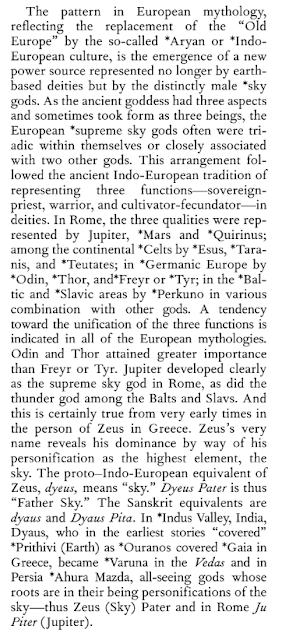.png)
Dunlap (1858) said that "Jove, Pluto, and Neptune, are parts or sons of Saturn. For the Sun is both water-god and god of the two regions heaven and hell," (p. 281). In other words, Saturn is the sun god represented in three different forms: water god (Neptune), heaven god (Jove), and hell god (Pluto). Jove is Jupiter-Zeus (Encyclopaedia Britannica, Jupiter). Eilenstein (2018) said that there were two different versions of Dyaus: Zeus (Dagda/Dag-Dyaus/Dag-Dya the "daytime sun god"), and Poseidon (Nuada/Nya-Da the "'Water Dyaus'" and the nighttime or hereafter sun/Hepom Nepots). Nuada/Nua-Dya also had the hippocampus. Eilenstein also stated that this led to the Greek "Zeus (day sun), Poseidon (Zeus in the water underworld), and Hades (Zeus in the earth underworld)," (p. 612 [German]). This supports Dyeus as being Saturn, and that Zeus, Poseidon, and Hades, were just different versions of Cronus! Uranus, Cronus, and Zeus were also three different forms of Zeus.
Zeus' main/Hellenistic wife, Hera, was probably also his grandmother Gaea (Gaia), his mother Rhea, and his Dodonaean wife Dione (Scull, 1880, pp. 53, 65, 77, 91-93, 97, and 363). This makes sense since Zeus was also Uranus, and Cronus. Hera was also the "Queen of heaven," (p. 93).
Jesus was also depicted as Zeus in artwork. According to Cook (1914), on "The famous sarcophagus of Iunius Bassus, a prefect of Rome who died in 359 A.D., the god Caelus is supporting Jesus, Peter, and Paul (Vol. 1 pp. 60-61; Figure 36). This relief is based off of Roman iconography showing Caelus supporting Jupiter, and the other Roman gods (pp. 60-61; Figure 35):
This means that Jesus was his own father. Jesus said that if anyone has seen him, then they saw the Father (John 14:7-11). This confirms that Jesus is Zeus.
4.) Poseidon:
Poseidon statue (2nd century, B.C.) from the National Archeological Museum in Athens, Greece (Encyclopaedia Britannica, Poseidon):
Poseidon is the Greek "god of the sea (and of water generally), earthquakes, and horses." He "was a brother of Zeus, the sky god and chief deity of ancient Greece, and Hades, god of the underworld," (Encyclopaedia Britannica, Poseidon, para. 1). Taylor (2022) said that Poseidon "is thought to have originated from an Indo-European deity named Potei-Dan, which translates as 'lord or husband god.'" Potei-Dan "was a sky father deity," and had a "forked lightning bolt." He and Demeter were worshipped by the Mycenaean Greeks around 1400 B.C., or earlier (in Mankey and Taylor, 2022, Poseidon). Poseidon can also be equated to Dyaus Pitar/Zeus through his wife: Demeter, who is also called Dyava Matar. Her name means "Dawn" in Sanskrit (The Christian Remembrancer, Volume 56 p. 169 Article 8). Poseidon was called Neptune in the Roman pantheon (Encyclopaedia Britannica, Poseidon, para. 5).
Poseidon was also Saturn. Vida (1944) said that El (Enlil) was called the "Lord of the Earth," and was Kronos and Poseidon (pp. 4-7). According to Smith (1876), Hea (Ea) is Saturn-Cronus and Poseidon. Hea is the "god of the lower region," and "is lord of the sea or abyss" (p. 57). Hea was also equated to the planet Saturn (Smith, 1884, p. 216). Poseidon was originally the "god of the depths of earth, whence the sea originates" (Vida, 1944, p. 6 note 25). Ea-Enki is the "lord of the earth," and the "god of water" or "fresh waters beneath the earth" (Encyclopaedia Britannica, Ea). Kramer (1963) said that Enki was "the Sumerian Poseidon" (p. 197). Duke (1971) stated that the scholar Leonard Palmer said that Poseidon's name is "a direct translation of 'calque' of the Sumerian EN.KI, 'lord of the earth'," (p. 324 note 28). Burkert (1977 [1985 translation]) said that Poseidon has been called "Husband of Earth," but this is "impossible to prove" (p. 136). However, Burkert said that Poseidon was the god of the sea and earthquakes, and was called the "Earth Shaker" (p. 137). In Tablet 1 of the Enuma Elish, Ea kills the "progenitor" father god Apsu, and lives inside him (Apsu is the "deified underground waters") (Horowitz, 1998, pp. 109-111). This coincides with Ea-Enki being the "Lord of Apsu/Abzu" (Encyclopaedia Britannica, Ea, para. 2). This would make Cronus and Poseidon the same god.
Poseidon and Zeus were originally the same deity as well. Poseidon seems to have originally been "Potei Dan," the "lord/husband of the earth goddess." Other names for Poseidon are “Potidas,” “Poteidawon,” and “Potei-Dan” (“Lord Zeus”) (Cook, 1925, Vol. 2, pp. 582-585). Another name, "Zenoposeidon," was a combination of a "Zeus of the sea" and a "Zeus of the sky" (p. 663). Dan, later called Potei Dan and then Poseidon, was the god of the first Greeks ("Minyan Greeks") from 2000 BC. Potei Dan meant "Master Dan." The second generation of Greeks, the "Achaean Greeks," worshipped the "Sky-god Zeus." They made Poseidon a lesser version of Zeus because these new Greeks became the new rulers of the land. This was unnecessary because Dan/Potei Dan, also called Dios, was Zeus (Seltman, 1956, p. 33) (Cook, 1914, Vol. 2, p. 846). Chadwick (1976) said that Potei meant "'O Lord'" (p. 86). Taylor (2022) said that, later on, more Indo-Europeans arrived to Greece and made Zeus the dominant deity instead of Potei-Dan, despite the two deities being the same individual. Zeus then became the husband of Demeter, and took the lightning bolt. Poseidon's "forked lightning bolt became a trident, which is a tool commonly used by fishers." The reason why Poseidon and Zeus were separated was because "the name got scrambled with the evolution of language," (in Mankey and Taylor, 2022, Poseidon). Thus, Cronus, Poseidon, and Zeus, were the same god.
Poseidon was also the chief deity of the Mycenaean Greeks. They called Poseidon "the Heavenly King." In the Sumerian pantheon, he was called "Lord of the Earth (that's Enki!)," and the Hittites called him the "Earth-King." The Mycenaeans, and Minoans ("Minyans"), basically had the same religion. The Mycenaeans seem to have borrowed their religion from the Minoans (Castleden, 2005, pp. 141-143). Poseidon seems to have reigned next to a goddess (in several different forms), or two goddesses. The great goddess might've been served under the names Eileithyia, Artemis, Demeter, and Athena. The "Minoan Great Goddess" was probably made up of Artemis ("Mistress of Animals"), Demeter ("Goddess of Vegetation"), and Athena ("Household Goddess") (pp. 142-143). The Mycenaeans probably worshipped two goddesses, along with Poseidon. These goddesses seem to be "Hera and Athene (Athena)." This is based on an ivory carving from "the temple-palace at Mycenae," which was "carved before 1300 BC" (p. 144). Poseidon was called wanax (possibly meaning "king or a god"), and the Mycenaean goddesses were called wanassa ("queen or a goddess") (pp. 143-144). Colavito (2014) said that Poseidon was married to Hera and Athena in the Mycenaean religion before. Later on, Hera became Zeus' wife and Athena became his daughter (p. 43).
Poseidon's trident represented lightning (Cook, 1925, Vol. 2, p. 850). The Hindu god Siva (Shiva) also had a trident (Franklin, 1784; in Franklin, 1788, p. 251).
Funnily enough, Poseidon was given Zeus' name by both the Greeks, and the Romans. For example, Poseidon was equated to Zeus under the names Zenoposeidon (Cook, 1925, Vol. 2 p. 663) (Smith, 1906, p. 29) (Grant, 1986, p. 412), and "Zeus Osogo/Osogollis." In fact, the two names were equated as "Zeus Osogollis Zenoposeidon,"(Unwin, 2017, p. 140) (Parker, 2017, p. 94) (Grant, 1986, p. 412). This deity was represented by the crab, eagle, trident, and double axe (Grant, 1986, p. 412) (Parker, 2017, p. 94). The eagle and double axe were the symbols of Zeus, while the trident and crab were symbols of Poseidon (Parker, 2017, p. 94). Coins of Zeus Osogollis depict him with the trident, and the eagle (Williamson, 2021, Figure 3.15C-E). A third name given to Poseidon was Zeus Karios, who was also Baal Saphon-Hadad (Adad), El (Enlil), and Ea (Rodan, 2019, pp. 85-86) (Teixidor, 1977, pp. 42-45) (Barre, 1983, pp. 81-82). In Rome, Neptune was called Jupiter Marinus (Franklin, 1784; in Franklin, 1788, Vol. 7 pp. 250-251) (Hamilton, 1820, p. 385). Jupiter Marinus was equated to Jupiter the destroyer, Thor, Typho (Typhon), Taranis, Mahadeva, and Siva (Shiva). His wife is Nephta, who is equated to Freya-Fraea, and Venus-Venus Marina. Neptha is the sister of Isis (Hamilton, 1820, pp. 385, 387-388) (Jones, 1798; in Memoirs of Science and the Arts, 1798, p. 24). Another name for Neptune was Jupiter Secundus (Johnson, 1800, p. 253) (Thomas, 1837, p. 163). It's interesting to see that Poseidon was both Ea, Enlil, and Adad, at the same time. Not only that, he was equated to Zeus pater/Jupiter multiple times.
3rd-century B.C. Malaysian tetradrachim coin depicting Zeus Osogollis with the trident and eagle (Williamson, 2021, Figure 3.15E):
Another aspect of Poseidon that equated him to Adad was that he did Adad's smiting pose. Multiple coins that depict Poseidon showcase him standing with his trident in his right hand, while his left hand is extended forward (Lopez, 2019; in Morais et al., 2019, pp. 265-267, 269-271).
Macedonian coin of Poseidon (294-293 B.C.) (
Lopez, 2019; in Morais et al., 2019, p. 267 Figure 3):Notice the Adad smiting pose of Poseidon on the right drawing of the coin.
Baal statue (AO 11598) (Louvre Collections, Figurine: AO 11598):
It should also be stated that Adad had the three-pronged trident.
Adad with the trident (Amzallag, 2023, p. 54 Figure 1.140):
Poseidon, as Baal Tsephon (Saphon-Adad), was credited with defeating Typhon with a thunderbolt (Hewitt, 1907, Vol. 1 pp. 193-194). This is interesting because Zeus is credited with defeating Typhon in the Greek religion (
Encyclopaedia Britannica, Typhon).
According to the translator's notes of the Taylor (1824) translation of the works of the ancient writer Pausanias, Pausanias said that Neptune is the "marine Jupiter" and Pluto is the "terrestrial Jupiter." Neptune is called the marine Jupiter "in the Orphic hymn to Equity," (
The Description of Greece [Taylor, 1824 translation], Vol. 3 pp. 254-255). In the Orphic hymn number LXIII (63), titled "To Equity," there is a "marine Jove" listed in the hymn (
The Mystical Hymns of Orpheus [Taylor, 1896 edition], p. 126):
Poseidon, and Zeus, are the same person.
Interestingly, Poseidon was the god of oracles. The first oracle at Delphi belonged to him. Apollo's oracle at Delphi came later (Colavito, 2014, p. 43).
Poseidon is the Archangel Asariel. However, Poseidon is also the Archangel Sachiel (Jupiter). Both Asariel and Sachiel have Thursday for their special day (
Archangels and Angels, Archangel Asariel-Angelic and Planetary Correspondences) (
Archangels and Angels, Archangel Sachiel-Angelic and Planetary Correspondences). Thus, Poseidon and Zeus, as well as the Archangels Asariel and Sachiel, were the same person.
Links:
Encyclopaedia Britannica. Poseidon:
https://www.britannica.com/topic/Poseidon
Taylor (2022; in Mankey and Taylor, 2022) (Poseidon):
https://books.google.com/books?id=tGWYEAAAQBAJ&pg=PT95&dq=Potei-Dan+god&hl=en&newbks=1&newbks_redir=0&source=gb_mobile_search&ovdme=1&sa=X&ved=2ahUKEwi4gYzh1uCCAxUxGVkFHRAfCa8Q6AF6BAgGEAM#v=onepage&q=Potei-Dan%20god&f=false
The Christian Remembrancer. Volume 56. Article 8:
https://books.google.com/books?id=lr0RAAAAYAAJ&pg=PA169&dq=Poseidon+sun+rising+out+of+the+ocean&hl=en&newbks=1&newbks_redir=0&source=gb_mobile_search&ovdme=1&sa=X&ved=2ahUKEwiMicmwndeEAxVfF1kFHayGAkcQ6AF6BAgLEAM#v=onepage&q=Poseidon%20sun%20rising%20out%20of%20the%20ocean&f=false
Vida (1944):
https://fdocuments.us/document/el-elyon-in-genesis-1418-20.html?page=1
-V2:
https://scholarlypublishingcollective.org/sblpress/jbl/article/63/1/1/190491
-V3:
https://www.jstor.org/stable/3262503
Smith (1876):
https://www.google.com/books/edition/The_Chaldean_Account_of_Genesis/wqHj8AWy9C0C?hl=en
Smith (1884) (P. 148):
https://books.google.com/books?id=us3Y7a9AhOYC&pg=PA155-IA3&dq=el+elu+deity&hl=en&newbks=1&newbks_redir=0&source=gb_mobile_search&ovdme=1&sa=X&ved=2ahUKEwj9q66_0J-CAxVSFlkFHaBfAesQ6AF6BAgFEAM#v=onepage&q=el%20elu%20deity&f=false
Encyclopaedia Britannica. Ea:
https://www.britannica.com/topic/Ea
Kramer (1963) (P. 197):
https://books.google.com/books?id=iY9xp4pLp88C&printsec=frontcover&dq=potei+dan+indoeuropean+god%C2%A0&hl=en&newbks=1&newbks_redir=0&source=gb_mobile_search&ovdme=1&sa=X&ved=2ahUKEwj8t73Rv_GCAxXXv4kEHS0PAQ4Q6AF6BAgIEAM#v=onepage&q=Poseidon&f=false
Burkert (1977 [1985 translation]) (PP. 136-137):
https://archive.org/details/greekreligion0000burk/page/136/mode/1up?view=theater
-V2:
https://books.google.com/books?id=sxurBtx6shoC&pg=PA136&dq=poteidan+sky+god&hl=en&newbks=1&newbks_redir=0&source=gb_mobile_search&ovdme=1&sa=X&ved=2ahUKEwi5rrSq3eCCAxWiMVkFHaCVB2sQ6AF6BAgOEAM#v=onepage&q=poteidan%20sky%20god&f=false
Seltman (1956) (P. 33):
https://archive.org/details/twelveolympianst0000char/page/33/mode/1up?q=Potei+Dan
Chadwick (1976):
https://books.google.com/books?id=RMj7M_tGaNMC&printsec=frontcover&dq=mycenaean+poseidon&hl=en&newbks=1&newbks_redir=0&source=gb_mobile_search&ovdme=1&sa=X&ved=2ahUKEwjp-Nil1rOFAxXYMVkFHbTaAG0Q6AF6BAgJEAM#v=onepage&q=mycenaean%20poseidon&f=false
Castleden (2005):
https://books.google.com/books?id=pLR-AgAAQBAJ&printsec=frontcover&dq=dyeus+pater+proto-indo+european+religion&hl=en&newbks=1&newbks_redir=0&source=gb_mobile_search&ovdme=1&sa=X&ved=2ahUKEwjek7W4zLOFAxWgMVkFHYLjD3c4ChDoAXoECAUQAw#v=onepage&q&f=false
Franklin (1784; in Franklin, 1788, Vol. 7):
https://books.google.com/books?id=AyhFAAAAcAAJ&printsec=frontcover&dq=Asiatic+researches+Vol.+1&hl=en&newbks=1&newbks_redir=0&source=gb_mobile_search&ovdme=1&sa=X&ved=2ahUKEwj7o4bL1a2CAxV2L1kFHcRHAiEQ6AF6BAgFEAM#v=onepage&q=Saturn&f=false
-V2:
https://books.google.com/books?id=dbaoEAAAQBAJ&pg=PA250&dq=jupiter+marinus&hl=en&newbks=1&newbks_redir=0&source=gb_mobile_search&ovdme=1&sa=X&ved=2ahUKEwjJ4-D2hauHAxXFFVkFHY_WDCoQ6AF6BAgFEAM#v=onepage&q=jupiter%20marinus&f=false
Hamilton (1820) (PP. 385, 387-388):
https://books.google.com/books?id=T0K_2ZGL9n0C&pg=PA388&dq=jupiter+marinus&hl=en&newbks=1&newbks_redir=0&source=gb_mobile_search&ovdme=1&sa=X&ved=2ahUKEwjr5q2Mg6uHAxUyFVkFHVxBCC0Q6AF6BAgNEAM#v=onepage&q=jupiter%20marinus&f=false
Jones (1798; in Memoirs of Science and the Arts, 1798) (P. 24):
https://books.google.com/books?id=kCZZAAAAcAAJ&pg=RA2-PA24&dq=jupiter+marinus&hl=en&newbks=1&newbks_redir=0&source=gb_mobile_search&ovdme=1&sa=X&ved=2ahUKEwiOtbuLhauHAxXzMVkFHSAlAi0Q6AF6BAgHEAM#v=onepage&q=jupiter%20marinus&f=false
-V2:
https://archive.org/details/b28749856/page/n5/mode/2up
Archangels and Angels. Archangel Asariel-Angelic and Planetary Correspondences:
http://www.archangels-and-angels.com/aa_pages/correspondences/angel_planet/archangel_asariel.html
Thomas (1837) (P. 163):
5.) Hades:
Sarapis-Hades (right), Cerberus (middle), and Isis-Persephone (left) (180-190 A.D.) (
Heraklion Museum):
%20(Heraklion%20Museum).jpg)
As mentioned before, Zeus was called Dan, Tan, and Zan. The name Zan, also called Zagreus (Elderkin, 1961, p. 62), is linked to "Mount Zagros or Zagron," located near Assyria and Media. The name reached Crete, then Argos, and finally to the rest of Greece (Cook, 1914, Vol. 1 p. 651). Zagreus' name "traveled to Crete via Phoenicia," (Guthrie, 1952 [1993 edition], p. 113). In the Idaean-Cretan religion, he was called Zeus redivivus or Zagreus. This Zeus was killed by a boar, and buried "on Mount Juktas," (Cook, 1914, Vol. 1 pp. 645-646, and 651). In Crete, this Zeus was called Zeus Chthonios, who represented "the great god who lived in the earth." This god, and other earth gods, were "worshipped before ever the gods of Homer" which lived on Olympus. Later on Zan, the Cretan Zeus, was Hellenized into Zagreus (Guthrie, 1952 [1993 edition], pp. 112-113) (Elderkin, 1961, p. 62). Under the "Orphic influence," Zagreus was Iachus, Dionysus, and "Hades or Zeus Chthonios," (Legge, 1915, Vol. 1 p. 130).
Pluto is the Roman name of the Greek god Hades (Encyclopaedia Britannica, Hades). Hades was also called Zeus Katachthonios (Brown, 1898, p. 120) (Gimbutas, 2023; in Larson et al., 2023, p. 117), and both of them were symbolized by the oak tree. This means that Zeus "lives not only above the ground but also in the ground" (Gimbutas, 2023, p. 117; in Larson et al., 2023). Baal, and Saturn, were also represented by the oak tree. The oak tree might've been a symbol of Bacchus as well (Loudon, 1838, p. 1752). Hades-Zeus Katachthonios was also called Zeus Chthonios, and Zeus Plousios (Stornoway, 2019, p. 196) (Legge, 1915, Vol. 1 p. 130). Hades was also called Dis, or Dis Pater (Coulter and Turner, 2000 [2020 edition], pp. 153 and 201) (Daly and Rengel, 2009, p. 145). Another spelling of the name seems to be Dies or Dies-piter. Dies was "lengthened from Dis" (White, 1871 [2022 edition], p. 57). Both Pluto-Dis and Jupiter were called Diespiter (White, 1871 [2022 edition], p. 57) (Hampson, 1841, p. 54 note 2), who is also dius pater (Jupiter Infernus). Deus, dies, and dis, are all the same word (Hampson, 1841, p. 54 note 2). Gale (1672) said that "Saturne, Jupiter, Dis, Dies pater, Jao, Apollo, and Bacchus," were the sun (p. 99). Pluto was also called Jupiter Infernus (Donaldson, 1860, p. 173) (Johnson, 1800, p. 253) (Thomas, 1837, p. 163).
Hades (Zan) was the older version of Zeus, along with Poseidon (Dan). To cement Poseidon, Hades, and Zeus, as being the same individual, we must look at the artifact called "the Capitoline triad." It depicts "Iupiter" (Jupiter) with "a thunderbolt and a trident in his left hand, and a two-pronged fork in his right, while a dolphin appears at his side." The thunderbolt means Jupiter is a "sky-god," the trident and the dolphin make him a "sea-god," and the two-pronged fork makes him an "earth-god." An inscription on the triad reads as "IOVE-IVTOR, 'to Iupiter the Helper'," (Cook, 1925, Vol. 2, pp. 803-804; Figure 770). The dolphin was a symbol of Poseidon (p. 795). The two-prong trident is also stated to be the symbol of Hades. Cook (1925) said that one coin said to have depicted "Plouton, fork in hand, carrying off Persephone upon a four-horse chariot," is actually Poseidon and Aithra (Vol. 2 pp. 800-801; p. 802 Figure 769). However, Sibley (2009) said that the coin was depicting "Hades with a long-handled fork (bident)." The bident was "a two-pronged (bident) variant of the trident," and Hades-Pluton-Pluto carried it "in his agricultural aspect," (pp. 91-92; p. 92 Figure 9.8).
Hades on a coin holding a two-pronged trident, according to Sibley (2009) (P. 92 Figure 9.8):
Besides, Hades/Zeus Chthonios was the earth god. Therefore, the two-pronged trident would symbolize Hades after all. This means that Zeus had the thunderbolt, bident, and trident.
Jupiter the Helper (Cook, 1925, Vol. 2, p. 804 Figure 770):
Interestingly, this would mean that Iupiter/Jupiter would've been spelled as "IoueIutor" or "Ioue Iutor." This proves that Jove was spelled as "Ioue," officially linking Dyeus to Ea/Ieue.
Dunlap (1858) said that Saturn is the winter sun (p. 110). Massey (1883) said that Aides (Hades) was the winter sun, while Zeus is the spring sun. This was declared "by the oracle of the God Iao in the Temple of Klaros," (Vol. 1 p. 417). This means that Hades was Cronus! Since Hades was Zeus, this is just another example of Cronus and Zeus being the same god.
According to the translator's notes of the Taylor (1824) translation of the works of the ancient writer Pausanias, Pausanias said that Neptune is the "marine Jupiter" and Pluto is the "terrestrial Jupiter." Neptune is called the marine Jupiter "in the Orphic hymn to Equity," (
The Description of Greece [Taylor, 1824 translation], Vol. 3 pp. 254-255). In the Orphic hymn number XVIII (18), titled "To Pluto," Pluto is indeed called "Terrestrial Jove" in the hymn (
The Mystical Hymns of Orpheus [Taylor, 1896 edition], p. 52):
Zeus was the ruler of the sky, land and water, and the underworld.
Links:
Heraklion Museum. Isis-Persephone and Sarapis-Hades. 180-190 A.D.:
https://heraklionmuseum.gr/en/exhibit/isis-persephone-and-sarapis-hades/
-Pic:
https://images.app.goo.gl/bHsBVti1LxA3jnzN8
Elderkin (1961) (P. 62):
https://books.google.com/books?newbks=1&newbks_redir=0&id=G0ARAQAAIAAJ&dq=Zan+Zagreus&focus=searchwithinvolume&q=Zan+
Cook (1914):
-Vol. 1:
https://books.google.com/books/about/Zeus.html?id=9e9gpRpZWCYC&printsec=frontcover&newbks=1&newbks_redir=0&source=gb_mobile_entity&hl=en&gl=US&ovdme=1#v=onepage&q&f=false
-Vol. 2 (1925):
https://books.google.com/books?id=xXzQAAAAMAAJ&newbks=1&newbks_redir=0&printsec=frontcover#v=onepage&q=chthonios&f=false
Encyclopaedia Britannica. Hades:
https://www.britannica.com/topic/Hades-Greek-mythology
6.) Ares:
Mars/Ares Ultor (26-14 B.C.) from the Cleveland Museum of Art (Encyclopaedia Britannica, Ares):
The god associated with the planet Mars is Ares, the notorious war god/spirit of the Greek and Roman pantheons. He is also a son of Zeus. Interestingly, Ares was associated with human sacrifice as well in the "early times, at least," of Sparta (
Encyclopaedia Britannica, Ares, para. 1-2). In the Germanic religion, Ares/Mars is called Tyr (
Encyclopaedia Britannica, Tyr). Tyr is also Dyeus/Dyaus (Winn, 1995, pp. 81-82) (Jordan, 2004 [2014 edition], p. 83). This would make Ares and Zeus the same deity. The Middle Eastern gods Ea and Nergal were also Mars, as stated previously. Ares-Mars was also called Dies Martis, while Zeus was (seemingly) called Dies Jovis (Clare, 1910, p. 196). Not only was Ares another form of Zeus, but he's explicitly equated to Zeus Chthonios/Hades. The Archangel Samael (Mars) and Azrael (Pluto) have Tuesday as their special day (
Archangels and Angels, Archangel Samael-Angelic and Planetary Correspondences) (
Archangels and Angels, Archangel Azrael-Angelic and Planetary Correspondences), and have Scorpio as their geomantic symbol (
Archangels and Angels, Archangel Samael-Angelic and Planetary Symbols) (
Archangels and Angels, Archangel Azrael-Angelic and Planetary Symbols).
.%20Photo%20by%20Jastrow%20(2006)%20(Wikipedia).jpg)
Hephaestus' origin seems to go back to Crete.
According to Hall (1914 [1915 edition]), there was a god named Velchanos in Crete. His mother was the goddess Rhea, and she raised him on Mount
Ida. Velchanos seems to have been "the only male Cretan deity." After "the Cretans came to the North, Zeus was the god who corresponded best to their Velchanos; when the Achaians and Dorians came to Crete, Velchanos alone represented the male godhead, and could be identified with Zeus." The Kouretes of the young Velchanos became Zeus' Kouretes. Velchanos is said to have diied, according to the Cretans. This was to the dismay of the "Northern Greeks" because "Hellenic gods did not die," (pp. 147-148). Philips (2014) said that "scholars are inclined to think that Volcanus or Velchanos is an eastern deity [...] and perhaps having a common origin with Hephaestus." The "word 'volcano'" also comes from this god (in Miller, 2014, p. 78).
Earlier sources also stated that Velchanos and Hephaestus were the same god. Bayley (1920) said that Velchanos was a "Candian or Cretan" deity. The "connection between Hephaestus and Velchanos is clearly indicated by the inscribed figure of Velchanos which appears upon the coins of the Candian town of Phaestus." The falcon seems to be the sign of the god's followers called, "the Volcae" (P. 426). Birdwood (1899) said that the coins from Phaestus dated back to "B.C. 400-300." Birdwood also stated that "Velchanos (cf. Vulcan)" was "the local (Semitic) Zeus," (in The Athenaeum Journal of Literature, Science, the Fine Arts, Music, and the Drama, 1899, p. 526). Hus (1962) said that the god "Velchans (Latin Vulcan)" was reminiscent "of Zeus Velchanos." (p. 92). Hus later states that Volcanus was Vulcan, Velchanos, and Hephaestus. Despite being a fire god, Vulcan was also a water god "connected with the nymphs," (p. 113). Hephaestus and Zeus were the same person.
There is more evidence that equates Hephaesus to Zeus. The Egyptian god Ptah was a "creator-god and maker of things, a patron of craftsman, especially sculptors," and "a mortuary god" that was represented as a mummy. He was equated to Hephaestus/Vulcan, and he was equated to Seker/Soker and Osiris "to form Ptah-Seker-Osiris." Ptah also had a bull called Apis, which "was called a manifestation of the god who gave oracles," (Encyclopaedia Britannica, Ptah). Ptah was equated to Kothar wa-Hasis, Hephaestus/Vulcan/Chrysor/Zeus Michius or Diamichius, and Enki/Ea. Jones (2009) said that, although Ea and El have similar abodes and attributes, Ea is equated to Kothar wa-Hasis on "Syrian and Canaanite pantheon lists" (p. 84; note 248). We can see this in Tugendhaft (2016). Ea, whose name is spelled as "Aya" and "Eyan," is equated to "Kotaru" (Kothar) on "The trilingual WGL" list "from Ugarit" (in Grafton and Most, 2016) (p. 173; p. 175 Table 8.1; p. 180). Kothar, or Kothar-wa-Hasis, was the "ancient West Semitic god of crafts, equivalent of the Greek god Hephaestus." He was also equated to Ptah
(Encyclopaedia Britannica, Kothar). Sanchoniatho said that Hephaestus/Vulcan, also called Chrysor, was Zeus Michius. Zeus Michius was also spelled as Diamichius (Sanchoniatho, Phoenician History [Rev. Cumberland, 1720, translation], p. 26). Mushet (1837) said that "Sol (or Helios), Saturn, Jupiter (surnamed Ammon) , and Vulcan, were all one; being titles of the chief deity,-the sun," (pp. 235-236). Smith (2020) said that Kothar and El could be "differentiations of the wise god, Ea/Enki, and possibly as divine instantiations of their very names." The same could be said for "Baal, Yamm, and Mot, as well as Shapshu and Yarih," (in Ferrara and Huffmon, 2020, p. 49 note 115).
Aside from being called Zeus' son, Hephaestus was Zeus himself.
Links:
Vulcan by Guillaume Coustou the Younger (1742). Photo by Jastrow (2006) (
Wikipedia):
https://en.wikipedia.org/wiki/Hephaestus#/media/File:Vulcan_Coustou_Louvre_MR1814.jpg
Bacchus Richelieu (100/150 A.D.) (
Louvre Collections, statue [Bacchus Richelieu]):
Dionysus, also called Bacchus, Liber Pater, Taurokeros, and Tauroprosopos, was the Greek and Roman "nature god of fruitfulness and vegetation, especially known as a god of wine and esctasy." As Bacchus, he was called the "thunderer," and is associated with bull imagery ("bull-horned" and "bull-faced"). His worship goes all the way back to the "Mycenaean period," which was in the 13th century B.C. Dionysus had different versions of his birth story, but his "birth by Semele, which is comparable to the circumstances surrounding Christ, Adonis, Moses, Perseus, and Llew Llaw," seems to point to Jesus being equated to Dionysus. In what seems to be the original story of Dionysus' birth, Zeus had sex with the human Semele. Long story short, Semele died after Hera told her to witness Zeus' glory. Zeus put the baby Dionysus in his "thigh and keeping him there until he reached maturity, so that he was twice born," (Encyclopaedia Britannica, Dionysus, para. 1-2, and 4). Shaw (2024) gives a deeper description of Dionysus' birth, and resurrection. In the Orphic tradition, Zeus impregnates Persephone (his own daughter!), and she gives birth to Zagreus. Hera and the Titans conspire to kill Zagreus. Hera lures the child out, and the Titans kill Zagreus. He is torn into seven pieces, and eaten. Only his heart and limbs survive. Finding out about this horrific event, Zeus sends Athena to retrieve Zagreus' heart and Apollo to retrieve the limbs. Zeus killed the Titans, and then fell in love with the human Semele. Zeus put Zagreus' heart into Semele's womb. Here found out about the affair, and told Semele to look at Zeus' glory. Semele died, but Zeus took her child and put him in his thigh. The child was born from Zeus' thigh as Dionysus (Ch. 11. Theurgic and Tantric Deification: Dionysus and Shiva [pp. 3-4]).
Bacchus' name was also spelled as "Iacchos-Iaho-and Sabaoth" (Blavatsky, 1891, Vol. 2 p. 518). There's Ia/Ya/Ea again! In fact, Dunlap and Blavatsky said that Hea/Iah/Ea, and Iah/Jehovah (Ie/Ieue), were Iacchus-Dionysus (Dunlap, 1894 [1898 edition], p. 253 note 7) (Blavatsky, 1891, Vol. 2 p. 302). Rogers (1884) said that Hea/Ea, Jehovah (Ieue), and Iacchos-Iao, had the same root word in their names, meaning "'to live'," (p. 347). As we already know, Ea's name on the Karatepe inscription was spelled as Ia. Espak (2006) also suggested that Ea's name means "'to live,'" (2.2.2 [pp. 35-36]). Thus, Dionysus was Ea!
In the Greek Orphic religion, Dionysus was both the father, and son, of the gods. The list of the gods were: "Phanes, Night, Ouranos, Kronos, Zeus, and Dionysus." Phanes was also called Erikepaios. Dionysus was "Phanes-Erikepaios, the god who brings existence to light." Dionysus was also called "Protogonos, the first born of the gods." Dionysus had a "'Threefold'" nature. According to Proclus, Dionysus was the "king of the gods who ensoul the universe." Dionysus' heart was the "indivisible Nous," and his severed body represented the seven "planetary gods of the World soul," (Shaw, 2024, Ch. 11. Theurgic and Tantric Deification: Dionysus and Shiva [pp. 3-4]). This sounds like God the Father, and Jesus Christ, being the same individual (John 14:7-11). According to Dunlap (1858), "Ak (Iacch-os)" had three different forms like Saturn: "sun-god (Ag-uieus), hell-god (Eacus), and Water (Aqua)," (p. 281). Eacus looks a lot like Ea, doesn't it?
In 63 AD, the Romans invaded the (second) Jewish temple in Jerusalem (Livius, Roman-Jewish Wars, Pompey's Siege of Jerusalem, para. 3-6), and said that they saw either "an ass under a golden vine" (Flood, 2021, p. 83 notes 118 and 120), or "the heavens under a golden vine" (Flood, 2021, p. 83 notes 118 and 120) (University of Chicago, Florus, The Epitome of Roman History, Book 1: The Mithridatic War, Ch. 40, Section 3.5.30; note 4). The donkey was basically the animal of Dionysus in Greece (Merrifield, 2008, p. 120) (Mitchell, 2018, p. 145). Iach (Ieue), the Arabian Iauk, Dionysus, and seemingly Ahura Mazda, were represented by the horse of heaven/the sun (Blavatsky, 1891, Vol. 2 p. 302). Vine gods include Osiris (before becoming a god of the dead), and Dionysus. Osiris was Hades, and Dionysus, as well (Unwin, 1996, p. 79). Drozdek (2007) said that both Dionysus and Hades were the same god, and shared the "Dionysiac festivals." (pp. 39-40). In the commentary to Sanchoniatho's book, and as stated by Rev. Taylor, it has been stated that Bacchus and Osiris were the same deity (Phoenician History [Rev. Cumberland, 1720 translation], p. 78) (Rev. Taylor, 1833, p. 340). Ausonius, who seems to have been channeling Dionysus (maybe as a prophet), quotes the deity saying that he was Bacchus, Osiris, Phanax, Dionysus, Liber, and Adonis. Blavatsky said that Dionysus was also Adoni (Adonay), and Iah-Jehovah (Blavatsky, 1891, Vol. 2 p. 302). As stated before, Zan/Zagreus was both Hades-Zeus Chthonios, and Dionysus. Zagreus was also equated to Uranus in the Alkmeonis poem. Uranus, Zeus, Hades, and Dionysus, were all the same god: Zan/Zagreus.
Cook (1914) said that the winged wheel is associated with Dionysus (Vol. 1, pp. 216). Acharya S (2004) said that Yahweh (Ieue), Osiris, Dionysus, Saturn-Cronus, and Sabazios/Sabaoth/Sabbat, were all the same deity, and the Judean coin cements Yahweh as being Dionysus (p. 121). Rev. Taylor (1833) said that a "verse cited by Macrobius" said that Jupiter, Pluto, the Sun, and Dionysus, are all one god (p. 340). Macrobius is also stated as saying that Sebadius is the sun, which was also called Solis Liber (Kavanagh, 1871, Vol. 1, p. 20). Dionysus was also spelled as Dyanysos. Dionysus was also Osiris, "Sabazius the Thracian corn god," and most interestingly, Laphystios (Coulter and Turner, 2000 [2021 edition], p. 152). Dyanysos looks like Dyaus. As stated earlier, Cronus was called Zeus Laphystios. Dionysus and Cronus were the same god! This makes sense, since both Hades and Saturn were the winter sun. In the Orphic hymn "To Sabazios," Zeus is equated to Sabazios. Sabazios, the "son of Kronos," "sewed" the "Bacchic Dionysos" into his thigh (The Orphic Hymns [Athanassakis and Wolkow, 2013 translation], p. 40 number 48). Zeus did this (Encyclopaedia Britannica, Dionysus, para. 2). Faber (1816) said that "Jupiter and Bacchus were the same person," and Jupiter was both "Sabazius as well as Bacchus," (Vol. 2 p. 292). The god Zeus Dios was like Dionysus in personality, and was represented by grapes and the plough (Cook, 1914, Vol. 2 p. 281). In fact, Zeus and Dionysus are synchronized under the name Zeus Dionysus (p. 282). Both Dionysus, and Zeus, are Sabazius. In fact, Cook (1914) said that "Dionysos or Zagreus was in some sense Zeus reborn," (Vol. 1 p. 647).
Since Osiris and Hades were both Dionysus, this would make Hades and Dionysus the Archangel Azrael (Archangels and Angels, Archangel Azrael-Angelic and Planetary Correspondences).
Dionysus on a winged wheel (Cook, 1914, Vol. 1, p. 216, Figure 159):
4th-century B.C. Philistia-Gaza coin probably featuring Ieu (Ea) on a winged wheel:
As we've already stated, Dionysus' birth narrative is similar to Jesus'. There are more connections between Jesus and Dionysus though. Jesus quotes Dionysus in the Acts of the Apostles. In Acts 26:14, the risen Jesus appears to Saul (soon to be called Paul) on the road to Damascus. Jesus says, "It is hard for thee to kick against the pricks" (KJV) (YLT). This phrase came originally from Dionysus: "Better to yield in prayer and sacrifice than to kick against the pricks, since Dionyse is god, and thou but a mortal," (Eurypides, The Bacchae, p. 46). It doesn't get any better from there! In Acts of the Apostles, Paul says a quote straight out of Aratus of Soli's The Phainomena. Paul said that the "poets" of Athens spoke about his god, in which "'We are all his offspring'" (Acts 17:22 and 28 [NIV] [KJB] [YLT]). Aratus in his poem said about Zeus, "We are his offspring" (The Phainomena, R. Brown translation, p. 13) (Encyclopaedia Britannica, Aratus, para. 2). The NIV translation of Acts 17 even stated that this phrase came straight out of Aratus' poem (Acts 17:28, note c)! So, not only are Ea/Ieue and Dionysus the same individual, but the New Testament is equating Jesus to Dionysus and saying that everybody are the "offspring" of Zeus! I already made a post stating that Jesus Christ is Dionysus ("Was Jesus Christ Real?").
Mercury, with winged hat and staff, classical statue in Uffizi, Florence (
Encyclopaedia Britannica, Mercury):
Hermes/Mercury is a son of Zeus/Jupiter, and was the messenger of the gods (Enyclopaedia Britannica, Hermes, para. 1) (Encyclopaedia Britannica. Mercury, para. 2). As stated previously, Ea was the father of the Middle Eastern Hermes, Nabu. This equates Ea to Zeus/Jupiter. Hermes is represented by the ram, and he-goat (Buckert, 1977 [1985 edition], p. 65). Hermes/Mercury is also Thoth (Encyclopaedia Britannica. Thoth, para. 2) (Boylan, 1922, p. 102 note 1; p. 140) (Archangels and Angels, Archangel Raphael-Angelic and Planetary Correspondences), and the war god Odin (Encyclopaedia Britannica, Odin). According to Harrison et al., (1927), Hermes was an imported deity from outside of the Greek religion, but he was rendered to being just a messenger deity by Homer in the Olympian pantheon. Hermes was "a snake to begin with." He "carried the snake staff," also called the "kerykeion with the twin twisted snakes." This makes Hermes "the very daimon of reincarnation," (pp. 294-295).
Odin is an interesting case. Odin was originally a sky god, who was the "parallel" of Varuna in "the Edda mythology." This would also equate Odin to Anu. Having one eye also establishes Odin as a sky god, since his one eye represents the sun (Bhattacharji, 1970 [2016 edition], p. 24). Creswell (1914) equates Varuna to Odin, and they are both the "Sky deified" (p. 498). Majumdar (1909) equates Odin to Varuna, and they are both "the god of the nether region" (p. 89).
It seems that Odin lost his left eye (Paxson, 2017, p. 228). Odin did this to obtain a "magic spear" (Losch, 2001 [2002 edition], p. 53 note 6). There's a parallel between Odin and Horus. Horus' right eye represents the sun, while his left eye represents the moon. Horus lost his left eye in a battle against Seth (Leviton, 2005, Black Eye of Horus) (Encyclopaedia Britannica, Eye of Horus). Odin's left eye seems to have been the moon. Zeus' eyes have been equated to the sun and moon as well (Palmer, 1999 [in Dorson, 1999], p. 179). Odin has been equated to Kronos as well (Losch, 2001 [2002 edition], p. 53 note 7). Creswell (1914) stated that Odin was the god of the sky, moon, lightning, and the planet Jupiter (p. 498). Varuna's eye was also said to be the sun (Oldenberg, 1988, p. 96) (Beck, 1997, p. 77; in Etzioni and Carney, 1997) (Macdonell, 1995, p. 23). Odin's spear might've represented the thunderbolt. Zeus was sometimes equated with the spear, since his double axe, which represented lightning, turned into the spear later on (Cook, 1914, Vol. 2, pp. 704 and 848). Wodan was seen as equating to Uranos (Uranus) as representing Heaven (Rhyn, 1895, p. 7). Wodan is another name for Odin (Encyclopaedia Britannica, Odin). Coulter and Turner (2000 [2020 edition]) said that "In nearly every aspect, Odin is similar to Jupiter (Roman) and Zeus (Greek)" (p. 358).
To cement Hermes-Odin as being Zeus, we have to look at the position of Odin in the Norse pantheon. The god Buri is Uranus, Bor is Cronus, and Odin is Zeus (Mallory and Adams, 1997, p. 19):
Encyclopaedia Britannica said that Buri was the grandfather of Odin (Encyclopaedia Britannica, Aurgelmir), so this cements Odin and Zeus as being the same deity. Nabu and Ea were also represented by the number 40, adding to the fact that Zeus and Hermes were indeed the same deity.
Along with being Zeus in the Norse pantheon, Zeus was represented by the ram (Cook, 1914, Vol. 1, pp. 346-349, 417), and both Zeus and Dionysus were represented by the goat (Cook, 1914, Vol. 1, pp. 706-707). One of the animals sacrificed to Zeus was the goat, along with the bull and cow (Smith, 1848 [1873 edition], Zeus, para. 2).
Hermes might've been Seth as well. Thoth, another name of Hermes, was a name given to Seth/Set spelled as "Tet." In Phoenicia, he was Taaut/Esmun-Esculapius the snake god. Seth, Thoth/Tet/Taaut, Saturn, and El/Il, were the same deity (Wake, 1870, pp. 211-213). Wake also stated that Hermes had "related deities," who are Sabazius/Bacchus-Dionysos, Priapus, and Khem. They were all sun gods, and symbols of fecundity. The "bull and the goat" were symbols of fecundity, and the sun (p. 213).
Links:
The Pushkin State Museum of Fine Arts. Department of Restoration. Archangel Raphael with Bishop Domonte (Restored) by Bartolome Esteban Murillo (1680):
10.) Prometheus:
Creation of Man by Prometheus (3rd century A.D.) at the Louvre Museum (See, 2014, p. 39 Figure 1-1):
Prometheus was a Greek Titan, but also a god. He was, in particular, "the supreme trickster, and a god of fire." He was also "a master craftsman." Prometheus tricked Zeus "into accepting the bones and fat of sacrifice instead of the meat." As punishment, Zeus "hid fire from the mortals." Prometheus "stole it and returned it to Earth." Zeus, in return, created Pandora and had her unleash calamities upon mankind by opening the "jar that she carried." Zeus is also said to have chained Prometheus to a mountain where an eagle eats his liver (Encyclopaedia Britannica, Prometheus). Interestingly, Vulcan is stated as being the creator of Pandora as well. He made her out of clay (Lang, 2023, Prometheus and Pandora [p. 3]). Then again, Vulcan is Zeus as stated previously, so Zeus did create Pandora anyway.
Prometheus is also credited with creating mankind (Williams College, Creation Myths: Greek Creation Myth). He did this with clay/mud. Athena helped too (Langdon, 1915, p. 31) (See, 2014, p. 39), and this can be seen on the Creation of Man by Prometheus relief from Italy (3rd century A.D./C.E.) (See, 2014, p. 39). Athena gave mankind their souls (Langdon, p. 31) (See, 2014, p. 39).
West (1994) said that Prometheus was Enki/Ea (pp. 129, 141, and 143-144). Hawthorne (1887) said that Prometheus was Zeus (pp. 10-11). Both individuals, along with Apollo, were the "newborn sun" that conquered winter (p. 10). Prometheus and Zeus were also Yao/Iao/Adonis (p. 11). St. Clair (1901) said that "Prometheus is assumed to have moved round with Zeus from spring to autumn," and that Prometheus' "place" was the "autumn equinox," (Vol. 1 pp. 344 and 375). If Prometheus was the autumn equinox, this would equate him to Dionysus.
Links:
Encyclopaedia Britannica. Prometheus:
https://www.britannica.com/topic/Prometheus-Greek-god
Lang (2023) (Prometheus and Pandora [p. 3]):
https://books.google.com/books?id=_MfKEAAAQBAJ&printsec=frontcover&dq=prometheus+creates+man&hl=en&newbks=1&newbks_redir=0&sa=X&ved=2ahUKEwi6wPqZrbmFAxWgP2IAHdHHA24Q6AF6BAgNEAI#v=onepage&q=prometheus%20creates%20man&f=false
Williams College. Creation Myths: Greek Creation Myth:
https://www.cs.williams.edu/~lindsey/myths/myths_16.html
Langdon (1915) (P. 31):
https://books.google.com/books?id=ll01AQAAMAAJ&pg=PA31&dq=prometheus+athena+man+creation&hl=en&newbks=1&newbks_redir=0&sa=X&ved=2ahUKEwjOoLi8sLmFAxXUGlkFHfqlCRIQ6AF6BAgQEAI#v=onepage&q=prometheus%20athena%20man%20creation&f=false
See (2014) (P. 39):
https://books.google.com/books?id=onDwBQAAQBAJ&pg=PA39&dq=prometheus+athena+man+creation&hl=en&newbks=1&newbks_redir=0&sa=X&ved=2ahUKEwiSqZuQsbmFAxX1M1kFHUMfAfA4ChDoAXoECAgQAg#v=onepage&q=prometheus%20athena%20man%20creation&f=false
West, Stephanie. Prometheus Orientalized. 1994. JSTOR. PP. 129, 141, and 143-144:
https://www.jstor.org/stable/24818292
Hawthorne (1887) (PP. 10-11):
https://books.google.com/books?id=8joCDv9XuIkC&pg=PA2&source=kp_read_button&hl=en&newbks=1&newbks_redir=0&gboemv=1#v=onepage&q=Iesous&f=false
St. Clair (1901) (Vol. 1 pp. 344 and 375):
https://books.google.com/books?id=u6XhAAAAMAAJ&pg=PA375&dq=prometheus+zeus+spring+sun&hl=en&newbks=1&newbks_redir=0&sa=X&ved=2ahUKEwik-NfW9d-KAxXNN2IAHXd7HR0Q6AF6BAgHEAI#v=onepage&q=prometheus%20zeus%20spring%20sun&f=false
11.) Apollo-Helios:
Apollo Belvedere (recreation) (130-140 A.D.) (
The Wilcox Classical Museum at the University of Kansas):
Apollo, also called Phoebus, was a son of Zeus/Jupiter and a god "connected with the Sun." In fact, the name "Phoebus means 'bright' or 'pure.'" He seems to have turned into a god of rules and justice "from the time of Homer onward." Of note, "he slew Python, the serpent that guarded" Delphi. Second, "He established his oracle by taking on the guise of a dolphin," (
Encyclopaedia Britannica, Apollo, para. 1 and 3). As noted before, the dolphin was a symbol of Poseidon. Coulter and Turner (2000 [2013 edition]) said that Apollo, or Apollon, might've "originated in Asia and was probably a Hittite god (Hobal)." He was the "God of Light," "God of Prophecy," "medicine, music, the lyre and archery." Apollo was also equated to the god Reshep, a Babylonian god (pp. 62-63). Hobal and Reshep are interesting. Resheph is Nergal (
Encyclopaedia Britannica, Resheph). Hab'al's (Hobal) name originally probably meant "He-B'al (the lord) and later confused with Abel, the son of Adam." Habal's "consorts are Allat and Al-ozzah," (Coulter and Turner, 2000 [2013 edition], p. 200). Allat is Ellat and Ilat (p. 37). Natan (2006) said that Hubal was Jupiter, and Allat is the female version of Allah (Vol. 2 pp. 168-169, and 390). Allat is Asherah! This would make Habal Enlil! Natan (2006) said that Hubal wasn't Allah (Vol. 2 p. 168). However, if Habal was Allat's partner, then he was. Apollo is Enlil, and Nergal. Apollo being a sun god, and a god of laws and justice, seems to equate him to Adad-Shamash-Nusku as well.
Helios on his chariot (300-280 B.C.) (
State Museums of Berlin) (
Encyclopaedia Britannica, Helios):
Date of 300-280 B.C. comes from the University of Cambridge's Museum of Classical Archeology Databases.
Helios was "the sun god, sometimes called a Titan." He is known for driving "a chariot daily from east to west daily across the sky." Helios was later equated to other gods, and one of them was probably Apollo (
Encyclopaedia Britannica, Helios). "Helios (or Sol, or Shamash)," was equated to Yahweh (Ieue) (Novenson, 2020; in Novenson, 2020, p. 46). Zeus has also been equated to Helios, as "Zeus Helios," whose religion was widespread "in the Orient," (Stone, 2001 [2022 edition], Vol. 2 p. 127). This matches Theos Hypsistos being equated to Zeus and Helios, as stated above. Sol is the Roman sun god that was equated to Helios (
Encyclopaedia Britannica, Sol, para. 1). Dunlap (1894) said that El was "Hael (Hel), the Greek Aelios and Helios," (p. 5). He was also Bel/Belitan, "the Old Bel," and was Kronos (Cronus) in Greece and Saturn in Rome. Bel/Belitan "must have originally been the Sun-god of the Semites for, in the priestly doctrines, he was held to be Sol and Saturn also," (pp. 208-209). El was also "Elios, Helios, and Iahoh (Ieue)," (p. 262 note 2). Parsons (1895) said that there was no "H" in front of the name Elios originally in Greek (pp. 88). He also said that El "was an appellation of the Sun-God," (pp. 87 and 127). The gods Iao, Bacchus, and "Elios (Helios)," and the sun, were all equated (p. 127). de Jassy (1908) said that El/Elu was Helios, and Sol (
in Carus, 1908, Vol. 18 pp. 130-131). Helios was Adad-Shamash-Nusku, and Enlil as well. Thompson (2007) said that Helios and Apollo were equated under the names "Helios Apollo" and "Helios Apollo Kisauloddenos" in Smyrna. Apollo became more famous in Smyrna in the "second Christian century (2nd century A.D.)," but he was still equated to Helios "In literary texts outside of Smyrna." To my surprise, Helios was also equated to Pluto (Hades) under the name "Pluto Helios" or "Plouton Helios" (in Aune and Young, 2007, pp. 101-102, 106-108, and p. 110). In the "Indo-Iranian" religion, Helios/Sol was Mithras, the god of light and the sun (Encyclopaedia Britannica, Mithra, para. 1 and 3).
Links:Apollo Belvedere (recreation) (130-140 A.D.) (The Wilcox Classical Museum at the University of Kansas):
https://wilcox.ku.edu/s/wilcox/item/11600
Coulter and Turner (2000 [2013 edition]):
Encyclopaedia Britannica. Resheph:
Novenson (2020; in Novenson, 2020) (P. 46):
Encyclopaedia Britannica. Mithras:
https://www.britannica.com/topic/Mithra
University of Cambridge's Museum of Classical Archeology Databases. Temple of Athena at Ilion, Helios metope:
https://museum.classics.cam.ac.uk/collections/casts/temple-athena-ilion-helios-metope
Part 3: Conclusion:
Dyeus Pater, more widely known as Zeus Pater and Jupiter, was the Saturn of Eurasia. All of the gods can be equated to him. He was also Ea/Ieue, the god of the Bible.
.png)
.png)
.png)
.png)
.png)
%20(Wiki).jpg)
.png)
%20from%20Smyrna%20(original%20from%202nd%20century%20B.C.)%20(Wikipedia).jpg)

%20(Louise,%202017,%20Figure%203).png)
%20(Hopeman,%202013,%20p.%20103%20Figure%2011).jpg)
.png)

%20(EB).png)
.png)
%20(Metropolitan%20Museum%20of%20Art)%20(Marie-Lan%20Nguyen)%20(Wikipedia).jpg)
.png)
.png)
.png)
.png)
.png)
.jpg)
.jpg)
.jpg)
.png)
.png)
%20(Lehti,%202024,%20p.%203)%20.png)
.png)
%20(Cook,%201914,%20Vol.%201,%20p.%20235).png)
.png)
.png)
.png)
.png)
%20(Lopez,%202019;%20in%20Morais%20et%20al.,%202019,%20p.%20267%20Figure%203).png)
.png)
.png)
%20(Heraklion%20Museum).jpg)
.png)
.png)
.png)
%20Ultor%20(26-14%20B.C.)%20(Cleveland%20Museum%20of%20Art)%20(EB).png)
.%20Photo%20by%20Jastrow%20(2006)%20(Wikipedia).jpg)
%20Richelieu%20(100%20or%20150%20A.D.)%20(Louvre%20Museum).jpg)
.png)
.jpg)
.png)
%20(See,%202014,%20p.%2039).png)
.jpg)
%20(State%20Museums%20of%20Berlin)%20(EB).png)


