In the Hindu religion, Dyeus is spelled "Dyaus". He was the primordial sky father, and creator god. He created "the rest of the Vedic pantheon," along with his wife Prthivi. Later on, he was replaced by the god Indra (Jordan, 2004 [2014 edition], pp. 83-84, and 359) (Encyclopaedia Britannica, Zeus, para. 1). Smith (1884) said that D'yaus, Vul/Yav, Il/El, Yao/Iao, and Jahveh, were all related and he became the single god of the Hebrews (p. 148). Another example is the sky god Anu. He was "a personification of the sky," and is equated to Dyaus, Jupiter, and Zeus (Frazer, 1926, pp. 66-67). In fact, Anu's name meant "heaven" (Krul, 2018, p. 10), just like Dyeus' name does. Anu was the Hindu sky god Varuna (Bhattacharji, 1970 [2016 edition], p. 24) (Lyle, 2012, p. 106 figure 9-1), and Varuna was the sky god Ouranos (Uranus) (Griswold, 1910, p. 31). Leeming (2005) said that Dyeus Pater was "The proto-Indo-European equivalent to Zeus," whose name means "Father sky." Dyeus was an equivalent to Ouranus, Varuna, and Ahura Mazda, who were all "personifications of the sky." The name Zeus also means "sky" (p. 128). The shining god is the heavenly/sky god.
The shining god is the sun. In the Papyrus from Derveni, Ouranos is equated to the sun (Rusten, 1985 [in Bailey, 1985, Vol. 89], p. 136). Anu is associated with the "sun's ecliptic," which is "'the way of Anu'," (Farbridge, 1923, p. 200). The sun's ecliptic is tracking the sun as it goes around the celestial sphere (Durham University, Department of Physics, User's Guide to the Night Sky, The Ecliptic: The Sun's Annual Path on the celestial Sphere, para. 1). Other names for Ana (Anu) are Oan/Oannes, Yan, and Hades/Pluto/Plutus/Dis (Rawlinson, 1885, pp. 74-75) (Ridpaph, 1890, p. 133). I thought that the name Oan for Anu equated him to Oannes, but Oannes/Uanna was actually a name for an Apkallu and not Anu (Toorn et al., 1999, p. 73) (Kilmer, 1985; in Conrad and Newig, 1985, p. 40). In actuality, the name Oan, also spelled On (Inman, 1868, pp. 243-244) (Dunlap, 1856, p. 22), is a name of the sun. The names "Ar and On give Ur-an-os, or Our-an-os ('Heaven,' or Saturn, which is Seth-uran-us, the El-Shaddi, Sadi, Set, or Seth of Genesis, Seth-os, a king of Egypt); Sal-ernum (now Sal-er-no) is Sol-uranus." Adding the name "Ak" to "Ur-an-os, gives 'Ekron, whose god was Baal-zebub,' K-ron-os, 'the beaming sun,' a name of Saturn (Ak-Ar-On)," (Dunlap, 1856, p. 22). This means that Uranus is Saturn!
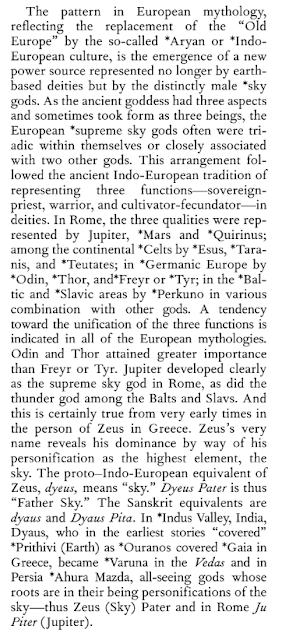
It seems that the shining god had a trinity. Also stated in the Papyrus from Derveni, Ouranos (Uranus), Kronos (Cronus), and Zeus, were equated as being the same deity (Rusten, 1985; in Bailey, 1985, Vol. 89, p. 135). Mushet (1837) said that "Ouranus, Cronus, and Zeus, were the same person." The goddesses that they married were also the same person too (pp. 62-63). Lemming (2005) said that the goddess was represented in "three aspects" or "three beings." This was the "maiden, mother, and crone." These were "the phases of nature-of the moon, of agriculture. She was birth, life, and death." An example of this is Hebe "the virgin cupbearer," Hera (mother), and Hecate "the crone of the moon and the underworld." The "European supreme sky gods often were triadic within themselves or closely associated with two other gods." The three gods served as one of three unique role: "sovereign-priest, warrior, and cultivator-fecundator." Leeming gives a couple of examples, but what stands out to me are two: "Jupiter, Mars, and Quirinus," and "Odin, Thor, and Freyr or Tyr," (p. 128):
.png)
Zeus had another trinity that is related to the sun. Professor Muller said that Zeus, Poseidon, and Hades, represented the sun and were originally the same deity under the name Dyaus and Zeus (Brown, 1898, pp. 119-120). Poseidon/Neptune represents "The Sun, rising out of the ocean and again sinking into it" (Rhyn, 1895, p. 7). He was also "the sun rising out of the sea," (The Christian Remembrancer, Volume 56, p. 169, Article 8). Pluto (Hades) represents "the invisible Sun that through the night tarries in the underworld" (Rhyn, 1895, p. 7). Plato said that Uranus/Coelus, Cronus, and Zeus, were a trinity. Others have stated that Zeus, Neptune, and Pluto, made a trinity and they were all the "son of Saturn," (Cudworth, 1875, Vol. 2 p. 212).
The father and sun gods also represented the sun. According to Claus (1972), the father god is the "dying, setting sun," while the son represents the "youthful, rising sun" that "arises like the phoenix in the ashes of the elder, in a continual process of dying and return." Claus uses the gods "Tamuz-Adon" (Tammuz-Adon)/Melkart (father), and Hadad/Baal Shamen (son), as examples. The father god is in the underworld, but when he leaves he is reborn as his son. The underworld is represented as two pillars, and these pillars are represented in the temple of the deity (Vol. 4 p. 46):
It also seems hard to tell who the father and son god are. According to MacKenzie (1907), the father and son god could be "interchangeable." For example, the Hittite supreme god Pappas/Attis, also called Hadad in Mitanni, is the father of Hercules (Ch. 20 pp. 259-261). Melkart is equated to Hercules by the Greeks (
Encyclopaedia Britannica, Melqart, para. 1) (Bowden and Rawlings; in Bowden and Rawlings, 2005, p. vii). So, Melqart can be Hadad's dad or vice versa.
In summation, the shining god was the sky/heavenly god/father, and was represented by the sun. The shining god had a trinity, and it represented the "sovereign-priest, warrior, and cultivator-fecundator," as well as the cycle of the sun. The father and son gods symbolized the setting and rising sun, with the father representing the setting sun in the underworld and the son representing the father reborn as the rising sun.
Links:NASA. Saturn: Facts:
https://science.nasa.gov/saturn/facts/
-Pic:
https://images.app.goo.gl/Rfg8heko4g8UkUcBA
Weor (2012) (Ch. 30):
https://books.google.com/books?id=jHWGyAMa5vYC&pg=PT266&dq=Jupiter+pentagram&hl=en&newbks=1&newbks_redir=0&source=gb_mobile_search&ovdme=1&sa=X&ved=2ahUKEwiWz8e3krKGAxURFFkFHWosAIU4ChDoAXoECAgQAw#v=onepage&q=Jupiter%20pentagram&f=false
Encyclopaedia Britannica. Israel:
https://www.britannica.com/place/Israel
-Pic of Hexagram:
https://images.app.goo.gl/9evYXYxGxJeqAEn9A
Hodapp (2006) (P. 166):
https://books.google.com/books?id=HhJ7DkMkeqQC&pg=PA166&dq=five-pointed+star+represents+Jupiter&hl=en&newbks=1&newbks_redir=0&sa=X&ved=2ahUKEwiasNz52JWHAxX2EVkFHZB5CroQ6AF6BAgMEAI#v=onepage&q=five-pointed%20star%20represents%20Jupiter&f=false
Edwards (2020):
https://www.thesun.co.uk/tech/11819043/saturn-hexagon-storm-mystery/
-Pic:
https://images.app.goo.gl/1Ha1fGTUCcsu1NG39
Bible Hub. Strong's Greek. 4481. Rhemphan. Strong's Lexicon:
https://biblehub.com/greek/4481.htm
Amos 5:
https://biblehub.com/nasb_/amos/5.htm
Acts 7:
https://biblehub.com/nasb_/acts/7.htm
Archangels and Angels. Archangel Michael-Angelic and Planetary Correspondences:
http://www.archangels-and-angels.com/aa_pages/correspondences/angel_planet/archangel_michael.html
Part 2: Demon:
2.1. Daimon vs. Demon:
I'm pretty sure that everybody, religious or not, knows what a demon is. The word "demon," also spelled as "daemon" and "daimon," seems to have originated in Greek (Encyclopaedia Britannica. Demon). The word "is derived from the Greek word daimon, which means 'supernatural being' or 'spirit'." The name was reserved for "a spiritual being that influenced a person's character," and later became denoted for a malevolent entity (Encyclopaedia Britannica, Angel and demon, Nature and significance: Demons, para. 1). A demon was "a supernatural power." Homer used the word "almost interchangeably with theos for a god." Theos represents "the personality of the god, and demon his activity," (Encyclopaedia Britannica. Demon). In Judaism, Christianity, and Islam, angels are benevolent entities while the malevolent entities are called demons (Encyclopaedia Britannica, Angel and demon, para. 2). According to the "New Testament Scholar Dale Basil Martin," the word daimon was used by the Greeks "to refer to gods, especially minor gods or intermediate supernatural beings, as well as the souls of the dead." They could also "be a supernatural entity that causes diseases, or the disease itself." They could also "possess humans, causing madness." Interestingly, "philosophers generally saw daimons as exclusively good." However, they were also seen "as capricious creatures who needed sacrifices to mollify them," (Gershon, 2021, para. 2). This is supposedly a positive thing, but I have my doubts. The "Assyrian Christian theologian Tatian fully identified demons as the 'arch-rebel' Satan and the fellow angels who followed him into banishment." This happened in the "second half of the second century CE (A.D.)," (para. 17).
It should be noted that demons were angels! Even though I grew up Catholic, that never seemed to hit me until now. Homer also used the word to emphasize a deity's "activity." As we will see below, the activity of this entity fits perfectly with our modern interpretation of the word demon, which is evil. Hence, I call it the demon deity.
Links:
Encyclopaedia Britannica. Demon:
https://www.britannica.com/topic/demon-Greek-religion#:~:text=demon%2C%20in%20Greek%20religion%2C%20a,with%20theos%20for%20a%20god.
Encyclopaedia Britannica. Angel and demon:
https://www.britannica.com/topic/angel-religion
Gershon (2021):
https://daily.jstor.org/where-demons-come-from/
2.2. What do demons do?
Now, what do demons do? Well, using the Bible, we learn that demons/unclean spirits possess people and other animals (Mark 5:1-13) (Matthew 12:22) (Luke 4:33-35) (John 10:19-21), cause blindness and make you mute (Matthew 12:22), and drive you insane (John 10:19-21). The Devil himself is a liar, and a murderer "from the beginning," (John 8:44).
Does the God of the Bible do any of these things? God lied to Adam about the Tree of Knowledge, saying that he would die if he ate the fruit from that tree. The serpent told Adam and Eve that they wouldn't die, and they didn't (especially Adam) after eating the fruit. As a result, God cursed Adam and the serpent, and caused Eve to have painful childbirths and to be "ruled over" by Adam (Genesis 2:15-17) (Genesis 3). God killed the entire human population, and every other animal on the Earth, with a flood. Only Noah and his family, and the creatures on the Ark, survived (Genesis 7:17-24). God hardened Pharaoh's heart, and the hearts of his servants, to perform his "'signs'" amongst the Egyptians. These signs were the plagues, like the plague of locusts (Exodus 10:1-20). Sounds like possession to me. God killed all of the firstborn of the Egyptians, their slaves, and their cattle (Exodus 12:29). God demands human sacrifice (Exodus 34:19) (Judges 11:29-40) (Nehemiah 10:34-36) (Matthew 26:26-28) (Hebrews 9:11-15) (Hebrews 10:10 [NASB] [NIV]) (Romans 3:21-26 [NASB] [NIV]) (Ephesians 2:11-16). God "opened the mouth" of Balaam's donkey, making it TALK to Balaam (Numbers 22:28-30). That definitely sounds like possession, and is one of the freakiest parts of the Bible. If God doesn't possess or kill something himself, he sends an angel or another spirit to do so for him. God sends a "tormenting spirit" to possess King Saul (1 Samuel 16:14), and an angel to kill Herod (Acts 12:23). The angel of the LORD was about to kill Balaam. The LORD (God) also "opened Balaam's eyes" in order to see the angel (Numbers 22:31-35). Sounds like possession by God, and attempted murder by his angel. Finally, God and one of his "'deceiving'" spirits conspire to possess the prophets of Ahab by putting the spirit "'in the mouths of all his prophets'," (1 Kings 22:19-23).
If God or one of his supernatural followers don't kill people, God commands his human followers to kill. In Numbers 31, God told Moses to kill the Midianites because they deceived the Israelites through Balaam. The Israelite soldiers spared the women though. Moses told them to kill all of the non-virgin women, but keep the virgin girls for themselves. He also commanded the soldiers to kill the young boys (Numbers 31:1-18). In 1 Samuel 15, Samuel tells King Saul that God commands him to kill the Amalekites, "both man and woman, child and infant, ox and sheep, camel and donkey." The Israelites and Amalekites have been enemies since the Exodus. The Amalekites "obstructed" the Israelites' path during their journey (1 Samuel 15:1-3). Now, God is telling King Saul not to just kill the Amalekite soldiers. He wants Saul to kill children and infants! Saul spared the Kenites who were living with the Amalekites because they were benefactors to Israel during the Exodus (1 Samuel 15:6). Saul captured, but didn't kill, Agag the king of the Amalekites. He also saved the best of the livestock (1 Samuel 15:7-9). God was mad at Saul for this, and told Samuel to tell Saul that Saul was no longer king. Samuel then killed Agag himself (1 Samuel 15:10-end). As if that wasn't bad enough, God sent a spirit to torture Saul (1 Samuel 16:14). Isaiah said that God will have Babylonian children killed, and the wives raped, on the "day of the LORD," (Isaiah 13:6 and 16). Hosea said that the children of Samaria will be killed, and "their pregnant women will be ripped open," because they "rebelled against their God," (Hosea 13:16). God doesn't just kill his enemies. He tortures his own people. Religious people will tell you that the God of the Bible is pro-life. How can this God be pro-life if he kills unborn babies, children, and commands rape and human sacrifice? This God isn't pro-life. He committed abortions without remorse. Heck, God killed his own Son as a human sacrifice (Matthew 26:26-28) (Hebrews 9:11-15) (Hebrews 10:10 [NASB] [NIV]) (Romans 3:21-26 [NASB] [NIV]) (Ephesians 2:11-16).
The actions of the God of the Bible matches those of any other demon/unclean spirit. He even controls the demons/unclean spirits, making them do his bidding. Wouldn't this make the God of the Bible a demon himself? Or, wouldn't this make the actions of the God of the Bible demonic? Doesn't this mean that God is the Devil!? In fact, God said he creates "darkness" and "disaster" (Isaiah 45:7 [NASB]). In the King James Version, "disaster" is "evil" (Isaiah 45:7 [KJV]). God causes darkness, and disaster/evil. The Devil barely does anything evil in the whole Bible. God commits the evil through most of the book. God lied to Adam in the beginning, not the serpent. Usually, we think of the serpent as Satan/the Devil. The true Evil One is God himself, and his actions and words prove this!
Links:
John 8:
https://biblehub.com/nasb_/john/8.htm
John 10:
https://biblehub.com/nasb_/john/10.htm
Luke 4:
https://biblehub.com/nasb_/luke/4.htm
Matthew 12:
https://biblehub.com/nasb_/matthew/12.htm
Mark 5:
https://biblehub.com/nasb_/mark/5.htm
Genesis 2:
https://biblehub.com/nasb_/genesis/2.htm
Genesis 3:
https://biblehub.com/nasb_/genesis/3.htm
Genesis 7:
https://biblehub.com/nasb_/genesis/7.htm
Exodus 10:
https://biblehub.com/nasb_/exodus/10.htm
Exodus 12:
https://biblehub.com/nasb_/exodus/12.htm
Exodus 34:
https://biblehub.com/nasb_/exodus/34.htm
Numbers 22:
https://biblehub.com/nasb_/numbers/22.htm
Judges 11:
https://biblehub.com/nasb_/judges/11.htm
Nehemiah 10:
https://biblehub.com/nasb_/nehemiah/10.htm
1 Samuel 16:
https://biblehub.com/nasb_/1_samuel/16.htm
Acts 12:
https://biblehub.com/nasb_/acts/12.htm
Isaiah 45:
-NASB:
https://biblehub.com/nasb_/acts/12.htm
-KJV:
https://biblehub.com/kjv/isaiah/45.htm
1 Kings 22:
https://biblehub.com/nasb_/1_kings/22.htm
Numbers 31:
https://biblehub.com/nasb_/numbers/31.htm
1 Samuel 15:
https://biblehub.com/nasb_/1_samuel/15.htm
Isaiah 13:
https://biblehub.com/nasb_/isaiah/13.htm
Hosea 13:
https://biblehub.com/nasb_/hosea/13.htm
Matthew 26:
https://biblehub.com/nasb_/matthew/26.htm
Hebrews 9:
https://biblehub.com/nasb_/hebrews/9.htm
Hebrews 10:
-NASB:
https://biblehub.com/nasb_/hebrews/10.htm
-NIV:
https://biblehub.com/niv/hebrews/10.htm
Romans 3:
-NASB
https://biblehub.com/nasb_/romans/3.htm
-NIV:
https://biblehub.com/niv/romans/3.htm
Ephesians 2:
https://biblehub.com/nasb_/ephesians/2.htm
Part 3: Cronus-Saturn:
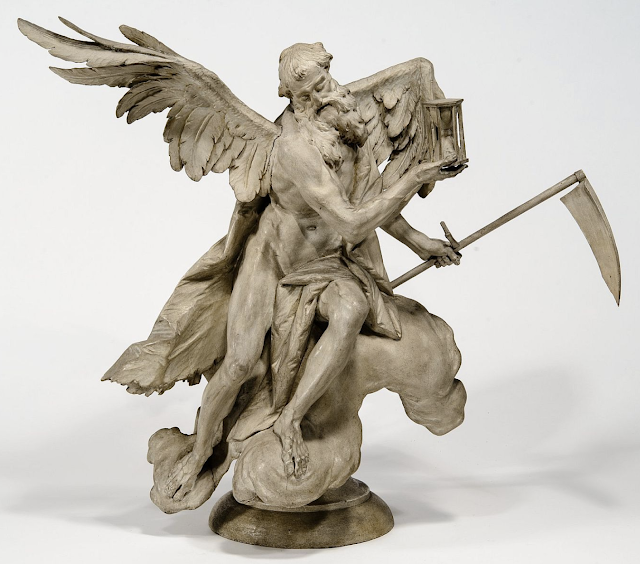
Chronos by Ignaz Gunther (1765-1770) from the Bayerisches National Museum:
.png)
As we have seen, the shining god is equated with the sun, and the planet Saturn. Saturn is also the name of a god, who is also called Cronus (Encyclopaedia Britannica, Cronus, para. 1). The best representation of Cronus-Saturn is in the Greek religion. In the Greek religion, Cronus, also called Saturn in the Roman religion, is the son of Uranus and Gaea. At the behest of his mother Gaea, Cronus castrated Uranus and took his position as king. The weapon Cronus used to do this is the scythe, or harpe. This was to symbolize "separating heaven from earth" (Encyclopaedia Britannica, Cronus) (Encyclopaedia Britannica, Uranus, para. 2). However, as stated above, Uranus is Saturn as well. Anu, another name for Uranus, betrayed the god Alalu (the first god and "a god of the earth") to take over the throne (Bachvarova, 2013 [in Chavalas, 2013], p. 274) (Livinstone, 2002, p. 89) (The Melammu Project, Kumarbi myth and Hesiod (1)). In the Kumarbi myth, Anu is castrated by Kumarbi (The Melammu Project, Kumarbi myth and Hesiod (1)) (Coulter and Turner, 2000 [2020 edition], p. 58). In the Phoenician religion, Ouranus ("heaven") is the son of Elion and Beruth. He was later castrated by his son Elus-Ilus-Cronus (Sanchoniatho, Phoenician History [Rev. Cumberland, 1720, translation], pp. 28-29, and 34). In the Greek religion, Cronus is later defeated by his son Zeus (Encyclopaedia Britannica, Cronus, para. 2). Uranus-Cronus-Zeus are the same deity, as mentioned previously. Saturn's name means "time," (Franklin, 1788; in Franklin, 1788, Vol. 7 p. 228) (Walshe, 1878; in Watts and Foote, 1878, Vol. 1-2 p. 59).
Interestingly, Plato gave an opposing account for the origin of Saturn. According to him, Saturn wasn't the son of Heaven (Uranus) and Earth (Gaia). Saturn, and his wife Cybele, were born "'from the waters of the great deep.'" The deep was also called "Ocean/Oceanus and Thetis," (Franklin, 1784; in Franklin, 1788, Vol. 7 p. 228) (Walshe, 1878; in Watts and Foote, 1878, Vol. 1-2 p. 58), which personified "the Ocean and Rivers," (Walshe, 1878; in Watts and Foote, 1878, Vol. 1-2 p. 58). So, Saturn is either the son of Uranus or he was born out of the ocean. Franklin (1784) also said that Saturn was the oldest god (in Franklin, 1788, Vol. 7 p. 228), which matches him being the supreme god. Uranus, who is Saturn's father, is also Saturn, as we have seen previously. Therefore, it would make sense that Saturn is the oldest god.
Saturn also foretold that so much rain would fall that a "vessel," or an "ark," would be needed to survive the rainfall. The boat would be needed to save "men, beasts, birds, and reptiles," (Franklin, 1788; in Franklin, 1788, Vol. 7 p. 228) (Walshe, 1878; in Watts and Foote, 1878, Vol. 1-2 p. 58-59).
Cronus was also the god Zeus. He was called Zeus Laphystios, Zeus Lycaeus, and Baal (Brown, 1898, pp. 118, 146-147) (Brown, 1902, p. 127) (Frazer, 1913, Vol. 9 p. 353) (Hutchinson, 1901, p. 13). It is said that human sacrifices were offered to Zeus Laphystios (Stoll, 1852, pp. 22-23) (Brown, 1899, p. 197), and Zeus Lycaeus (Frazer, 1913, Vol. 9 p. 353). Zeus Laphystios also seems to have been associated with the ram, which was a solar symbol (Brown, 1899, pp. 197-198). Both Saturn and Jupiter were called Deus. Saturn was called Deus Latius or Latens ("'hiding god'"), while Jupiter was Deus Latiaris. Both gods were the "God of Latium," (Robertson, 1900, p. 246) (Cudworth, 1845, Vol. 2 p. 212). St. Austin, also called St. Austin of Canterbury, said "that according to this Varronian notion of Saturn likewise, the Pagan Jupiter and Saturn were really but one and the same Numen," (Cudworth, 1845, Vol. 2 p. 213) (St. Austin Catholic Church and School, Who is St. Austin? And Why is Our Parish Named in His Honor?, para. 2). In the Middle Eastern pantheon, the gods Enlil (Cronus) and Marduk (Zeus) are equated by the number 50. Another god named Ninurta was equated to the numbers 40, the number of the gods Ea and Nabu, and 50 the number of Enlil and Marduk (Rollig, 1971, p. 500 [German]) (Parpola, 1993, p. 182 notes 87-88) (Toorn, 1999; in Toorn et al., 1999, p. 842). Ninurta was also Kronos (Cronus) (Long, 1987 [2015 edition], p. 151 note 43). This cements Cronus and Zeus as being the same individual.
In the Jewish and Christian religions, Cronus-Saturn is the Archangel Cassiel, who is associated with the planet Saturn (Archangels and Angels, Archangel Cassiel-Angelic and Planetary Correspondences). Archangel Cassiel's astrological, and geomantic, signs are Capricorn and Aquarius (Archangels and Angels, Archangel Cassiel-Angelic and Planetary Symbols). Capricorn is an astrological sign that is represented by a half goat, and half fish. As for the design of the creature, "One explanation of the fishtail with which the goat is often represented is found in the Greek myth of Pan," who turned into the creature in order "to avoid the monster Typhon," (Encyclopaedia Britannica, Capricorn, para. 1). According to Woolfolk (2011), the goat is the symbol of Capricorn (p. 28), but "The older symbol" was "the mythical Sea-Goat," (p. 79). The Archangel Uriel, who is the god Uranus, is also represented by Aquarius for his geomantic sign, and his special day is Saturday (Archangels and Angels, Archangel Uriel-Angelic and Planetary Correspondences) (Archangels and Angels, Archangel Uriel-Angelic and Planetary Symbols). Cassiel's special day is Saturday as well (Archangels and Angels, Archangel Cassiel-Angelic and Planetary Correspondences). Uranus and Cronus are the same deity.
Saturn-Cassiel rules the Seventh Heaven (Archangels and Angels, Archangel Cassiel-Angelic and Planetary Correspondences). Uranus isn't listed as any of the Heavens, but since Uranus and Saturn are the same entity, I'll put it in the Seventh Heaven.
Links:
Chronos by Ignaz Gunther (1765-1770) from the Bayerisches National Museum:
https://www.bayerisches-nationalmuseum.de/en/collection/highlights/00057847
Encyclopaedia Britannica. Cronus:
https://www.britannica.com/topic/Cronus
Encyclopaedia Britannica. Uranus:
https://www.britannica.com/topic/Uranus-mythology
Bachvarova (2013) (in Chavalas, 2013) (P. 274):
https://books.google.com/books?id=BY9mAQAAQBAJ&pg=PA274&dq=Alulu+Anu&hl=en&newbks=1&newbks_redir=0&source=gb_mobile_search&ovdme=1&sa=X&ved=2ahUKEwjt9O6F1OSCAxV0EmIAHYSHCb0Q6AF6BAgKEAM#v=onepage&q=Alulu%20Anu&f=false
Livingstone (2002) (P. 89):
https://books.google.com/books?id=1nhO28Gm0sAC&pg=PA89&dq=anu+ouranos&hl=en&newbks=1&newbks_redir=0&source=gb_mobile_search&sa=X&ved=2ahUKEwjk-deSkP39AhWXEVkFHQZzBwAQ6AF6BAgEEAM#v=onepage&q=anu%20ouranos&f=false
The Melammu Project. Kumarbi myth and Hesiod (1):
http://www.melammu-project.eu/database/gen_html/a0001230.html
Sanchoniatho. Phoenician History (Rev. Cumberland, 1720, translation):
https://books.google.com/books?id=g94TAAAAYAAJ&printsec=frontcover#v=onepage&q&f=false
-V2:
https://archive.org/details/SanchoniathosPhonicianHistory/page/n47/mode/1up
Coulter and Turner (2000 [2013 edition]) (PP. 13 and 168):
https://books.google.com/books?id=sEIngqiKOugC&pg=PA95&dq=marduk+bel&hl=en&newbks=1&newbks_redir=0&source=gb_mobile_search&sa=X&ved=2ahUKEwjDisSt3oP7AhXaM1kFHZY6CakQ6AF6BAgEEAM#v=snippet&q=Adad&f=false
-2020 edition (P. 168):
https://books.google.com/books?id=62hnEAAAQBAJ&printsec=frontcover&source=gb_mobile_entity&newbks=1&newbks_redir=0&hl=en&gl=US&focus=searchwithinvolume#v=onepage&q&f=false
-2021 edition (P. 348):
https://books.google.com/books?id=QEJUEAAAQBAJ&printsec=frontcover&dq=Encyclopedia+of+Ancient+Deities%0D%0ABy+Charles+Russell+Coulter,+Patricia+Turner+ningirsu&hl=en&newbks=1&newbks_redir=0&source=gb_mobile_search&ovdme=1&sa=X&ved=2ahUKEwiwuaSqnKeGAxU3yxQJHQS_CgEQ6AF6BAgHEAM#v=onepage&q=Encyclopedia%20of%20Ancient%20Deities%20%20By%20Charles%20Russell%20Coulter%2C%20Patricia%20Turner%20ningirsu&f=false
Archangels and Angels. Archangel Cassiel:
-Angelic and Planetary Correspondences:
-Angelic and Planetary Symbols:
http://www.archangels-and-angels.com/aa_pages/correspondences/angelic_symbols/symbolsl_cassiel.html
Encyclopaedia Britannica. Capricorn:
https://www.britannica.com/place/Capricorn
Woolfolk (2011) (PP. 28 and 79):
https://books.google.com/books?id=731H-g3sYe8C&printsec=frontcover&dq=capricorn+astrological+sign+goat&hl=en&newbks=1&newbks_redir=0&source=gb_mobile_search&ovdme=1&sa=X&ved=2ahUKEwjQyoWthuOGAxXOm4kEHcVnBCwQ6AF6BAgHEAM#v=onepage&q=capricorn%20astrological%20sign%20goat&f=false
Brown (1898):
https://books.google.com/books?id=sBnXAAAAMAAJ&printsec=frontcover&dq=semitic+influence+on+hellenic+mythology&hl=en&newbks=1&newbks_redir=0&source=gb_mobile_search&ovdme=1&sa=X&ved=2ahUKEwj4-uGB2MWEAxXcGVkFHXANCiEQ6AF6BAgNEAM#v=onepage&q=Kronos%20sun%20god&f=false
Brown (1899) (PP. 197-198):
https://books.google.com/books?id=WW5AAAAAIAAJ&pg=PA197&dq=zeus+laphystios+kronos&hl=en&newbks=1&newbks_redir=0&source=gb_mobile_search&ovdme=1&sa=X&ved=2ahUKEwiRx7Ol68WEAxWHD1kFHVCZAgQ4ChDoAXoECAYQAw#v=onepage&q=zeus%20laphystios%20kronos&f=false
Brown (1902) (P. 127):
https://books.google.com/books?id=DlcMAAAAYAAJ&pg=PA127&dq=zeus+laphystios+kronos&hl=en&newbks=1&newbks_redir=0&source=gb_mobile_search&ovdme=1&sa=X&ved=2ahUKEwjN5of16cWEAxUMLFkFHWXuDgAQ6AF6BAgNEAM#v=onepage&q=zeus%20laphystios%20kronos&f=false
Stoll (1852) (PP. 22-23):
https://books.google.com/books?id=XZt5TCM2rbAC&pg=PA22&dq=zeus+laphystios+kronos&hl=en&newbks=1&newbks_redir=0&source=gb_mobile_search&ovdme=1&sa=X&ved=2ahUKEwitleX_68WEAxVdEFkFHQt0DT04ChDoAXoECAsQAw#v=onepage&q=zeus%20laphystios%20kronos&f=false
Robertson (1900) (P. 246):
https://books.google.com/books?id=dPqDy6FFO68C&pg=PA246&dq=Deus+Latius+Saturn&hl=en&newbks=1&newbks_redir=0&source=gb_mobile_search&sa=X&ved=2ahUKEwjMsfmdj72GAxUmN2IAHS-0AM8Q6AF6BAgGEAM#v=onepage&q=Deus%20Latius%20Saturn&f=false
Cudworth (1845) (Vol. 2 pp. 212-213):
https://books.google.com/books?id=zgc-AAAAcAAJ&pg=PA212&dq=Deus+Latius+Saturn&hl=en&newbks=1&newbks_redir=0&source=gb_mobile_search&sa=X&ved=2ahUKEwjMsfmdj72GAxUmN2IAHS-0AM8Q6AF6BAgIEAM#v=onepage&q=Deus%20Latius%20Saturn&f=false
St. Austin Catholic Church and School. Who is St. Austin? And Why is Our Parish Named in His Honor?:
https://staustin.org/news/fv
Franklin (1784; in Franklin, 1788, Vol. 7):
https://books.google.com/books?id=AyhFAAAAcAAJ&printsec=frontcover&dq=Asiatic+researches+Vol.+1&hl=en&newbks=1&newbks_redir=0&source=gb_mobile_search&ovdme=1&sa=X&ved=2ahUKEwj7o4bL1a2CAxV2L1kFHcRHAiEQ6AF6BAgFEAM#v=onepage&q=Saturn&f=false
-V2:
https://books.google.com/books?id=dbaoEAAAQBAJ&pg=PA250&dq=jupiter+marinus&hl=en&newbks=1&newbks_redir=0&source=gb_mobile_search&ovdme=1&sa=X&ved=2ahUKEwjJ4-D2hauHAxXFFVkFHY_WDCoQ6AF6BAgFEAM#v=onepage&q=jupiter%20marinus&f=false
Walshe (1878; in Watts and Foote, 1878) (Vol. 1-2 p. 58):
https://books.google.com/books?id=DbxCAAAAYAAJ&pg=RA1-PA59&dq=Abraham+and+Saturn+may+be+considered+as+identical&hl=en&newbks=1&newbks_redir=0&source=gb_mobile_search&ovdme=1&sa=X&ved=2ahUKEwjx_arEy66HAxU5EFkFHbRsDioQ6AF6BAgMEAM#v=onepage&q=Abraham%20and%20Saturn%20may%20be%20considered%20as%20identical&f=false
Frazer (1913) (Vol. 9 p. 353):
%20(Harvey%20and%20Choi,%202022).png)
.jpg)

%20(Bayerisches%20National%20Museum,%20Chronos).jpg)
.jpg)
%20(Turgeon%20and%20Morse,%202024).jpg)
.png)
.png)
.png)
.jpg)

.jpg)
%20is%20Kiyyun%20and%20Saturn%20(Bible%20Hub,%20Strong's%20Greek,%204481.%20Rhemphan,%20Strong's%20Lexicon).png)

.jpg)
.jpeg)


.png)
.png)